QUESTION IMAGE
Question
question 24
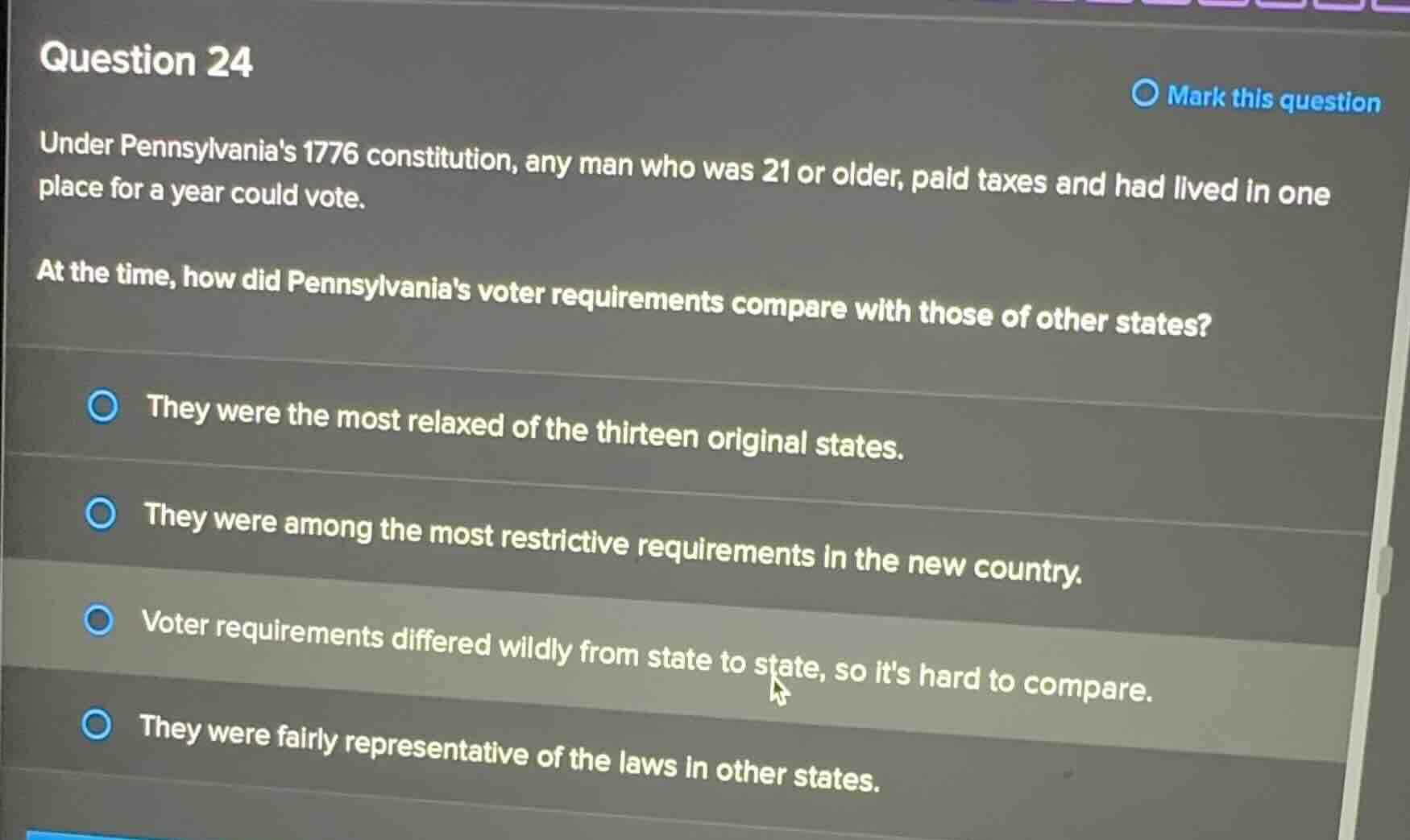
under pennsylvanias 1776 constitution, any man who was 21 or older, paid taxes and had lived in one place for a year could vote.
at the time, how did pennsylvanias voter requirements compare with those of other states?
they were the most relaxed of the thirteen original states.
they were among the most restrictive requirements in the new country.
voter requirements differed wildly from state to state, so its hard to compare.
they were fairly representative of the laws in other states.
Analyze Pennsylvania's 1776 voter requirements
The Pennsylvania Constitution of 1776 was one of the most democratic and radical state constitutions of the revolutionary era. It eliminated property ownership requirements for voting, which were standard in almost all other states. Instead, it granted the franchise to any free man who was 21 or older, paid taxes, and had resided in the state for one year.
Compare with other states
During the Revolutionary period, most other states maintained strict property qualifications (requiring voters to own a certain amount of land or personal property) to ensure only those with a "stake in society" could vote. By replacing property ownership with a simple taxpaying requirement, Pennsylvania dramatically expanded its electorate. This made its voter requirements the most relaxed and inclusive among the original thirteen states.
Evaluate the given options
- Option 1 ("They were the most relaxed of the thirteen original states."): This is historically accurate because Pennsylvania was unique in eliminating property-owning requirements entirely in favor of a taxpaying requirement.
- Option 2 ("They were among the most restrictive requirements..."): Incorrect, as they were the most expansive.
- Option 3 ("Voter requirements differed wildly... so it's hard to compare."): Incorrect, as historians can easily compare these requirements and identify Pennsylvania's as exceptionally democratic.
- Option 4 ("They were fairly representative..."): Incorrect, as most other states retained traditional property qualifications.

Snap & solve any problem in the app
Get step-by-step solutions on Sovi AI
Photo-based solutions with guided steps
Explore more problems and detailed explanations
- They were the most relaxed of the thirteen original states. (Correct answer)
- They were among the most restrictive requirements in the new country.
- Voter requirements differed wildly from state to state, so it's hard to compare.
- They were fairly representative of the laws in other states.