QUESTION IMAGE
Question
question 24 (multiple choice worth 3 points)
(02.08r lc)
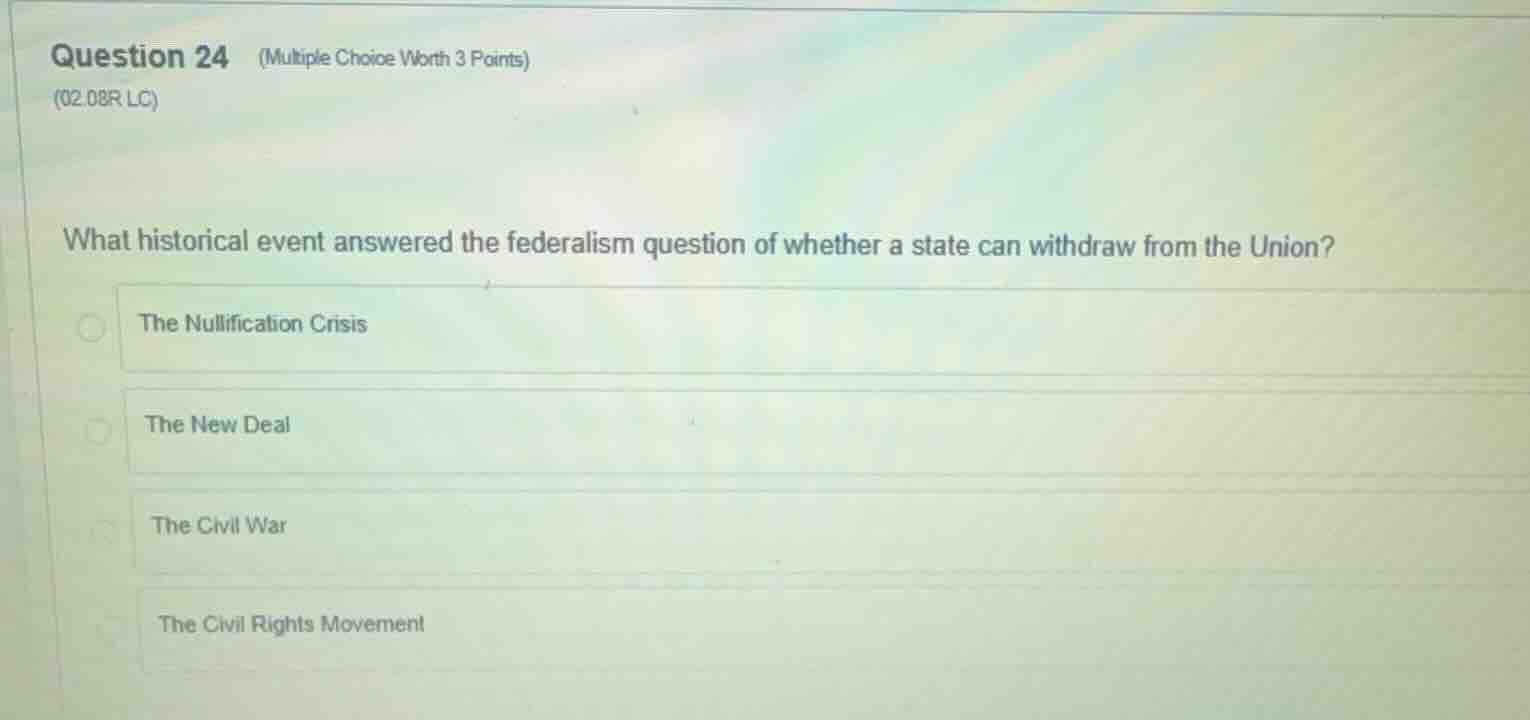
what historical event answered the federalism question of whether a state can withdraw from the union?
the nullification crisis
the new deal
the civil war
the civil rights movement
Analyze the constitutional question of secession
The question asks which historical event resolved whether a state has the constitutional right to withdraw (secede) from the United States Union.
Evaluate the historical options
- The Nullification Crisis (1832–1833) addressed whether a state could void federal law within its borders, but did not permanently resolve the ultimate question of secession.
- The New Deal (1930s) expanded the scope of federal economic power but did not address state withdrawal.
- The Civil War (1861–1865) was fought directly over secession. The Union victory established that states do not have the right to unilaterally secede, a principle later affirmed legally in Texas v. White (1869).
- The Civil Rights Movement (1950s–1960s) focused on equal protection and voting rights, not secession.
Determine the correct option
The Civil War is the definitive historical event that answered the federalism question of whether a state can withdraw from the Union.

Snap & solve any problem in the app
Get step-by-step solutions on Sovi AI
Photo-based solutions with guided steps
Explore more problems and detailed explanations
- (A) The Nullification Crisis
- (B) The New Deal
- (C) The Civil War (Correct answer)
- (D) The Civil Rights Movement