QUESTION IMAGE
Question
question 24 of 25
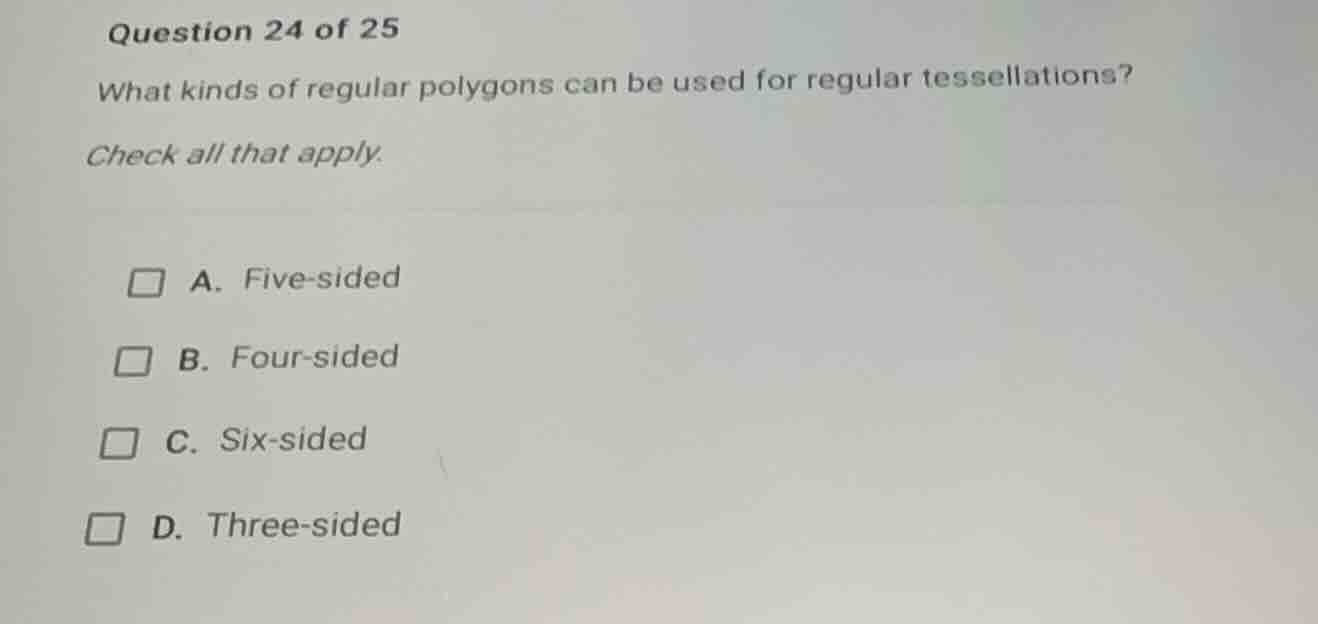
what kinds of regular polygons can be used for regular tessellations?
check all that apply.
a. five-sided
b. four-sided
c. six-sided
d. three-sided
Define regular tessellation condition
Using the Regular Tessellation knowledge point
For a regular polygon to form a regular tessellation, the interior angle of the polygon must divide \(360^\circ\) exactly without leaving a remainder. This ensures that the polygons can meet at a vertex with no gaps or overlaps.
Calculate interior angles
Using the Interior Angle Formula knowledge point
The interior angle \(\theta\) of a regular \(n\)-sided polygon is given by:
We evaluate this formula for each given option:
- For three-sided (equilateral triangle, \(n=3\)):
- For four-sided (square, \(n=4\)):
- For five-sided (regular pentagon, \(n=5\)):
- For six-sided (regular hexagon, \(n=6\)):
Test divisibility of 360 degrees
Using the Regular Tessellation knowledge point
We check if \(360^\circ\) is divisible by each interior angle \(\theta\):
- Three-sided (\(\theta = 60^\circ\)):
- Four-sided (\(\theta = 90^\circ\)):
- Five-sided (\(\theta = 108^\circ\)):
- Six-sided (\(\theta = 120^\circ\)):
Therefore, three-sided, four-sided, and six-sided regular polygons can be used for regular tessellations.

Snap & solve any problem in the app
Get step-by-step solutions on Sovi AI
Photo-based solutions with guided steps
Explore more problems and detailed explanations
- A. Five-sided
- B. Four-sided (Correct answer)
- C. Six-sided (Correct answer)
- D. Three-sided (Correct answer)