QUESTION IMAGE
Question
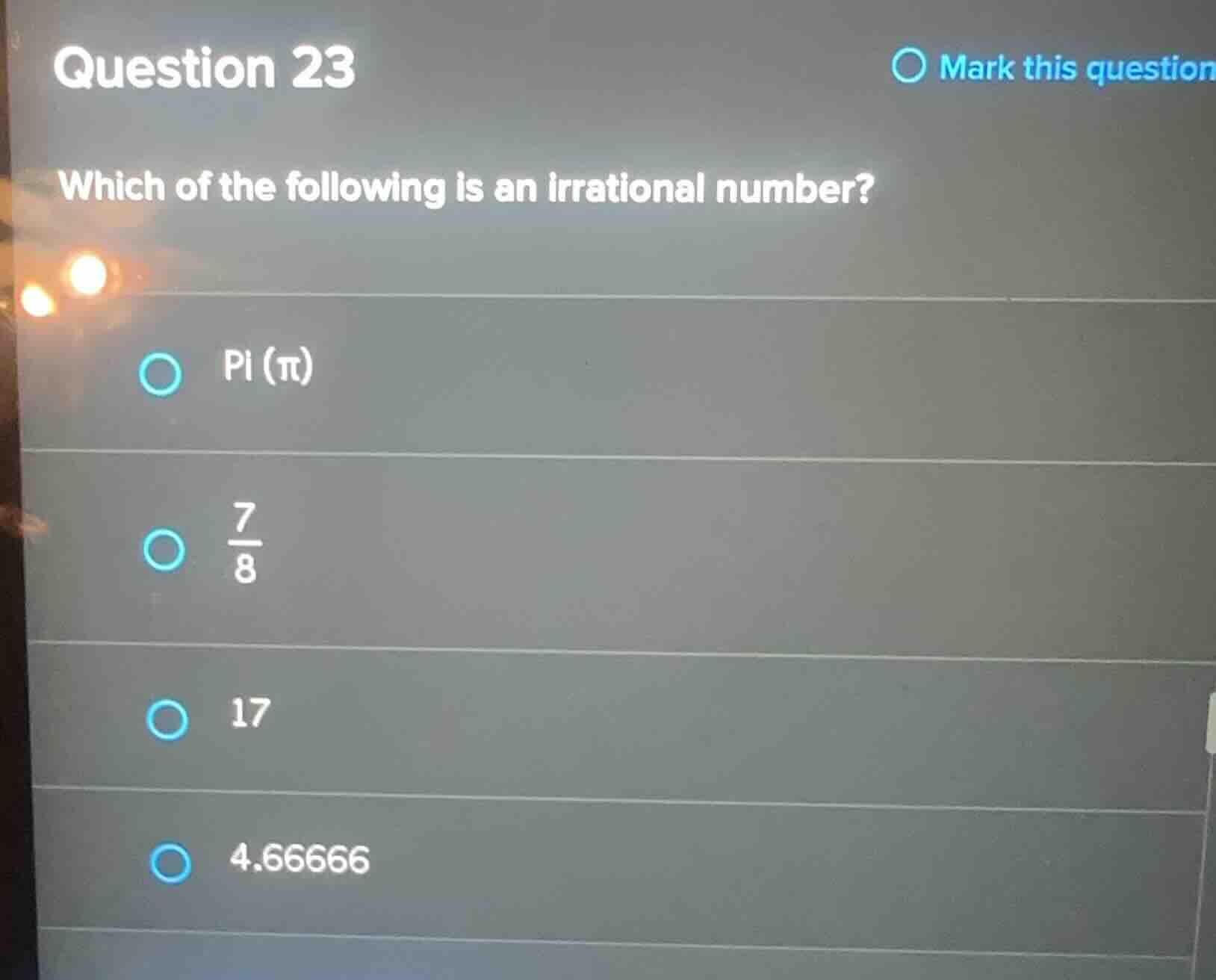
question 23
which of the following is an irrational number?
- pi (\pi)
- \frac{7}{8}
- 17
- 4.66666
Define rational and irrational numbers
Using the Rational Numbers and Number Classification knowledge points
- A rational number is any number that can be written as a fraction \(\frac{a}{b}\), where \(a\) and \(b\) are integers and \(b
eq 0\). In decimal form, rational numbers either terminate or repeat.
- An irrational number is a real number that cannot be expressed as a simple fraction. Its decimal representation goes on forever without repeating.
Analyze each option
Using the Rational Numbers and Number Classification knowledge points
- \(\text{Pi } (\pi)\): The mathematical constant \(\pi \approx 3.14159...\) has a non-terminating, non-repeating decimal expansion. It cannot be written as a fraction of two integers. Therefore, it is an irrational number.
- \(\frac{7}{8}\): This is explicitly written as a ratio of two integers, \(7\) and \(8\). Therefore, it is a rational number.
- \(17\): This integer can be written as \(\frac{17}{1}\). Therefore, it is a rational number.
- \(4.66666\): This is a terminating decimal (or a representation of a repeating decimal \(4.\bar{6} = \frac{14}{3}\)). In either case, it can be expressed as a fraction of two integers. Therefore, it is a rational number.

Snap & solve any problem in the app
Get step-by-step solutions on Sovi AI
Photo-based solutions with guided steps
Explore more problems and detailed explanations
- (A) Pi (\(\pi\)) (Correct answer)
- (B) \(\frac{7}{8}\)
- (C) 17
- (D) 4.66666