QUESTION IMAGE
Question
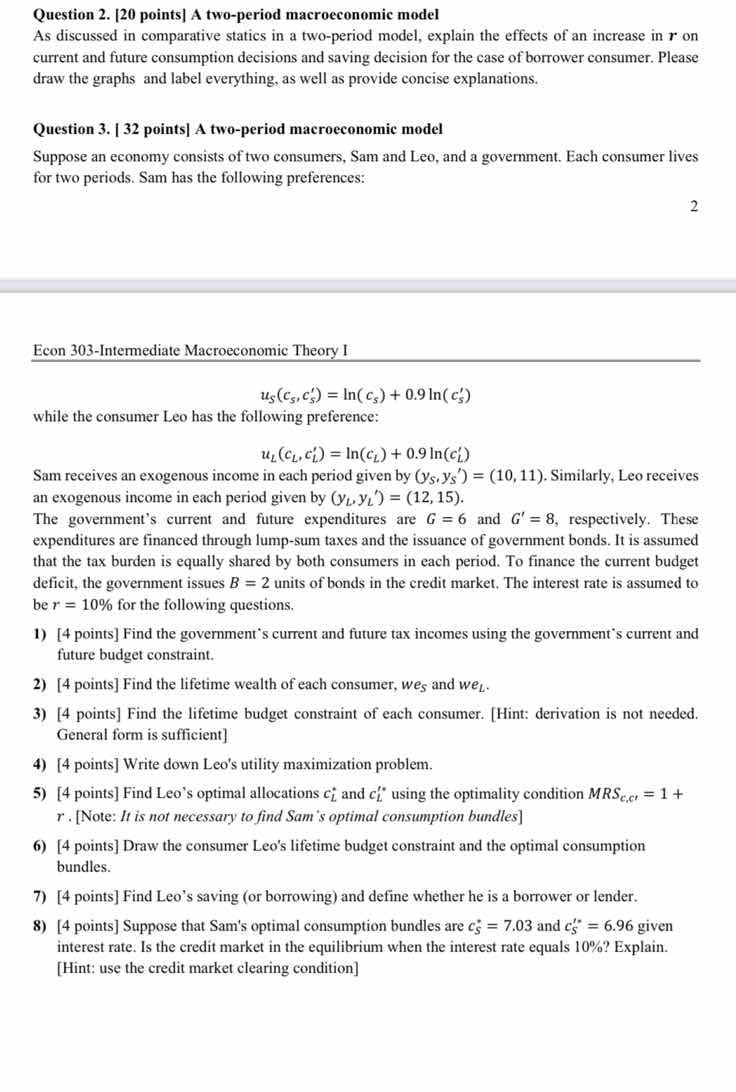
question 2. 20 points a two-period macroeconomic model
as discussed in comparative statics in a two-period model, explain the effects of an increase in \\(r\\) on current and future consumption decisions and saving decision for the case of borrower consumer. please draw the graphs and label everything, as well as provide concise explanations.
question 3. 32 points a two-period macroeconomic model
suppose an economy consists of two consumers, sam and leo, and a government. each consumer lives for two periods. sam has the following preferences:
\\u_s(c_s, c_s) = \ln(c_s) + 0.9 \ln(c_s)\\
while the consumer leo has the following preference:
\\u_l(c_l, c_l) = \ln(c_l) + 0.9 \ln(c_l)\\
sam receives an exogenous income in each period given by \\((y_s, y_s) = (10, 11)\\). similarly, leo receives an exogenous income in each period given by \\((y_l, y_l) = (12, 15)\\).
the governments current and future expenditures are \\(g = 6\\) and \\(g = 8\\), respectively. these expenditures are financed through lump-sum taxes and the issuance of government bonds. it is assumed that the tax burden is equally shared by both consumers in each period. to finance the current budget deficit, the government issues \\(b = 2\\) units of bonds in the credit market. the interest rate is assumed to be \\(r = 10\\%\\) for the following questions.
- 4 points find the governments current and future tax incomes using the governments current and future budget constraint.
- 4 points find the lifetime wealth of each consumer, \\(we_s\\) and \\(we_l\\).
- 4 points find the lifetime budget constraint of each consumer. hint: derivation is not needed. general form is sufficient
- 4 points write down leos utility maximization problem.
- 4 points find leos optimal allocations \\(c_l^*\\) and \\(c_l^*\\) using the optimality condition \\(mrs_{c,c} = 1 + r\\). note: it is not necessary to find sams optimal consumption bundles
- 4 points draw the consumer leos lifetime budget constraint and the optimal consumption bundles.
- 4 points find leos saving (or borrowing) and define whether he is a borrower or lender.
- 4 points suppose that sams optimal consumption bundles are \\(c_s^* = 7.03\\) and \\(c_s^* = 6.96\\) given interest rate. is the credit market in the equilibrium when the interest rate equals 10%? explain. hint: use the credit market clearing condition
Calculate government tax incomes
We use the government's budget constraints for both periods.
The current period government budget constraint is:
Given \(G = 6\) and \(B = 2\):
Since the tax burden is shared equally between Sam and Leo, each pays \(t = \frac{T}{2} = 2\).
The future period government budget constraint is:
Given \(G' = 8\), \(B = 2\), and \(r = 0.10\):
Each consumer pays a future tax of \(t' = \frac{T'}{2} = 5.1\).
Find lifetime wealth of each consumer
The lifetime wealth \(we_i\) of consumer \(i\) is defined as:
For Sam (\(y_S = 10\), \(y_S' = 11\)):
For Leo (\(y_L = 12\), \(y_L' = 15\)):
State lifetime budget constraints
The general form of the lifetime budget constraint for consumer \(i\) is:
For Sam:
For Leo:
Formulate Leo's utility maximization problem
Leo maximizes lifetime utility subject to his lifetime budget constraint:
Solve for Leo's optimal allocations
Using the optimality condition:
Substitute this into the lifetime budget constraint:
Now, solve for \(c_L'^*\):
Determine Leo's saving behavior
Saving is defined as current disposable income minus current consumption:
Since \(s_L = 0\), Leo is neither a borrower nor a lender; he is a hand-to-mouth consumer (or exactly balanced).
Evaluate credit market equilibrium
The credit market clearing condition requires total private savings to equal the government's bond issuance:
First, calculate Sam's saving \(s_S\):
Total private savings:
Since \(s_S + s_L = 0.97
eq B = 2\), the credit market is not in equilibrium at \(r = 10\%\). There is an excess demand for loans (or shortage of savings).

Snap & solve any problem in the app
Get step-by-step solutions on Sovi AI
Photo-based solutions with guided steps
Explore more problems and detailed explanations
Question 1
- Current government tax income: \(T = 4\) (individual tax \(t = 2\))
- Future government tax income: \(T' = 10.2\) (individual tax \(t' = 5.1\))
Question 2
- Sam's lifetime wealth: \(we_S = 13.36\)
- Leo's lifetime wealth: \(we_L = 19\)
Question 3
- Sam's lifetime budget constraint: \(c_S + \frac{c_S'}{1.1} = 13.36\)
- Leo's lifetime budget constraint: \(c_L + \frac{c_L'}{1.1} = 19\)
Question 4
Question 5
- Optimal current consumption: \(c_L^* = 10\)
- Optimal future consumption: \(c_L'^* = 9.9\)
Question 6
See the graph below illustrating Leo's lifetime budget line with horizontal intercept at \(19\), vertical intercept at \(20.9\), endowment point at \((10, 9.9)\), and the optimal choice tangent to the indifference curve at \((10, 9.9)\).
Question 7
- Leo's saving: \(s_L = y_L - t_L - c_L^* = 12 - 2 - 10 = 0\)
- Leo is neither a borrower nor a lender (he is exactly balanced).
Question 8
- No, the credit market is not in equilibrium.
- The credit market clearing condition is \(s_S + s_L = B\).
- Here, \(s_S = 10 - 2 - 7.03 = 0.97\) and \(s_L = 0\), so total private savings \(0.97
eq 2\).