QUESTION IMAGE
Question
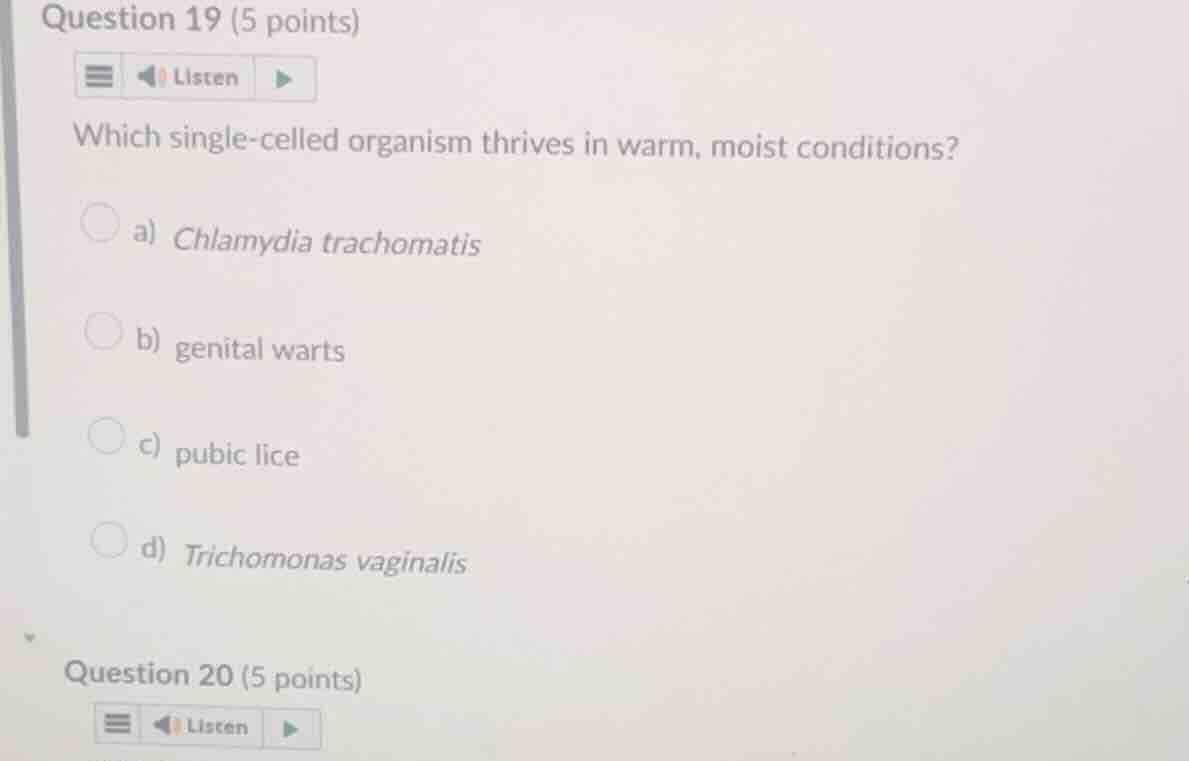
question 19 (5 points)
which single-celled organism thrives in warm, moist conditions?
a) chlamydia trachomatis
b) genital warts
c) pubic lice
d) trichomonas vaginalis
question 20 (5 points)
🆕 New Concept Discovered: Sexually Transmitted Pathogens
Characteristics of organisms causing STIs
Step 1: Analyze the organism types in the options
To find the correct single-celled organism, let's look at what each option represents:
- Chlamydia trachomatis: This is a bacterium. While bacteria are single-celled, Chlamydia trachomatis is an obligate intracellular parasite, meaning it cannot survive or reproduce outside of a host cell. It does not freely "thrive" in external warm, moist environments like damp towels or wet surfaces.
- Genital warts: This is a symptom caused by the Human Papillomavirus (HPV), which is a virus (non-cellular), not a single-celled organism.
- Pubic lice: These are parasitic insects (multicellular animals), not single-celled organisms.
- Trichomonas vaginalis: This is a single-celled protozoan parasite.
Step 2: Identify the organism that thrives in warm, moist conditions
Trichomonas vaginalis is a microscopic, single-celled protozoan (a flagellate) that causes trichomoniasis. Unlike many other sexually transmitted pathogens, it is relatively hardy and can survive for several hours on moist, warm external surfaces (such as damp towels, bathing suits, or toilet seats), making it unique among common STI pathogens for its ability to thrive in these specific environmental conditions.

Snap & solve any problem in the app
Get step-by-step solutions on Sovi AI
Photo-based solutions with guided steps
Explore more problems and detailed explanations
d) Trichomonas vaginalis