QUESTION IMAGE
Question
question 15
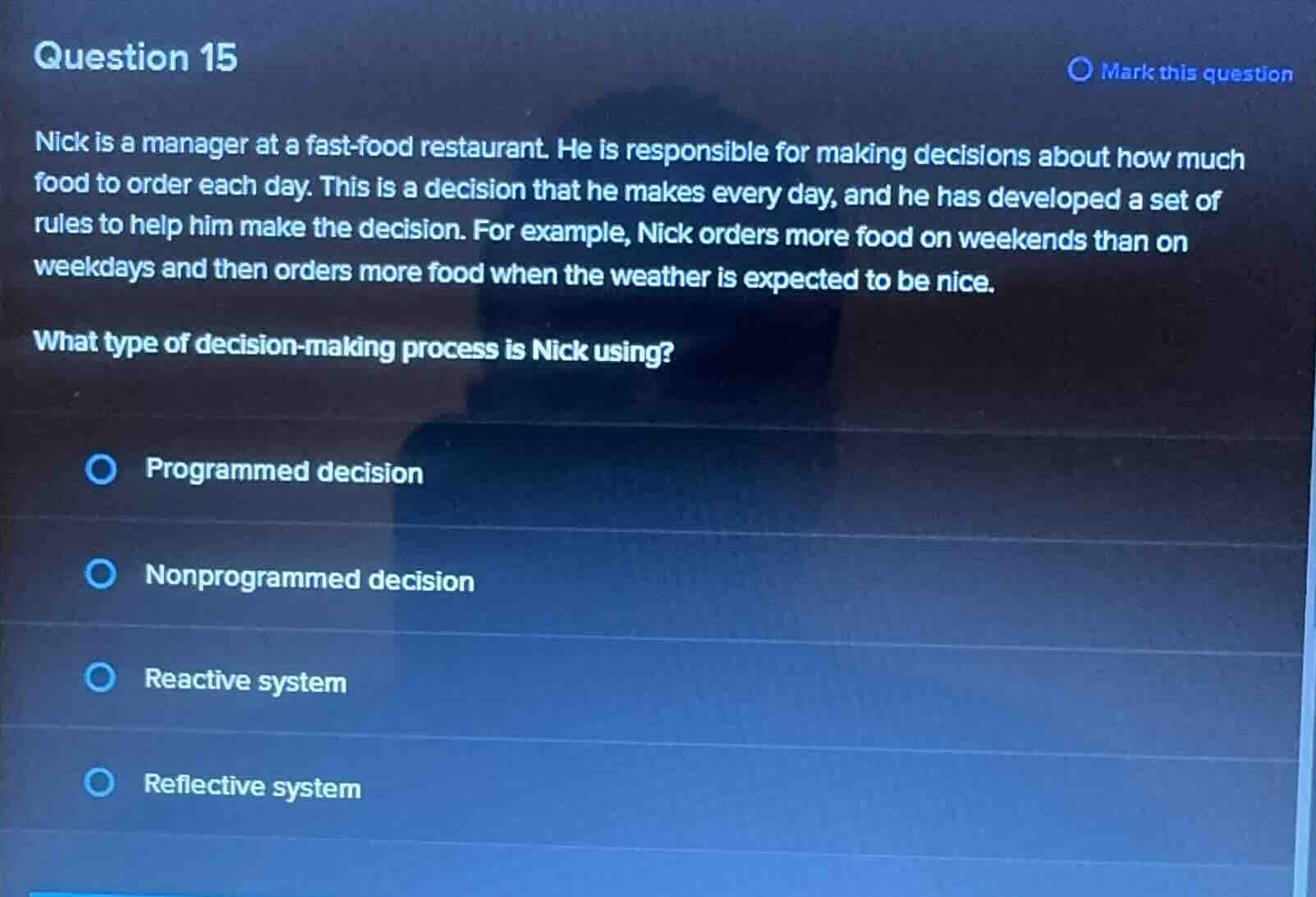
nick is a manager at a fast-food restaurant. he is responsible for making decisions about how much food to order each day. this is a decision that he makes every day, and he has developed a set of rules to help him make the decision. for example, nick orders more food on weekends than on weekdays and then orders more food when the weather is expected to be nice.
what type of decision-making process is nick using?
programmed decision
nonprogrammed decision
reactive system
reflective system
Analyze the decision characteristics
The scenario describes Nick's daily task of ordering food for a fast-food restaurant. This is a routine, repetitive decision that occurs frequently ("every day").
Evaluate the decision-making rules
Nick has developed a specific set of rules and guidelines to handle this repetitive situation (e.g., ordering more food on weekends and when the weather is nice). This systematic approach allows him to handle the recurring problem efficiently without starting the decision-making process from scratch each time.
Match with organizational behavior concepts
In management and Decision-Making Styles, decisions are categorized based on their frequency and structure:
- Programmed decisions are repetitive, routine decisions that can be handled using a systematic, rule-based approach or standard operating procedure.
- Nonprogrammed decisions are unique, unstructured, and require custom, creative solutions because they are novel or infrequent.
- Reactive and Reflective systems refer to cognitive processing systems (System 1 and System 2 thinking) rather than the specific classification of the organizational decision-making process itself.
Since Nick's decision is routine and guided by a predetermined set of rules, it is classified as a programmed decision.

Snap & solve any problem in the app
Get step-by-step solutions on Sovi AI
Photo-based solutions with guided steps
Explore more problems and detailed explanations
- Programmed decision (Correct answer)
- Nonprogrammed decision
- Reactive system
- Reflective system