QUESTION IMAGE
Question
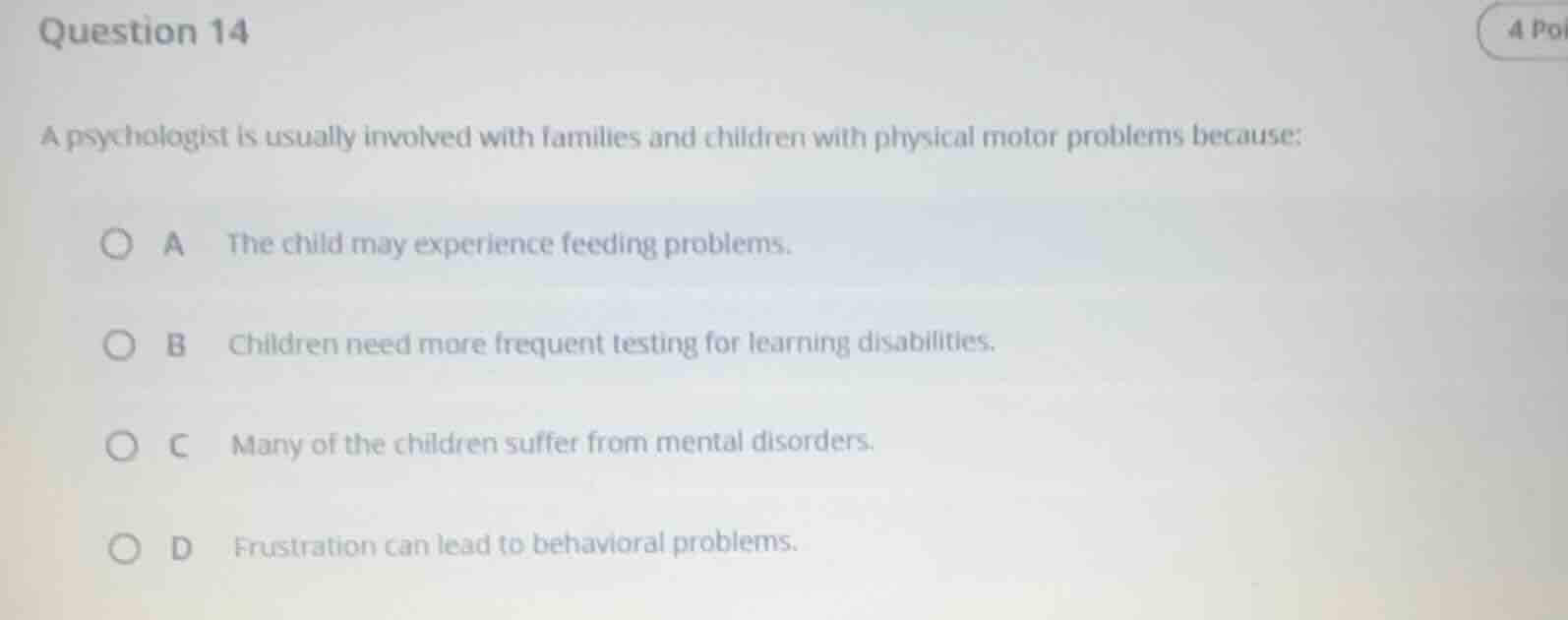
question 14
a psychologist is usually involved with families and children with physical motor problems because:
a the child may experience feeding problems.
b children need more frequent testing for learning disabilities.
c many of the children suffer from mental disorders.
d frustration can lead to behavioral problems.
Analyze the role of a psychologist
A psychologist's primary focus is on mental health, emotional well-being, coping mechanisms, and behavior. When working with children who have Physical Disabilities (such as physical motor problems) and their families, the psychologist addresses the emotional and behavioral consequences of these physical limitations.
Evaluate the options
- Option A (Feeding problems): Feeding issues are typically managed by speech-language pathologists, occupational therapists, or pediatricians rather than psychologists.
- Option B (Testing for learning disabilities): While psychologists do perform cognitive and educational testing, having a physical motor problem does not inherently mean a child needs more frequent testing for learning disabilities.
- Option C (Mental disorders): Having a physical motor problem does not mean the child automatically suffers from clinical mental disorders. This statement is overly broad and pathologizing.
- Option D (Frustration and behavioral problems): Children with motor difficulties often experience significant frustration due to their physical limitations and difficulty communicating or performing daily tasks. This frustration can manifest as Behavioral Disorders or behavioral challenges, which falls directly under a psychologist's scope of practice to help manage and support.

Snap & solve any problem in the app
Get step-by-step solutions on Sovi AI
Photo-based solutions with guided steps
Explore more problems and detailed explanations
- (A) The child may experience feeding problems.
- (B) Children need more frequent testing for learning disabilities.
- (C) Many of the children suffer from mental disorders.
- (D) Frustration can lead to behavioral problems. (Correct answer)