QUESTION IMAGE
Question
question 14
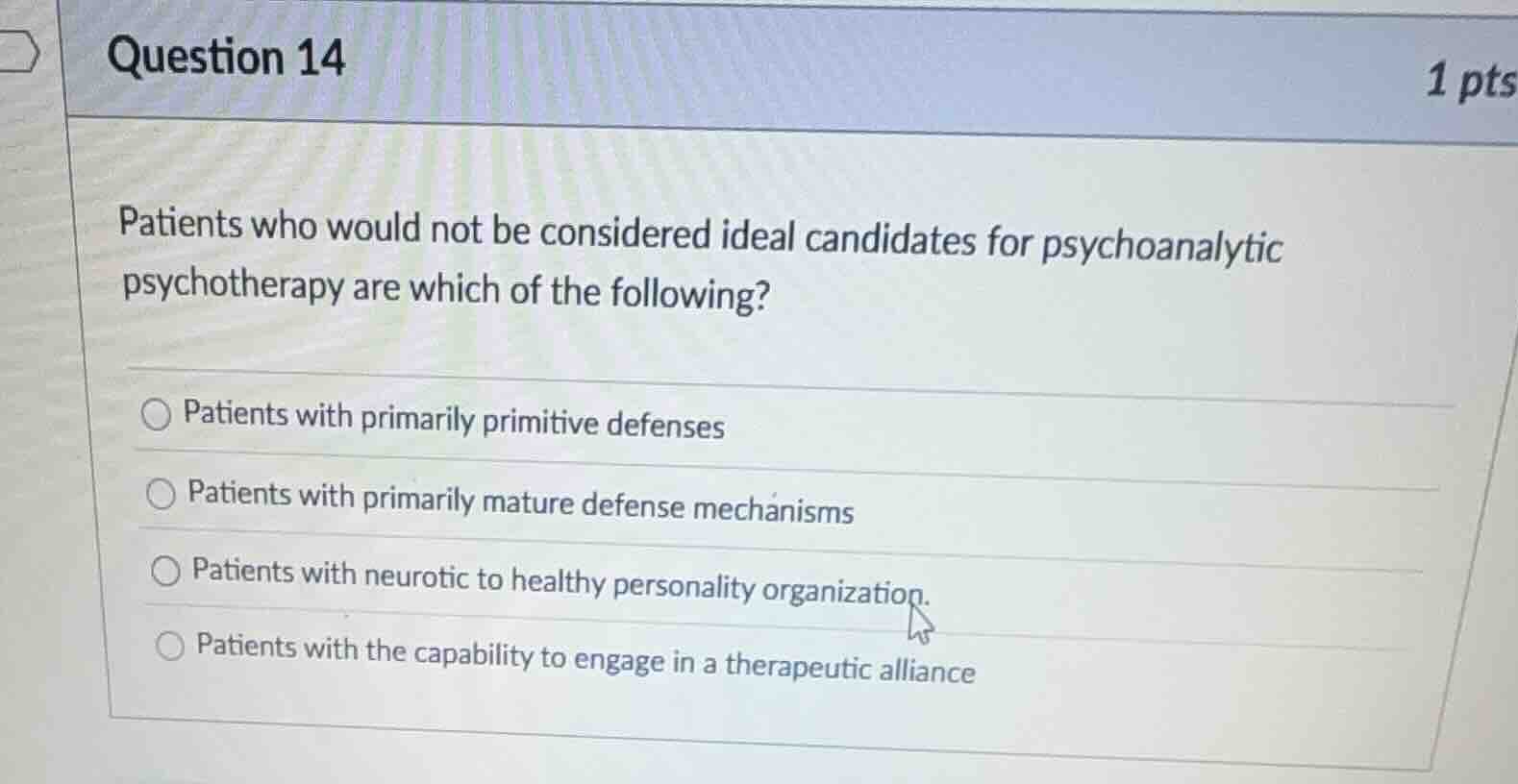
patients who would not be considered ideal candidates for psychoanalytic psychotherapy are which of the following?
- patients with primarily primitive defenses
- patients with primarily mature defense mechanisms
- patients with neurotic to healthy personality organization
- patients with the capability to engage in a therapeutic alliance
🆕 New Concept Discovered: Psychoanalytic Suitability Criteria
Evaluating patient characteristics for expressive vs. supportive therapy.
Step 1: Understand the requirements of psychoanalytic psychotherapy
Psychoanalytic (or expressive) psychotherapy relies heavily on the patient's ability to self-reflect, tolerate painful emotions without acting out, and analyze their own mental processes.
To engage successfully, patients generally need:
- Neurotic to healthy personality organization (intact reality testing and a cohesive sense of self).
- Mature defense mechanisms (such as sublimation, suppression, or intellectualization) which allow them to discuss conflicts without destabilizing.
- The capacity to form a therapeutic alliance (the ability to trust and work collaboratively with a therapist).
Step 2: Identify the counter-indications
Patients who primarily use primitive defenses (such as projection, denial, splitting, or delusional projection) struggle with reality testing and integrating conflicting parts of themselves.
These patients (often with borderline or psychotic personality organization) find the unstructured, expressive nature of classic psychoanalytic psychotherapy destabilizing. Instead, they are better suited for supportive psychotherapy, which helps strengthen defenses rather than uncovering deep-seated unconscious conflicts.
Therefore, patients with primarily primitive defenses are not considered ideal candidates for traditional psychoanalytic psychotherapy.

Snap & solve any problem in the app
Get step-by-step solutions on Sovi AI
Photo-based solutions with guided steps
Explore more problems and detailed explanations
Patients with primarily primitive defenses