QUESTION IMAGE
Question
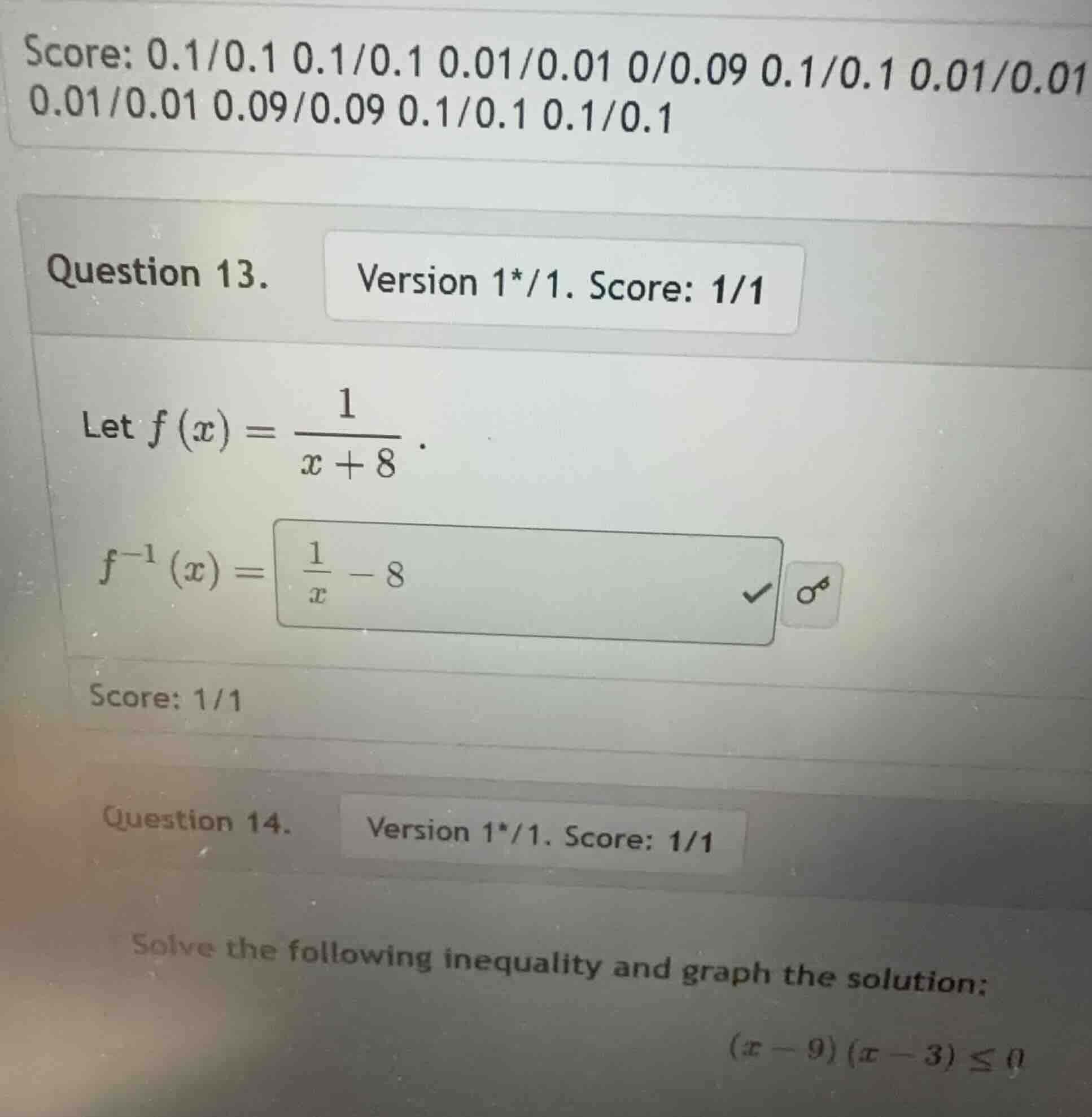
question 13. version 1*/1. score: 1/1
let (f(x) = \frac{1}{x + 8}).
(f^{-1}(x) = \frac{1}{x} - 8)
question 14. version 1*/1. score: 1/1
solve the following inequality and graph the solution:
((x - 9)(x - 3) \le 0)
🆕 New Concept Discovered: Solving Quadratic Inequalities
Finding where a parabola is below or on the x-axis.
Step 1: Find the boundary points
Set the quadratic expression equal to zero to find the critical boundary points:
This gives:
Step 2: Test the intervals
The boundary points \( x = 3 \) and \( x = 9 \) divide the number line into three intervals: \( (-\infty, 3) \), \( (3, 9) \), and \( (9, \infty) \).
We test a value from each interval in the inequality \( (x - 9)(x - 3) \leq 0 \):
- For \( (-\infty, 3) \): Test \( x = 0 \)
- For \( (3, 9) \): Test \( x = 5 \)
- For \( (9, \infty) \): Test \( x = 10 \)
The inequality is satisfied in the middle interval where the product is negative or zero.
Step 3: Write the solution in interval notation
Since the inequality is \( \leq \) (less than or equal to), we include the endpoints \( 3 \) and \( 9 \) using square brackets:
Step 4: Graph the solution
To graph this on a number line:
- Place solid dots (or brackets) at \( x = 3 \) and \( x = 9 \) to show they are included.
- Shade the line segment between \( 3 \) and \( 9 \).
       ●===================●
--+----+----+----+----+----+----+----+----+----+--
  0    1    2    3    4    5    6    7    8    9   10
Snap & solve any problem in the app
Get step-by-step solutions on Sovi AI
Photo-based solutions with guided steps
Explore more problems and detailed explanations
Interval Notation:
Graph:
A shaded segment on the number line from \( 3 \) to \( 9 \) with solid endpoints at both \( 3 \) and \( 9 \).