QUESTION IMAGE
Question
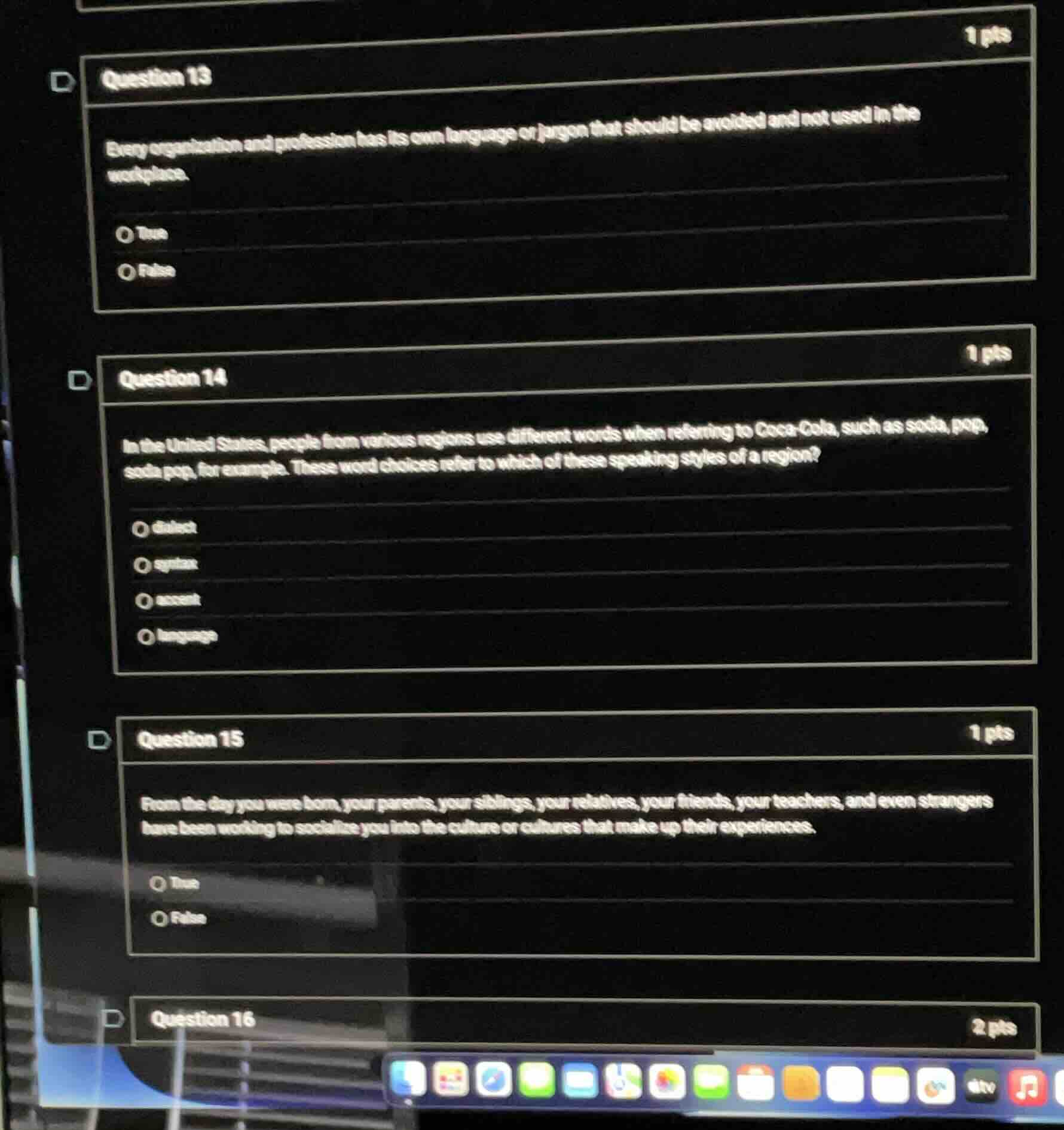
question 13
every organization and profession has its own language or jargon that should be avoided and not used in the workplace.
true
false
question 14
in the united states, people from various regions use different words when referring to coca-cola, such as soda, pop, soda pop, for example. these word choices refer to which of these speaking styles of a region?
dialect
syntax
accent
language
question 15
from the day you were born, your parents, your siblings, your relatives, your friends, your teachers, and even strangers have been working to socialize you into the culture or cultures that make up their experiences.
true
false
Analyze Question 13
The statement claims that jargon should be avoided and not used in the workplace. While jargon should be avoided when communicating with outsiders or those unfamiliar with the terms, it is a highly efficient and necessary tool for communication among members within the same organization or profession. Therefore, the absolute claim that it "should be avoided and not used in the workplace" is false.
Analyze Question 14
The question asks about regional word choices (such as "soda," "pop," or "soda pop") for the same item.
- Dialect refers to regional or social variations of a language, including vocabulary, grammar, and pronunciation.
- Syntax refers to the rules governing sentence structure.
- Accent refers specifically to pronunciation differences.
- Language refers to the broader system of communication.
Since the differences are specific vocabulary choices used by people in different regions, this is an example of a dialect.
Analyze Question 15
The statement describes the lifelong process of socialization, where family, peers, teachers, and society transmit cultural values, beliefs, and norms to an individual from birth. This is a foundational concept in sociology and communication studies, making the statement true.

Snap & solve any problem in the app
Get step-by-step solutions on Sovi AI
Photo-based solutions with guided steps
Explore more problems and detailed explanations
Question 13
- True
- False (Correct answer)
Question 14
- dialect (Correct answer)
- syntax
- accent
- language
Question 15
- True (Correct answer)
- False