QUESTION IMAGE
Question
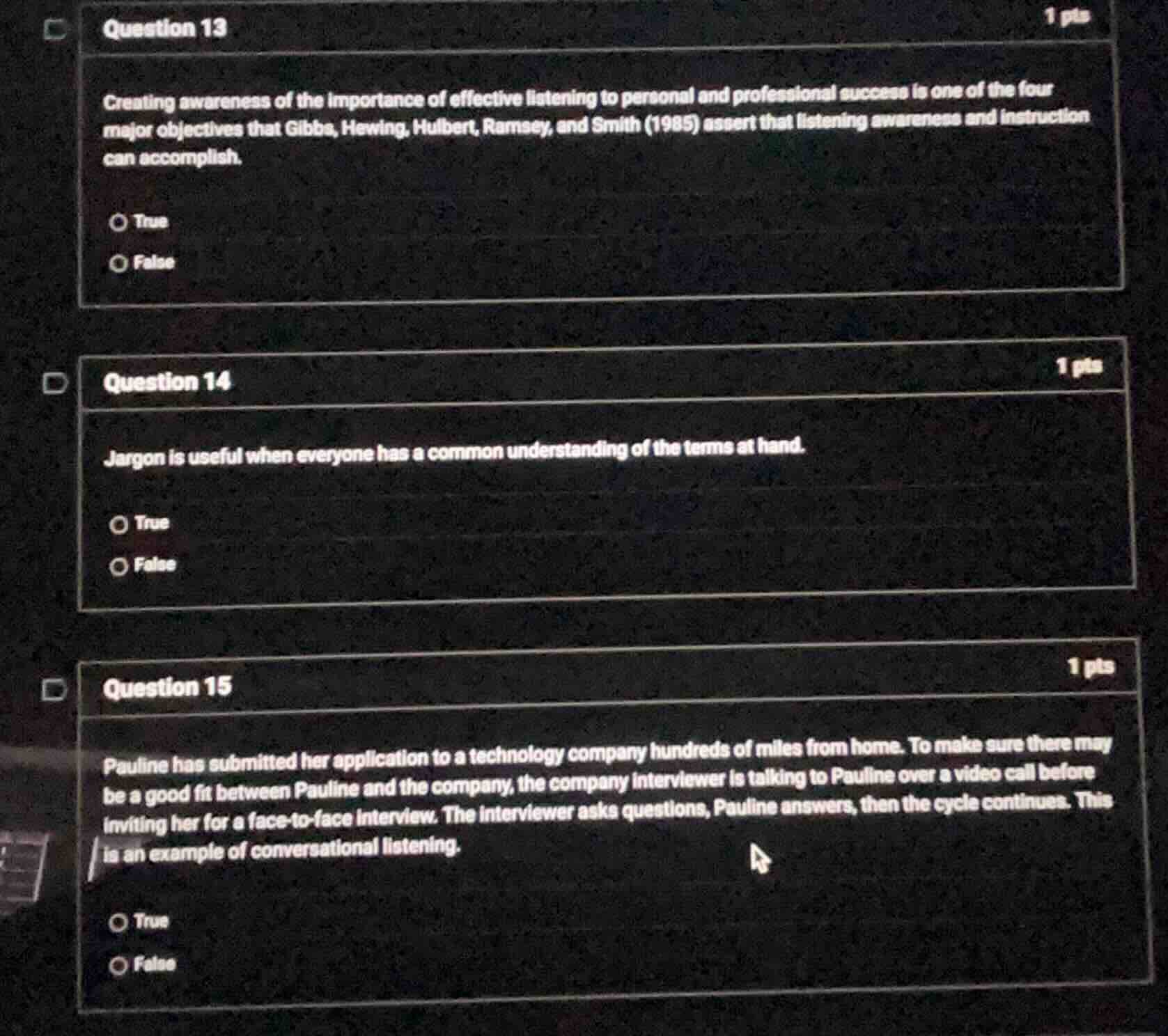
question 13
creating awareness of the importance of effective listening to personal and professional success is one of the four major objectives that gibbs, hewing, hulbert, ramsey, and smith (1985) assert that listening awareness and instruction can accomplish.
true
false
question 14
jargon is useful when everyone has a common understanding of the terms at hand.
true
false
question 15
pauline has submitted her application to a technology company hundreds of miles from home. to make sure there may be a good fit between pauline and the company, the company interviewer is talking to pauline over a video call before inviting her for a face-to-face interview. the interviewer asks questions, pauline answers, then the cycle continues. this is an example of conversational listening.
true
false
Analyze Question 13
The statement asserts that creating awareness of the importance of effective listening to personal and professional success is one of the four major objectives that Gibbs, Hewing, Hulbert, Ramsey, and Smith (1985) assert that listening awareness and instruction can accomplish. According to established business communication and listening pedagogy literature, Gibbs et al. (1985) identified four primary objectives of listening training:
- Creating awareness of the importance of effective listening to personal and professional success.
- Helping individuals assess their own listening strengths and weaknesses.
- Providing instruction in specific listening skills.
- Providing opportunities to practice and receive feedback on these skills.
Therefore, the statement is true.
Analyze Question 14
The statement states that jargon is useful when everyone has a common understanding of the terms at hand. In communication theory, jargon refers to specialized language used by a particular group or profession. While jargon can act as a barrier to outsiders, it serves as an efficient and precise shorthand when communicating within a group where all members share a common understanding of the terms. Thus, the statement is true.
Analyze Question 15
The scenario describes an interviewer talking to Pauline over a video call to assess fit, where the interviewer asks questions, Pauline answers, and the cycle continues. Conversational listening involves reciprocal, interactive, and spontaneous dialogue where both parties actively listen and respond to co-create meaning. An interview structure consisting of a rigid question-and-answer cycle (interviewer asks, candidate answers, cycle repeats) is primarily transactional and evaluative rather than a collaborative conversational listening process. Therefore, the statement is false.

Snap & solve any problem in the app
Get step-by-step solutions on Sovi AI
Photo-based solutions with guided steps
Explore more problems and detailed explanations
Question 13
- True (Correct answer)
- False
Question 14
- True (Correct answer)
- False
Question 15
- True
- False (Correct answer)