QUESTION IMAGE
Question
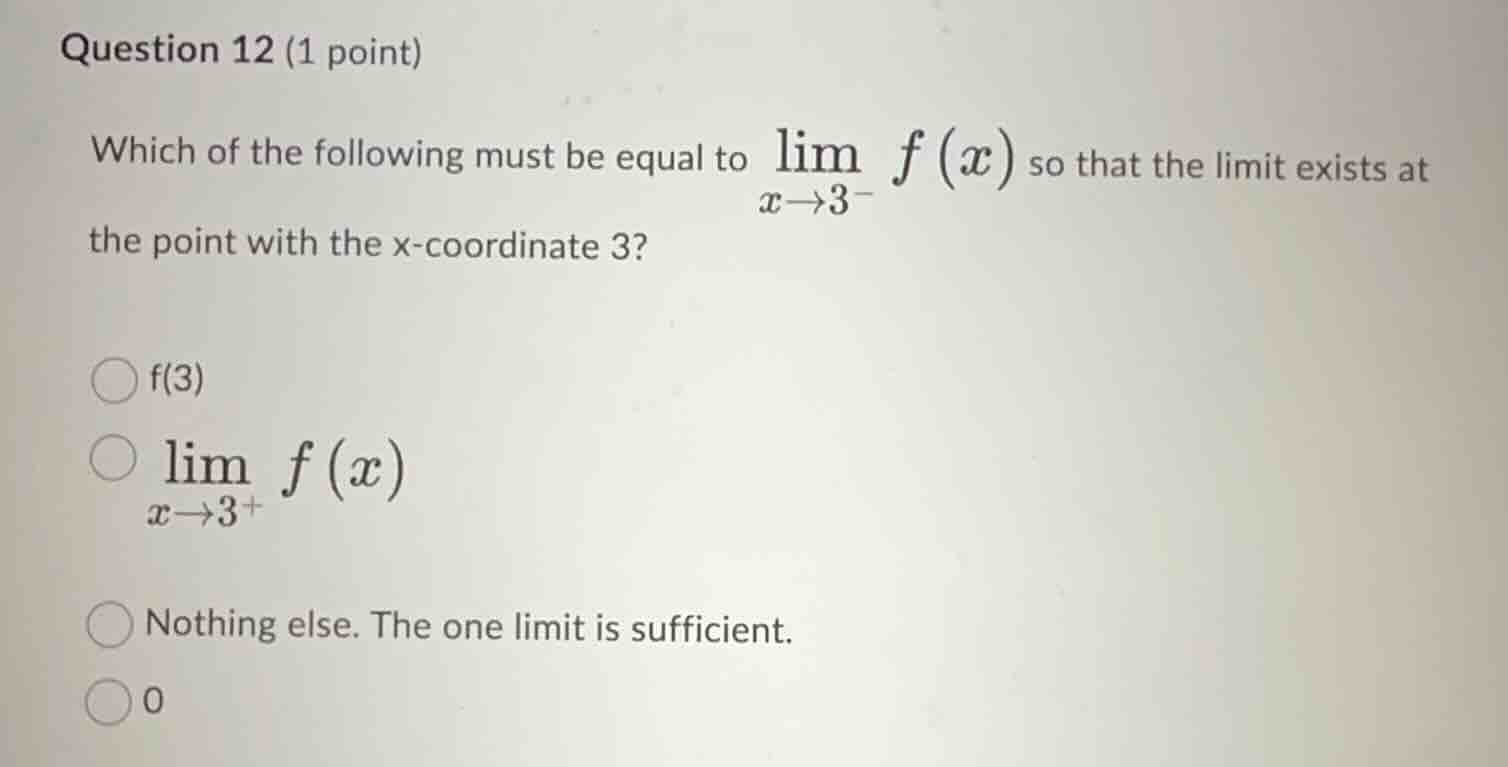
question 12 (1 point)
which of the following must be equal to \\(\lim_{x \to 3^-} f(x)\\) so that the limit exists at the point with the x-coordinate 3?
\\(f(3)\\)
\\(\lim_{x \to 3^+} f(x)\\)
nothing else. the one limit is sufficient.
0
Define the condition for limit existence
To understand when a limit exists at a specific point, we look at how the function behaves as it approaches that point from both sides. Using the Limit Evaluation concept, a two-sided limit \(\lim_{x \to c} f(x)\) exists if and only if both the left-sided limit and the right-sided limit exist and are equal to the same real number.
Apply the definition to the given point
We are given the left-sided limit:
For the two-sided limit to exist at the point with \(x\)-coordinate \(3\), this left-sided limit must equal the right-sided limit. Using the Limits of Piecewise Functions concept, we evaluate the behavior from the right:
Therefore, we must have:
Evaluate the given options
Let's analyze the choices:
- \(f(3)\): This is the function value at \(x = 3\). The existence of a limit does not depend on the function being defined or continuous at that point.
- \(\lim_{x \to 3^+} f(x)\): This is the right-sided limit, which must equal the left-sided limit for the overall limit to exist.
- "Nothing else. The one limit is sufficient.": A single one-sided limit is not sufficient to guarantee the existence of a two-sided limit.
- \(0\): The limit does not have to equal \(0\); it can be any real number as long as both sides match.
Thus, the correct option is \(\lim_{x \to 3^+} f(x)\).

Snap & solve any problem in the app
Get step-by-step solutions on Sovi AI
Photo-based solutions with guided steps
Explore more problems and detailed explanations
- (A) \(f(3)\)
- (B) \(\lim_{x \to 3^+} f(x)\) (Correct answer)
- (C) Nothing else. The one limit is sufficient.
- (D) 0