QUESTION IMAGE
Question
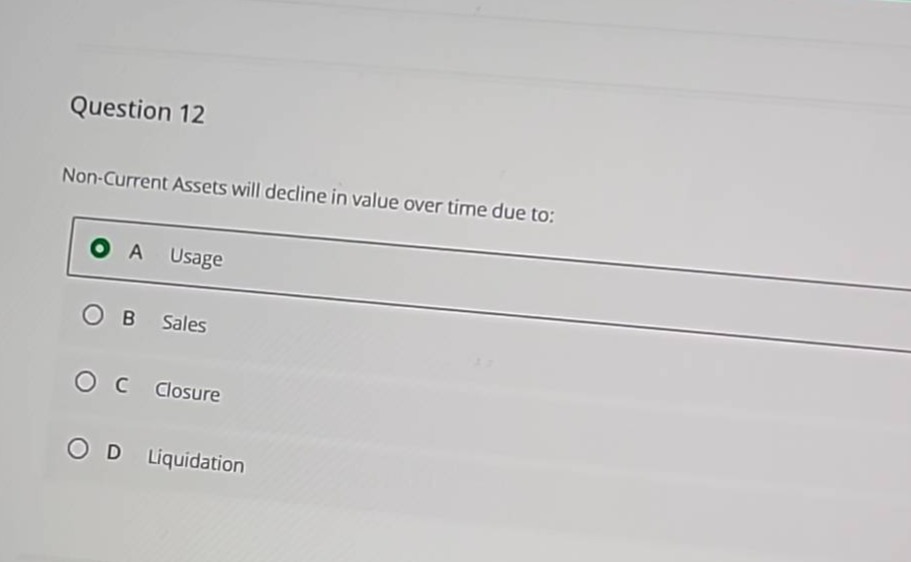
question 12
non-current assets will decline in value over time due to:
a usage
b sales
c closure
d liquidation
🆕 New Concept Discovered: Asset Depreciation
The gradual loss of value in long-term assets.
Step 1: Understand Non-Current Assets
Non-current assets (also known as fixed assets) are long-term resources owned by a business that are expected to provide economic benefits for more than one year. Examples include machinery, vehicles, buildings, and equipment.
Step 2: Analyze the Cause of Value Decline
Over time, these physical assets lose their value. In accounting, this systematic reduction in value is called depreciation. The primary drivers of depreciation are:
- Wear and tear (Usage): Physical deterioration from using the asset to generate revenue.
- Obsolescence: Becoming outdated due to technological advancements.
- Passage of time: Natural aging of the asset.
Among the given options, Usage directly represents the physical wear and tear that causes an asset's value to decline gradually over its useful life.
Step 3: Evaluate Other Options
- B Sales: Selling an asset removes it from the balance sheet entirely at a specific point in time; it is not a gradual decline in value over time.
- C Closure: Closing a business or department stops operations but is not the direct cause of gradual asset wear.
- D Liquidation: This is the process of selling off all assets quickly to convert them to cash, usually when winding up a business, rather than a gradual decline in value over time.

Snap & solve any problem in the app
Get step-by-step solutions on Sovi AI
Photo-based solutions with guided steps
Explore more problems and detailed explanations
A Usage