QUESTION IMAGE
Question
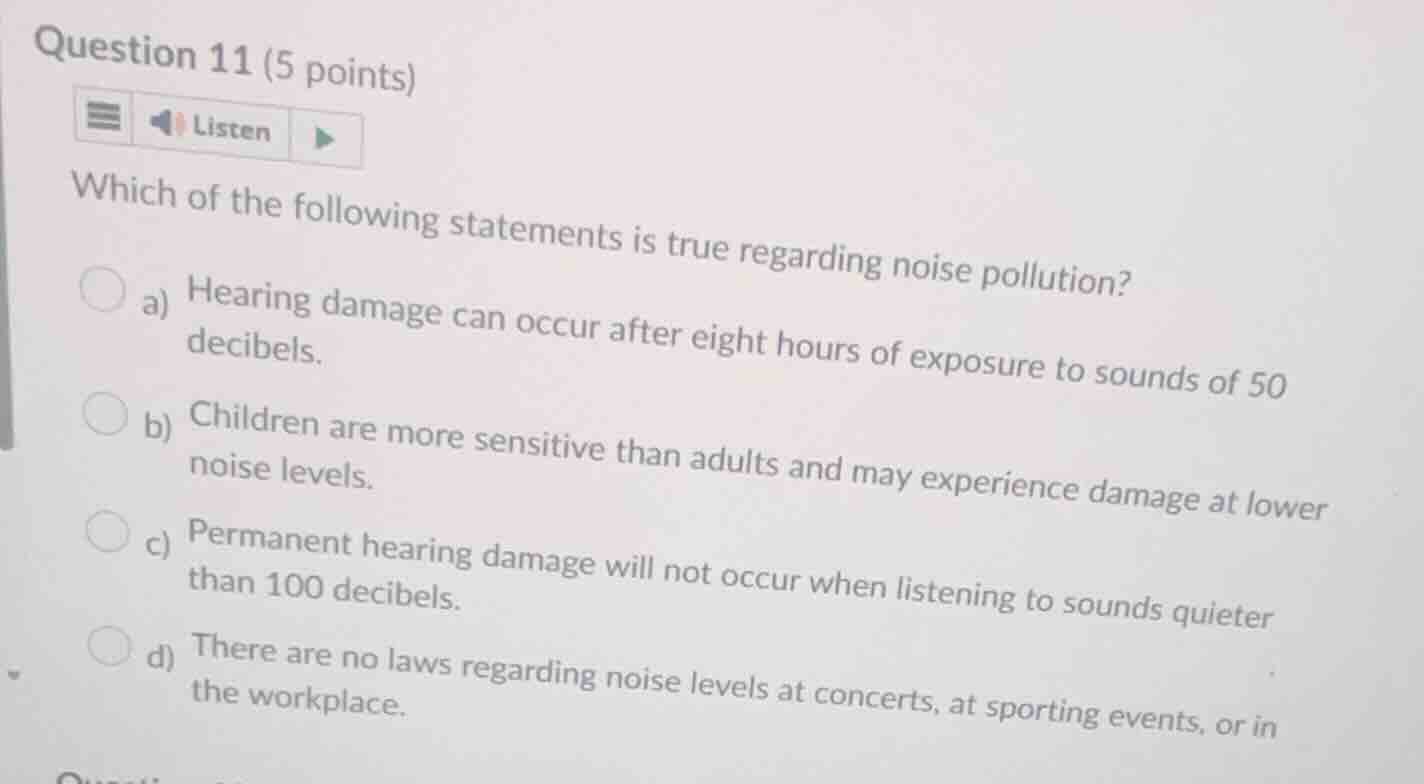
question 11 (5 points)
which of the following statements is true regarding noise pollution?
a) hearing damage can occur after eight hours of exposure to sounds of 50 decibels.
b) children are more sensitive than adults and may experience damage at lower noise levels.
c) permanent hearing damage will not occur when listening to sounds quieter than 100 decibels.
d) there are no laws regarding noise levels at concerts, at sporting events, or in the workplace.
🆕 New Concept Discovered: Environmental Noise Pollution and Auditory Health
Understanding how sound intensity affects human health and development.
Step 1: Analyze the effects of sound intensity on hearing damage
Hearing damage is determined by both the intensity of the sound (measured in decibels, dB) and the duration of exposure.
- Evaluating option (a): A sound level of \( 50\text{ dB} \) is equivalent to a quiet conversation or a quiet suburb. It is completely safe and does not cause hearing damage, even with prolonged exposure. Typically, prolonged exposure to sounds at or above \( 85\text{ dB} \) is where the risk of hearing damage begins.
- Evaluating option (c): Permanent hearing damage can certainly occur at levels below \( 100\text{ dB} \). For example, long-term exposure to \( 85\text{–}90\text{ dB} \) (like heavy city traffic or lawnmowers) can cause gradual, permanent hearing loss over time.
Step 2: Analyze regulatory laws regarding noise
- Evaluating option (d): There are clear occupational safety laws (such as OSHA regulations in the United States) that strictly limit noise exposure levels in the workplace to protect workers' hearing. Many local municipalities also have strict noise ordinances regulating public events like concerts and sporting events.
Step 3: Analyze vulnerability differences between children and adults
- Evaluating option (b): Children's ear canals are smaller than those of adults, which naturally amplifies higher-frequency sounds. Additionally, their developing auditory systems and brains are more vulnerable to the physiological stress and physical damage caused by high noise levels. Consequently, children are more sensitive to noise pollution and can experience auditory damage and cognitive developmental delays at lower decibel levels than adults.

Snap & solve any problem in the app
Get step-by-step solutions on Sovi AI
Photo-based solutions with guided steps
Explore more problems and detailed explanations
b) Children are more sensitive than adults and may experience damage at lower noise levels.