QUESTION IMAGE
Question
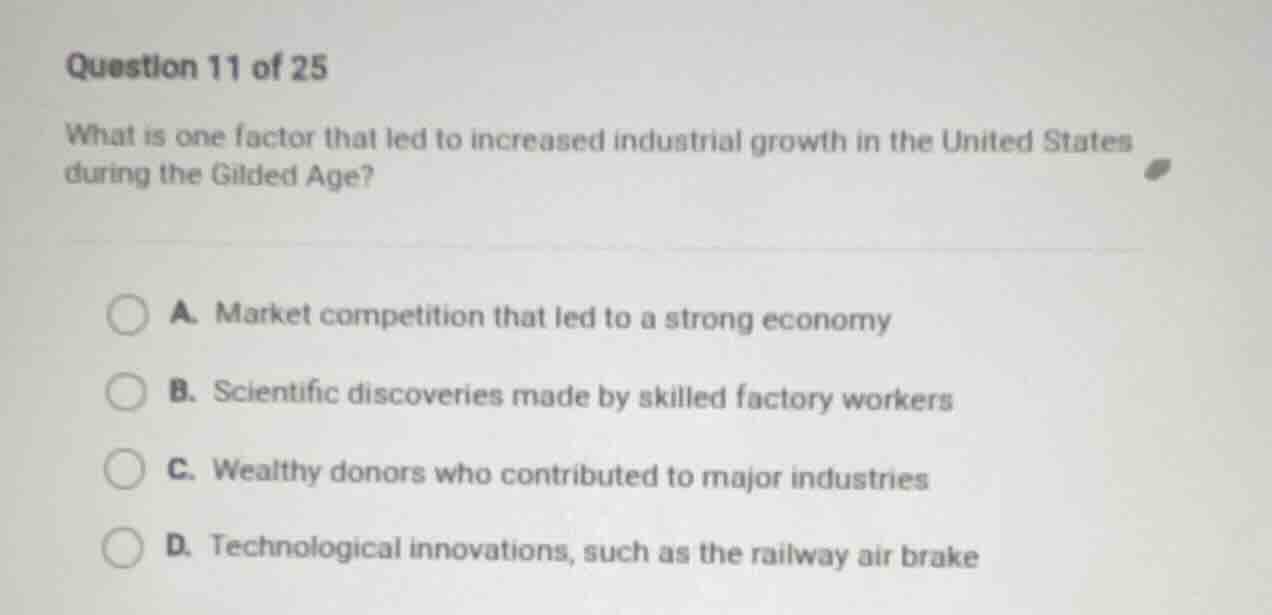
question 11 of 25
what is one factor that led to increased industrial growth in the united states during the gilded age?
a. market competition that led to a strong economy
b. scientific discoveries made by skilled factory workers
c. wealthy donors who contributed to major industries
d. technological innovations, such as the railway air brake
Analyze the historical context of Gilded Age industrial growth
The Gilded Age (late 19th century) in the United States was characterized by rapid industrialization, urbanization, and economic expansion. Key drivers of this growth included technological innovations, expansion of the railroad network, and abundant natural resources.
Evaluate the provided options
- A. Market competition that led to a strong economy: While competition existed, the era was actually defined by the rise of monopolies, trusts, and consolidation (reducing competition) to stabilize profits.
- B. Scientific discoveries made by skilled factory workers: Most major industrial innovations were developed by professional inventors, engineers, or entrepreneurs (e.g., Thomas Edison, George Westinghouse, Alexander Graham Bell) rather than ordinary factory workers.
- C. Wealthy donors who contributed to major industries: Industrial growth was funded by investment capitalists, investment banks, and corporate profits, not philanthropic "donors."
- D. Technological innovations, such as the railway air brake: Technological breakthroughs (like the Bessemer process, the telephone, and George Westinghouse's railway air brake) vastly improved efficiency, safety, and the scale of transportation and manufacturing, directly driving industrial expansion.
Determine the correct choice
Option D is historically accurate and directly answers the prompt.

Snap & solve any problem in the app
Get step-by-step solutions on Sovi AI
Photo-based solutions with guided steps
Explore more problems and detailed explanations
- (A) Market competition that led to a strong economy
- (B) Scientific discoveries made by skilled factory workers
- (C) Wealthy donors who contributed to major industries
- (D) Technological innovations, such as the railway air brake (Correct answer)