QUESTION IMAGE
Question
question 2 of 10
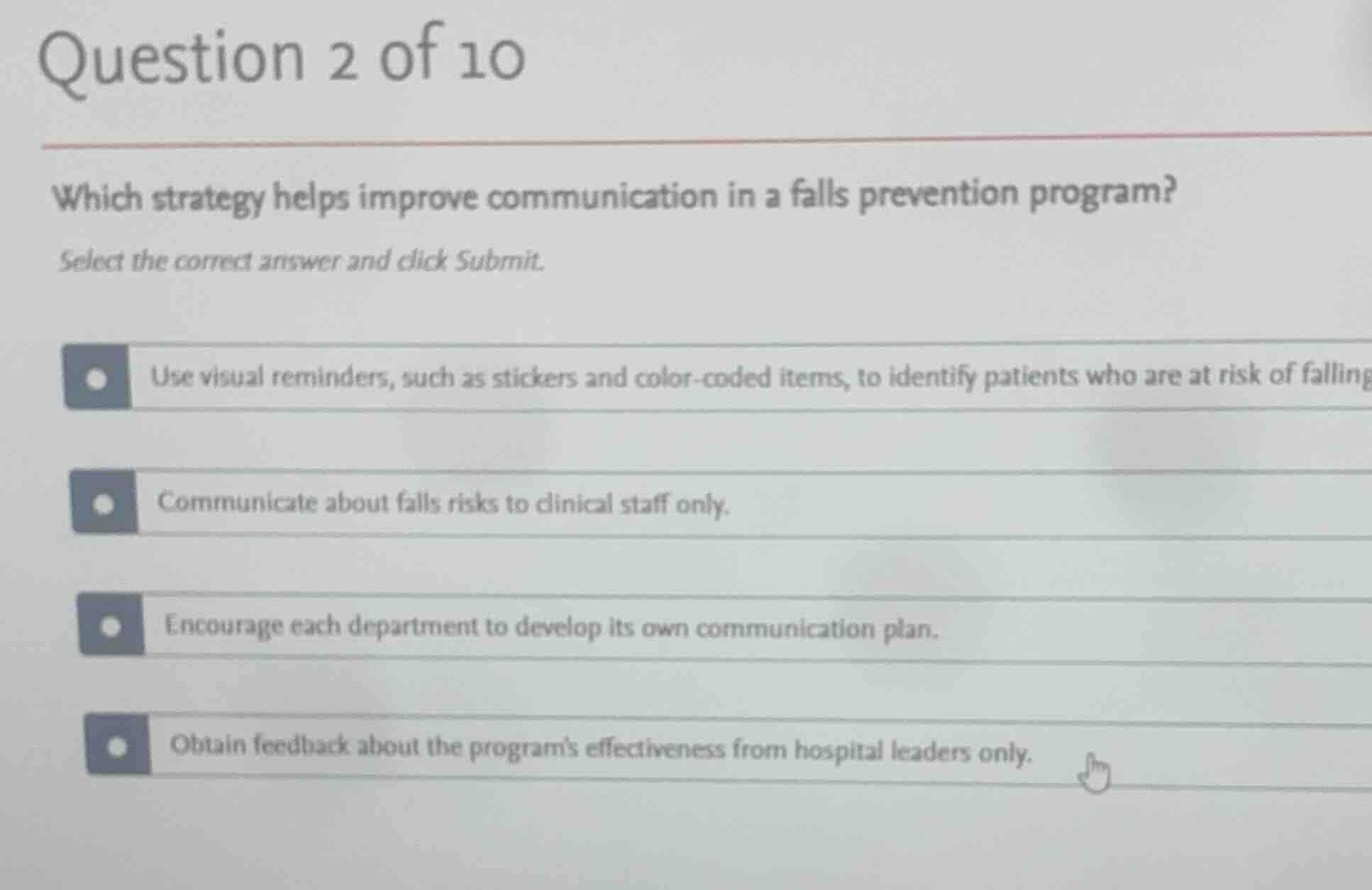
which strategy helps improve communication in a falls prevention program?
select the correct answer and click submit.
- use visual reminders, such as stickers and color-coded items, to identify patients who are at risk of falling
- communicate about falls risks to clinical staff only.
- encourage each department to develop its own communication plan.
- obtain feedback about the programs effectiveness from hospital leaders only.
<pre_analysis>
{
"quality": "clear",
"question_count": 1,
"skills_matched": [
"direct_cot",
"multiple_choice_formatter",
"explain_then_answer",
"quick"
],
"needs_drawing": false,
"concepts_used": [
"Fall Prevention Strategies"
],
"new_concepts": [
"Healthcare Communication Systems"
],
"current_concepts": [
"Fall Prevention Strategies",
"Healthcare Communication Systems"
]
}
</pre_analysis>
<reasoning>
Analyze the communication strategies in fall prevention
- Option 1: Visual reminders (stickers, color-coded items) provide immediate, standardized, and non-verbal communication of fall risk to all staff members, patients, and families.
- Option 2: Restricting communication to clinical staff only is unsafe, as non-clinical staff (e.g., dietary, transport, environmental services) also interact with patients and need to know their fall risk.
- Option 3: Allowing each department to develop its own plan leads to fragmentation and inconsistency rather than standardized, effective communication.
- Option 4: Obtaining feedback from hospital leaders only ignores the critical frontline staff who execute the program daily.
</reasoning>
<answer>
<mcq-correct>Use visual reminders, such as stickers and color-coded items, to identify patients who are at risk of falling</mcq-correct>
<mcq-option>Communicate about falls risks to clinical staff only.</mcq-option>
<mcq-option>Encourage each department to develop its own communication plan.</mcq-option>
<mcq-option>Obtain feedback about the program's effectiveness from hospital leaders only.</mcq-option>
</answer>
<post_analysis>
{
"subject": "Natural Science",
"question_type": "Multiple Choice",
"knowledge_point": [
"Natural Science",
"Medicine and Health Sciences",
"Patient Safety and Quality Improvement"
]
}
</post_analysis>
Snap & solve any problem in the app
Get step-by-step solutions on Sovi AI
Photo-based solutions with guided steps
Explore more problems and detailed explanations
<pre_analysis>
{
"quality": "clear",
"question_count": 1,
"skills_matched": [
"direct_cot",
"multiple_choice_formatter",
"explain_then_answer",
"quick"
],
"needs_drawing": false,
"concepts_used": [
"Fall Prevention Strategies"
],
"new_concepts": [
"Healthcare Communication Systems"
],
"current_concepts": [
"Fall Prevention Strategies",
"Healthcare Communication Systems"
]
}
</pre_analysis>
<reasoning>
Analyze the communication strategies in fall prevention
- Option 1: Visual reminders (stickers, color-coded items) provide immediate, standardized, and non-verbal communication of fall risk to all staff members, patients, and families.
- Option 2: Restricting communication to clinical staff only is unsafe, as non-clinical staff (e.g., dietary, transport, environmental services) also interact with patients and need to know their fall risk.
- Option 3: Allowing each department to develop its own plan leads to fragmentation and inconsistency rather than standardized, effective communication.
- Option 4: Obtaining feedback from hospital leaders only ignores the critical frontline staff who execute the program daily.
</reasoning>
<answer>
<mcq-correct>Use visual reminders, such as stickers and color-coded items, to identify patients who are at risk of falling</mcq-correct>
<mcq-option>Communicate about falls risks to clinical staff only.</mcq-option>
<mcq-option>Encourage each department to develop its own communication plan.</mcq-option>
<mcq-option>Obtain feedback about the program's effectiveness from hospital leaders only.</mcq-option>
</answer>
<post_analysis>
{
"subject": "Natural Science",
"question_type": "Multiple Choice",
"knowledge_point": [
"Natural Science",
"Medicine and Health Sciences",
"Patient Safety and Quality Improvement"
]
}
</post_analysis>