QUESTION IMAGE
Question
question 1 of 10
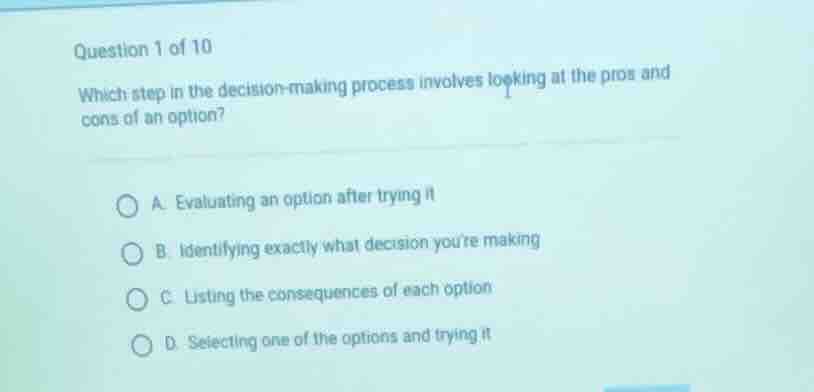
which step in the decision-making process involves looking at the pros and cons of an option?
a. evaluating an option after trying it
b. identifying exactly what decision youre making
c. listing the consequences of each option
d. selecting one of the options and trying it
<pre_analysis>
{
"quality": "clear",
"question_count": 1,
"skills_matched": [
"direct_cot",
"multiple_choice_formatter",
"explain_then_answer",
"quick"
],
"needs_drawing": false,
"concepts_used": [],
"new_concepts": [
"Decision-Making Process"
],
"current_concepts": [
"Decision-Making Process"
]
}
</pre_analysis>
<reasoning>
Analyze the question stem
The question asks which step in the decision-making process involves looking at the pros and cons of an option.
Evaluate the given options
- Option A (Evaluating an option after trying it): This is a reflective step that occurs after action has been taken, rather than the analysis of pros and cons before deciding.
- Option B (Identifying exactly what decision you're making): This is the initial step of defining the problem or goal.
- Option C (Listing the consequences of each option): Weighing the pros (positive consequences) and cons (negative consequences) of each choice directly corresponds to listing and analyzing their consequences.
- Option D (Selecting one of the options and trying it): This is the action step where a choice is implemented.
Determine the correct choice
Listing the consequences of each option is the step where one weighs the positive and negative outcomes (pros and cons) of each potential path. Therefore, Option C is the correct answer.
</reasoning>
<answer>
<mcq-option>A. Evaluating an option after trying it</mcq-option>
<mcq-option>B. Identifying exactly what decision you're making</mcq-option>
<mcq-correct>C. Listing the consequences of each option</mcq-correct>
<mcq-option>D. Selecting one of the options and trying it</mcq-option>
</answer>
<post_analysis>
{
"subject": "Social Science",
"question_type": "Multiple Choice",
"knowledge_point": [
"Social Science",
"Psychology",
"Decision-Making Process"
]
}
</post_analysis>
Snap & solve any problem in the app
Get step-by-step solutions on Sovi AI
Photo-based solutions with guided steps
Explore more problems and detailed explanations
<pre_analysis>
{
"quality": "clear",
"question_count": 1,
"skills_matched": [
"direct_cot",
"multiple_choice_formatter",
"explain_then_answer",
"quick"
],
"needs_drawing": false,
"concepts_used": [],
"new_concepts": [
"Decision-Making Process"
],
"current_concepts": [
"Decision-Making Process"
]
}
</pre_analysis>
<reasoning>
Analyze the question stem
The question asks which step in the decision-making process involves looking at the pros and cons of an option.
Evaluate the given options
- Option A (Evaluating an option after trying it): This is a reflective step that occurs after action has been taken, rather than the analysis of pros and cons before deciding.
- Option B (Identifying exactly what decision you're making): This is the initial step of defining the problem or goal.
- Option C (Listing the consequences of each option): Weighing the pros (positive consequences) and cons (negative consequences) of each choice directly corresponds to listing and analyzing their consequences.
- Option D (Selecting one of the options and trying it): This is the action step where a choice is implemented.
Determine the correct choice
Listing the consequences of each option is the step where one weighs the positive and negative outcomes (pros and cons) of each potential path. Therefore, Option C is the correct answer.
</reasoning>
<answer>
<mcq-option>A. Evaluating an option after trying it</mcq-option>
<mcq-option>B. Identifying exactly what decision you're making</mcq-option>
<mcq-correct>C. Listing the consequences of each option</mcq-correct>
<mcq-option>D. Selecting one of the options and trying it</mcq-option>
</answer>
<post_analysis>
{
"subject": "Social Science",
"question_type": "Multiple Choice",
"knowledge_point": [
"Social Science",
"Psychology",
"Decision-Making Process"
]
}
</post_analysis>