QUESTION IMAGE
Question
question 8 of 10
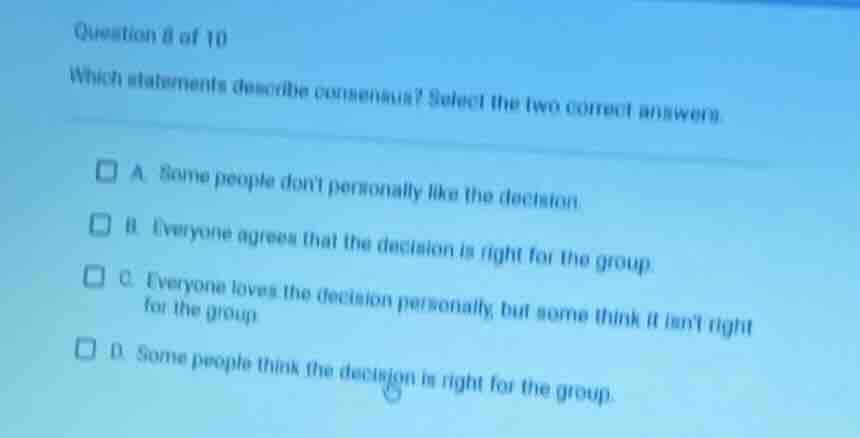
which statements describe consensus? select the two correct answers.
a. some people dont personally like the decision.
b. everyone agrees that the decision is right for the group.
c. everyone loves the decision personally, but some think it isnt right for the group.
d. some people think the decision is right for the group.
<pre_analysis>
{
"quality": "clear",
"question_count": 1,
"skills_matched": [
"direct_cot",
"multiple_choice_formatter",
"explain_then_answer",
"tutor"
],
"needs_drawing": false,
"concepts_used": [
"Decision-Making Process",
"Conflict Resolution Steps"
],
"new_concepts": [
"Consensus Building"
],
"current_concepts": [
"Decision-Making Process",
"Conflict Resolution Steps",
"Consensus Building"
]
}
</pre_analysis>
<reasoning>
Define consensus in decision-making
Consensus is a collaborative Decision-Making Process where group members develop and agree to support a decision in the best interest of the whole. It does not mean everyone gets their first choice, but rather that everyone can live with and support the final outcome.
Analyze option A
In a consensus, some people may not personally prefer the decision, but they agree to support it because it benefits the group. This statement accurately describes a characteristic of consensus.
Analyze option B
Consensus requires that everyone agrees the decision is the right choice for the group as a whole, even if it is not their personal favorite. This is a core requirement of consensus.
Analyze option C
If people think a decision is not right for the group, consensus has not been reached. Consensus focuses on group alignment, not personal preference.
Analyze option D
Consensus requires agreement from "everyone" in the group to support the decision, not just "some" people.
Select the two correct answers
Based on the analysis, options A and B correctly describe the nature of consensus.
</reasoning>
<answer>
<mcq-correct>(A) Some people don't personally like the decision.</mcq-correct>
<mcq-correct>(B) Everyone agrees that the decision is right for the group.</mcq-correct>
<mcq-option>(C) Everyone loves the decision personally, but some think it isn't right for the group.</mcq-option>
<mcq-option>(D) Some people think the decision is right for the group.</mcq-option>
</answer>
<post_analysis>
{
"subject": "Social Science",
"question_type": "Multiple Choice",
"knowledge_point": [
"Social Science",
"Psychology",
"Group Dynamics and Consensus"
]
}
</post_analysis>
Snap & solve any problem in the app
Get step-by-step solutions on Sovi AI
Photo-based solutions with guided steps
Explore more problems and detailed explanations
<pre_analysis>
{
"quality": "clear",
"question_count": 1,
"skills_matched": [
"direct_cot",
"multiple_choice_formatter",
"explain_then_answer",
"tutor"
],
"needs_drawing": false,
"concepts_used": [
"Decision-Making Process",
"Conflict Resolution Steps"
],
"new_concepts": [
"Consensus Building"
],
"current_concepts": [
"Decision-Making Process",
"Conflict Resolution Steps",
"Consensus Building"
]
}
</pre_analysis>
<reasoning>
Define consensus in decision-making
Consensus is a collaborative Decision-Making Process where group members develop and agree to support a decision in the best interest of the whole. It does not mean everyone gets their first choice, but rather that everyone can live with and support the final outcome.
Analyze option A
In a consensus, some people may not personally prefer the decision, but they agree to support it because it benefits the group. This statement accurately describes a characteristic of consensus.
Analyze option B
Consensus requires that everyone agrees the decision is the right choice for the group as a whole, even if it is not their personal favorite. This is a core requirement of consensus.
Analyze option C
If people think a decision is not right for the group, consensus has not been reached. Consensus focuses on group alignment, not personal preference.
Analyze option D
Consensus requires agreement from "everyone" in the group to support the decision, not just "some" people.
Select the two correct answers
Based on the analysis, options A and B correctly describe the nature of consensus.
</reasoning>
<answer>
<mcq-correct>(A) Some people don't personally like the decision.</mcq-correct>
<mcq-correct>(B) Everyone agrees that the decision is right for the group.</mcq-correct>
<mcq-option>(C) Everyone loves the decision personally, but some think it isn't right for the group.</mcq-option>
<mcq-option>(D) Some people think the decision is right for the group.</mcq-option>
</answer>
<post_analysis>
{
"subject": "Social Science",
"question_type": "Multiple Choice",
"knowledge_point": [
"Social Science",
"Psychology",
"Group Dynamics and Consensus"
]
}
</post_analysis>