QUESTION IMAGE
Question
question 1 of 10
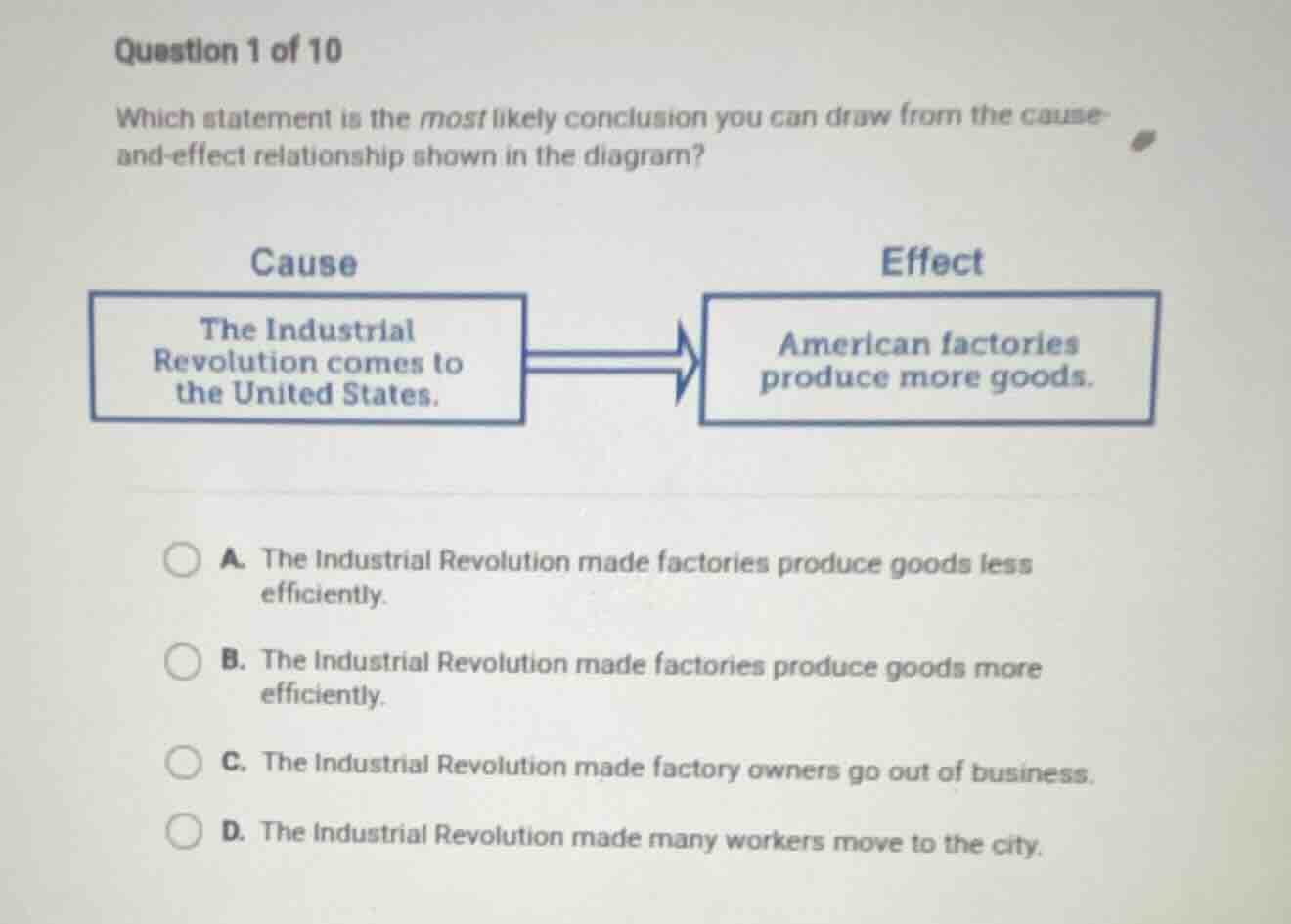
which statement is the most likely conclusion you can draw from the cause-and-effect relationship shown in the diagram?
cause: the industrial revolution comes to the united states.
effect: american factories produce more goods.
a. the industrial revolution made factories produce goods less efficiently.
b. the industrial revolution made factories produce goods more efficiently.
c. the industrial revolution made factory owners go out of business.
d. the industrial revolution made many workers move to the city.
Analyze the cause-and-effect diagram
The diagram shows a direct cause-and-effect relationship:
- Cause: The Industrial Revolution comes to the United States.
- Effect: American factories produce more goods.
Evaluate the options based on the diagram
- Option A: Suggests factories became less efficient, which contradicts the increase in production.
- Option B: Suggests factories became more efficient. Increased efficiency (producing more goods with the same or fewer resources) directly explains why factories were able to produce more goods.
- Option C: Suggests owners went out of business, which is inconsistent with increased production.
- Option D: While urbanization did happen, it is not the direct conclusion drawn from the specific cause-and-effect link of producing more goods shown in this diagram.
Determine the best conclusion
The most logical conclusion connecting the arrival of the Industrial Revolution to increased factory production is that the revolution made production processes more efficient.

Snap & solve any problem in the app
Get step-by-step solutions on Sovi AI
Photo-based solutions with guided steps
Explore more problems and detailed explanations
- (A) The Industrial Revolution made factories produce goods less efficiently.
- (B) The Industrial Revolution made factories produce goods more efficiently. (Correct answer)
- (C) The Industrial Revolution made factory owners go out of business.
- (D) The Industrial Revolution made many workers move to the city.