QUESTION IMAGE
Question
question 8 of 10
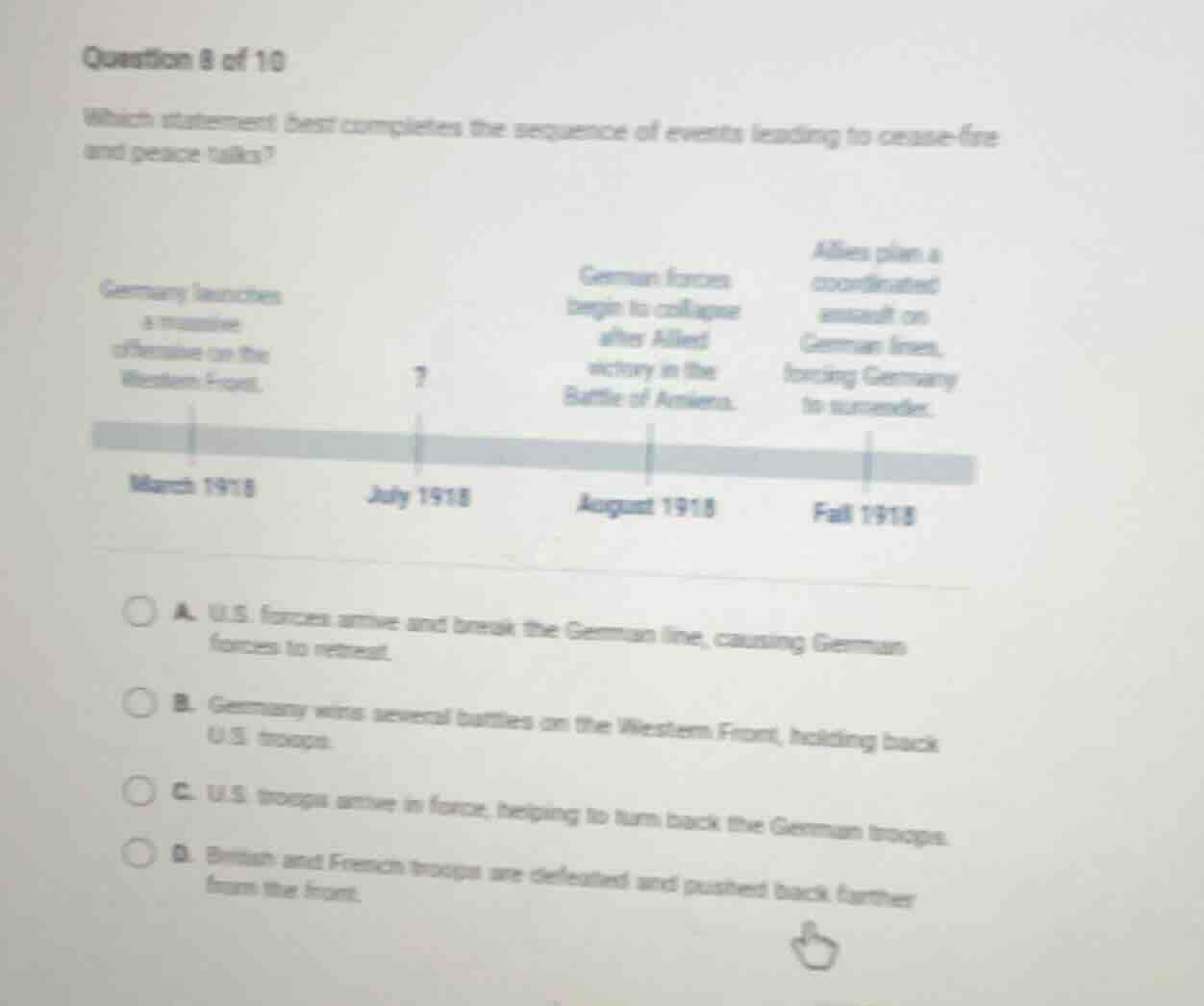
which statement best completes the sequence of events leading to cease-fire and peace talks?
timeline
march 1918: germany launches a massive offensive on the western front.
july 1918: ?
august 1918: german forces begin to collapse after allied victory in the battle of amiens.
fall 1918: allies plan a coordinated assault on german lines, forcing germany to surrender.
a. u.s. forces arrive and break the german line, causing german forces to retreat.
b. germany wins several battles on the western front, holding back u.s. troops.
c. u.s. troops arrive in force, helping to turn back the german troops.
d. british and french troops are defeated and pushed back farther from the front.
Analyze the timeline context
The timeline outlines the final stages of World War I on the Western Front in 1918:
- March 1918: Germany launches a massive offensive on the Western Front (the Spring Offensive).
- July 1918: This is the missing event marked with a question mark.
- August 1918: German forces begin to collapse after the Allied victory in the Battle of Amiens.
- Fall 1918: Allies plan a coordinated assault on German lines, forcing Germany to surrender.
Evaluate the historical turning point
By mid-1918, the German Spring Offensive had exhausted its resources. The turning point occurred in the summer of 1918 when American troops arrived in large numbers on the Western Front. Using the US Entry into World War I knowledge point, we know that the fresh American Expeditionary Forces (AEF) provided critical reinforcement to the exhausted French and British armies, helping to halt the German advance and launch successful counter-offensives (such as the Second Battle of the Marne in July 1918).
Compare the multiple-choice options
- Option A states that U.S. forces broke the German line, causing them to retreat. While U.S. forces played a major role, the initial breakthrough and collapse of the German lines are historically associated with the Battle of Amiens in August (the next step on the timeline).
- Option B and Option D suggest German victories or Allied defeats, which contradicts the timeline's progression toward a German collapse.
- Option C states that "U.S. troops arrive in force, helping to turn back the German troops." This perfectly fits the July 1918 timeframe, as the arrival of fresh American divisions bolstered the Allied defense and initiated the counter-offensive that led directly to the August collapse.

Snap & solve any problem in the app
Get step-by-step solutions on Sovi AI
Photo-based solutions with guided steps
Explore more problems and detailed explanations
- (A) U.S. forces arrive and break the German line, causing German forces to retreat.
- (B) Germany wins several battles on the Western Front, holding back U.S. troops.
- (C) U.S. troops arrive in force, helping to turn back the German troops. (Correct answer)
- (D) British and French troops are defeated and pushed back farther from the front.