QUESTION IMAGE
Question
question 5 of 10
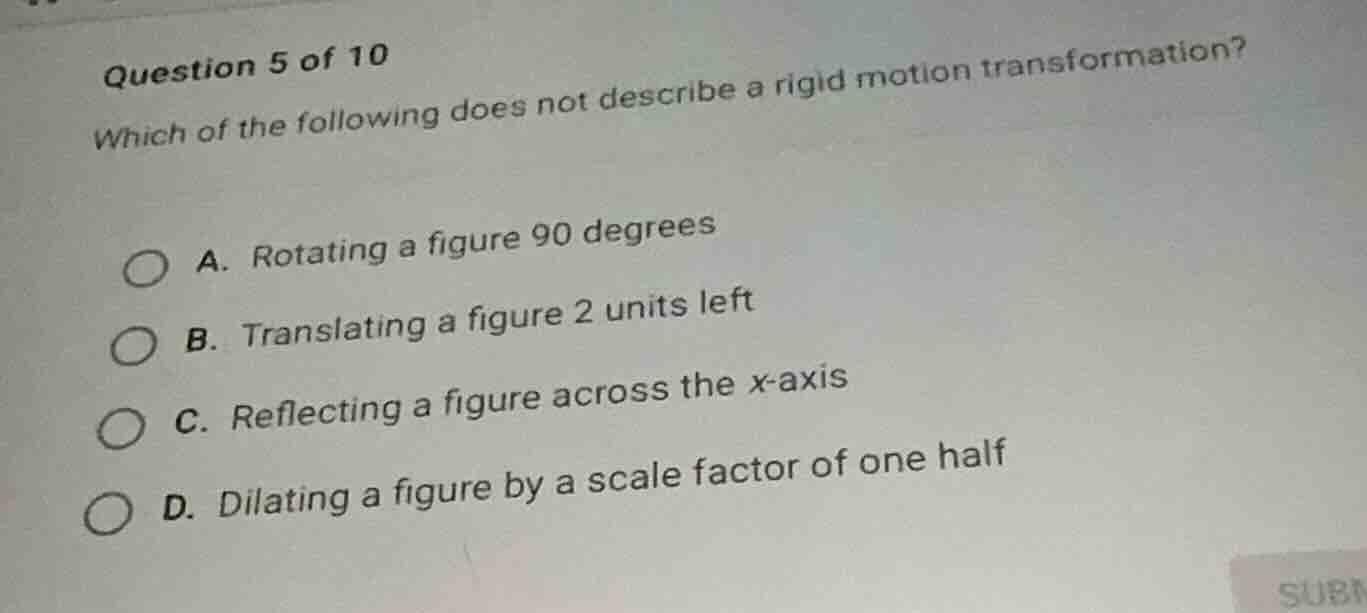
which of the following does not describe a rigid motion transformation?
a. rotating a figure 90 degrees
b. translating a figure 2 units left
c. reflecting a figure across the \\(x\\)-axis
d. dilating a figure by a scale factor of one half
Define rigid motion transformations
Rigid motions (isometries) preserve distance and angle measures, keeping the size and shape of the figure exactly the same. These include translations, rotations, and reflections.
Analyze the given options
- A. Rotating a figure 90 degrees: Rotation is a rigid motion because it preserves size and shape.
- B. Translating a figure 2 units left: Translation is a rigid motion because it preserves size and shape.
- C. Reflecting a figure across the x-axis: Reflection is a rigid motion because it preserves size and shape.
- D. Dilating a figure by a scale factor of one half: Dilation changes the size of the figure, so it does not preserve distance and is not a rigid motion.
Identify the correct choice
Since dilation changes the size of the figure, option D does not describe a rigid motion transformation.

Snap & solve any problem in the app
Get step-by-step solutions on Sovi AI
Photo-based solutions with guided steps
Explore more problems and detailed explanations
- A. Rotating a figure 90 degrees
- B. Translating a figure 2 units left
- C. Reflecting a figure across the x-axis
- D. Dilating a figure by a scale factor of one half (Correct answer)