QUESTION IMAGE
Question
question 6 of 10
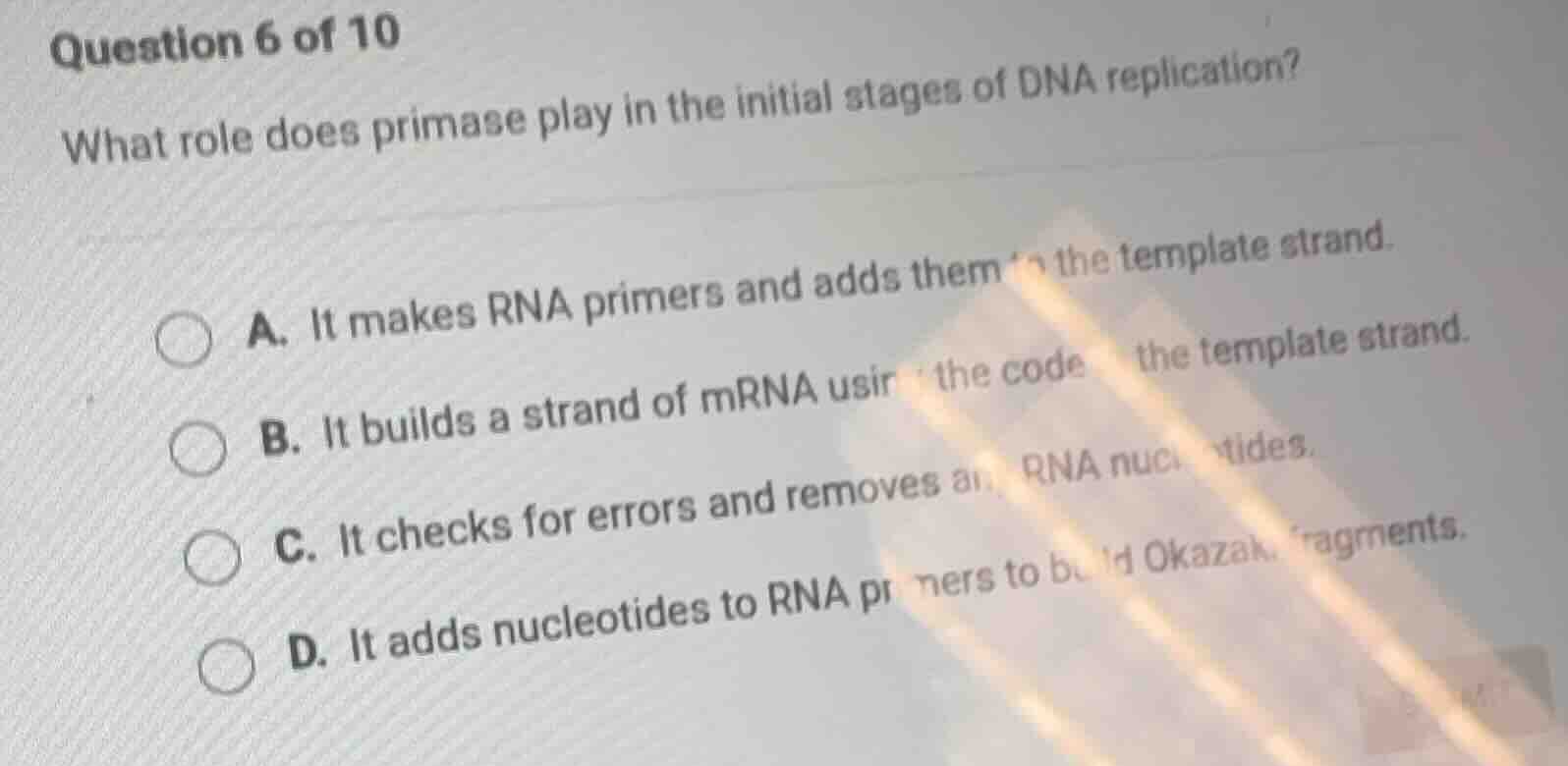
what role does primase play in the initial stages of dna replication?
a. it makes rna primers and adds them to the template strand.
b. it builds a strand of mrna using the code of the template strand.
c. it checks for errors and removes any rna nucleotides.
d. it adds nucleotides to rna primers to build okazaki fragments.
<pre_analysis>
{
"quality": "clear",
"question_count": 1,
"skills_matched": [
"direct_cot",
"multiple_choice_formatter",
"explain_then_answer",
"tutor"
],
"needs_drawing": false,
"concepts_used": [
"DNA Replication Stages"
],
"new_concepts": [
"DNA Primase Function"
],
"current_concepts": [
"DNA Replication Stages",
"DNA Primase Function"
]
}
</pre_analysis>
<reasoning>
Identify the role of primase in replication
During the process of DNA Replication Stages, DNA polymerase cannot initiate the synthesis of a new DNA strand from scratch; it requires a free 3'-OH group to attach new nucleotides. To provide this starting point, an enzyme called primase synthesizes a short sequence of RNA nucleotides, known as an RNA primer, complementary to the DNA template strand.
Evaluate the given options
- Option A states that primase makes RNA primers and adds them to the template strand. This matches the biological function of primase.
- Option B describes transcription (building mRNA), which is carried out by RNA polymerase, not DNA replication.
- Option C describes proofreading and repair mechanisms, which are primarily functions of DNA polymerases and exonucleases.
- Option D describes the elongation of the lagging strand (building Okazaki fragments), which is performed by DNA polymerase III.
Determine the correct choice
Since primase is specifically responsible for synthesizing short RNA primers to initiate DNA synthesis, Option A is the correct statement.
</reasoning>
<answer>
<mcq-correct>A. It makes RNA primers and adds them to the template strand.</mcq-correct>
<mcq-option>B. It builds a strand of mRNA using the code of the template strand.</mcq-option>
<mcq-option>C. It checks for errors and removes any RNA nucleotides.</mcq-option>
<mcq-option>D. It adds nucleotides to RNA primers to build Okazaki fragments.</mcq-option>
</answer>
<post_analysis>
{
"subject": "Natural Science",
"question_type": "Multiple Choice",
"knowledge_point": [
"Natural Science",
"Biology",
"DNA Replication"
]
}
</post_analysis>
Snap & solve any problem in the app
Get step-by-step solutions on Sovi AI
Photo-based solutions with guided steps
Explore more problems and detailed explanations
<pre_analysis>
{
"quality": "clear",
"question_count": 1,
"skills_matched": [
"direct_cot",
"multiple_choice_formatter",
"explain_then_answer",
"tutor"
],
"needs_drawing": false,
"concepts_used": [
"DNA Replication Stages"
],
"new_concepts": [
"DNA Primase Function"
],
"current_concepts": [
"DNA Replication Stages",
"DNA Primase Function"
]
}
</pre_analysis>
<reasoning>
Identify the role of primase in replication
During the process of DNA Replication Stages, DNA polymerase cannot initiate the synthesis of a new DNA strand from scratch; it requires a free 3'-OH group to attach new nucleotides. To provide this starting point, an enzyme called primase synthesizes a short sequence of RNA nucleotides, known as an RNA primer, complementary to the DNA template strand.
Evaluate the given options
- Option A states that primase makes RNA primers and adds them to the template strand. This matches the biological function of primase.
- Option B describes transcription (building mRNA), which is carried out by RNA polymerase, not DNA replication.
- Option C describes proofreading and repair mechanisms, which are primarily functions of DNA polymerases and exonucleases.
- Option D describes the elongation of the lagging strand (building Okazaki fragments), which is performed by DNA polymerase III.
Determine the correct choice
Since primase is specifically responsible for synthesizing short RNA primers to initiate DNA synthesis, Option A is the correct statement.
</reasoning>
<answer>
<mcq-correct>A. It makes RNA primers and adds them to the template strand.</mcq-correct>
<mcq-option>B. It builds a strand of mRNA using the code of the template strand.</mcq-option>
<mcq-option>C. It checks for errors and removes any RNA nucleotides.</mcq-option>
<mcq-option>D. It adds nucleotides to RNA primers to build Okazaki fragments.</mcq-option>
</answer>
<post_analysis>
{
"subject": "Natural Science",
"question_type": "Multiple Choice",
"knowledge_point": [
"Natural Science",
"Biology",
"DNA Replication"
]
}
</post_analysis>