QUESTION IMAGE
Question
question 2 of 10
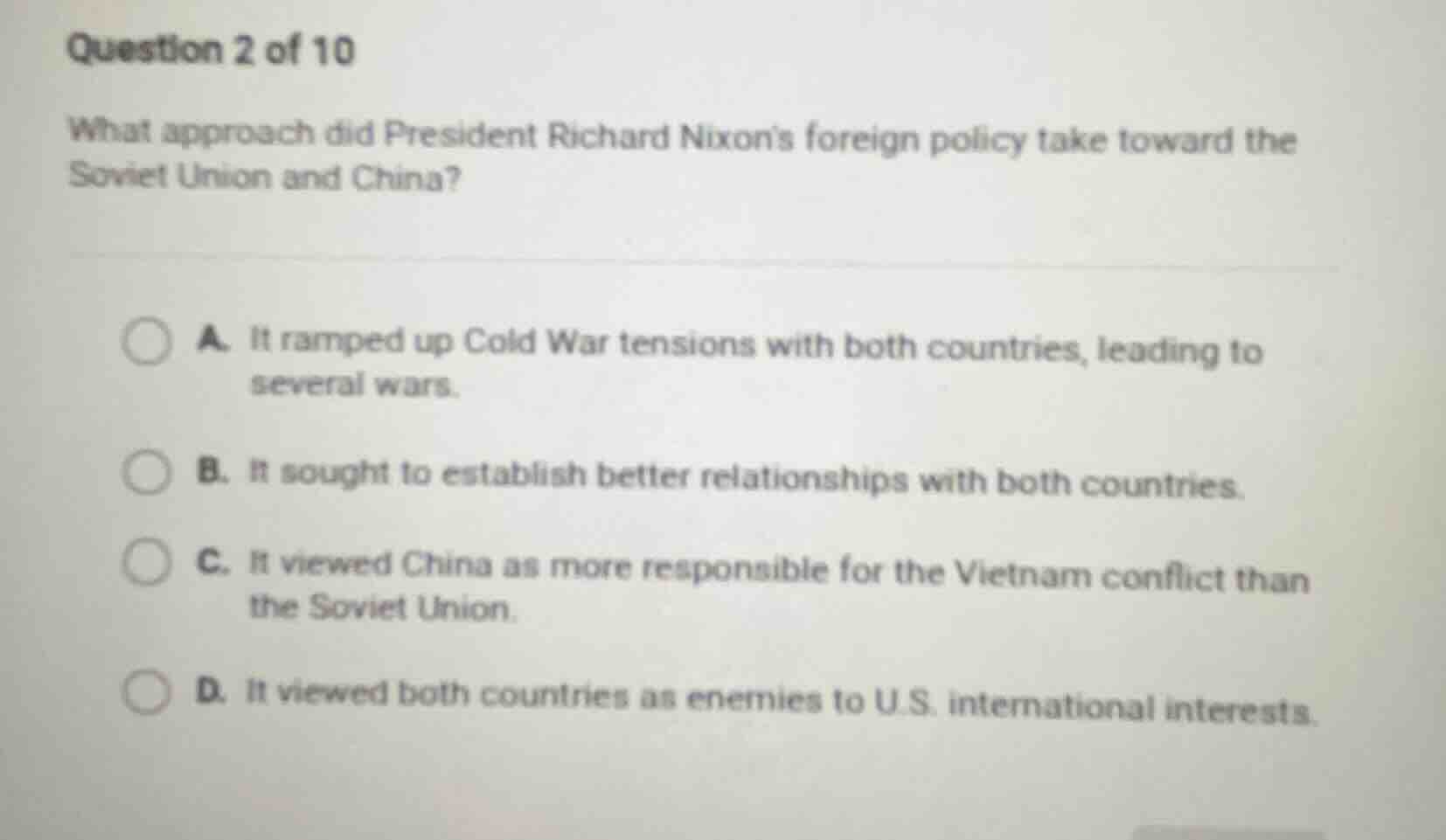
what approach did president richard nixons foreign policy take toward the soviet union and china?
a. it ramped up cold war tensions with both countries, leading to several wars.
b. it sought to establish better relationships with both countries.
c. it viewed china as more responsible for the vietnam conflict than the soviet union.
d. it viewed both countries as enemies to u.s. international interests.
Analyze Nixon's foreign policy goals
Using the US History 1970s knowledge point
- President Richard Nixon and National Security Advisor Henry Kissinger pursued a foreign policy strategy known as détente to ease Cold War tensions.
- This strategy aimed to establish better, more stable relationships with both major communist powers, the Soviet Union and the People's Republic of China.
Evaluate the historical actions taken
- Nixon visited communist China in February 1972, opening diplomatic relations and exploiting the Sino-Soviet split.
- Shortly after, in May 1972, Nixon visited Moscow, leading to the Strategic Arms Limitation Talks (SALT I) agreement with the Soviet Union.
Assess the multiple-choice options
- Option A is incorrect because Nixon's policy aimed to reduce, not ramp up, tensions, and did not lead to several wars between them.
- Option B is correct because his administration actively sought to improve diplomatic relations with both nations.
- Option C is incorrect because it does not represent the primary strategic approach of his triangular diplomacy.
- Option D is incorrect because, while they remained ideological rivals, Nixon shifted away from viewing them purely as monolithic enemies, seeking negotiation instead of confrontation.

Snap & solve any problem in the app
Get step-by-step solutions on Sovi AI
Photo-based solutions with guided steps
Explore more problems and detailed explanations
- (A) It ramped up Cold War tensions with both countries, leading to several wars.
- (B) It sought to establish better relationships with both countries. (Correct answer)
- (C) It viewed China as more responsible for the Vietnam conflict than the Soviet Union.
- (D) It viewed both countries as enemies to U.S. international interests.