QUESTION IMAGE
Question
question 6 of 10
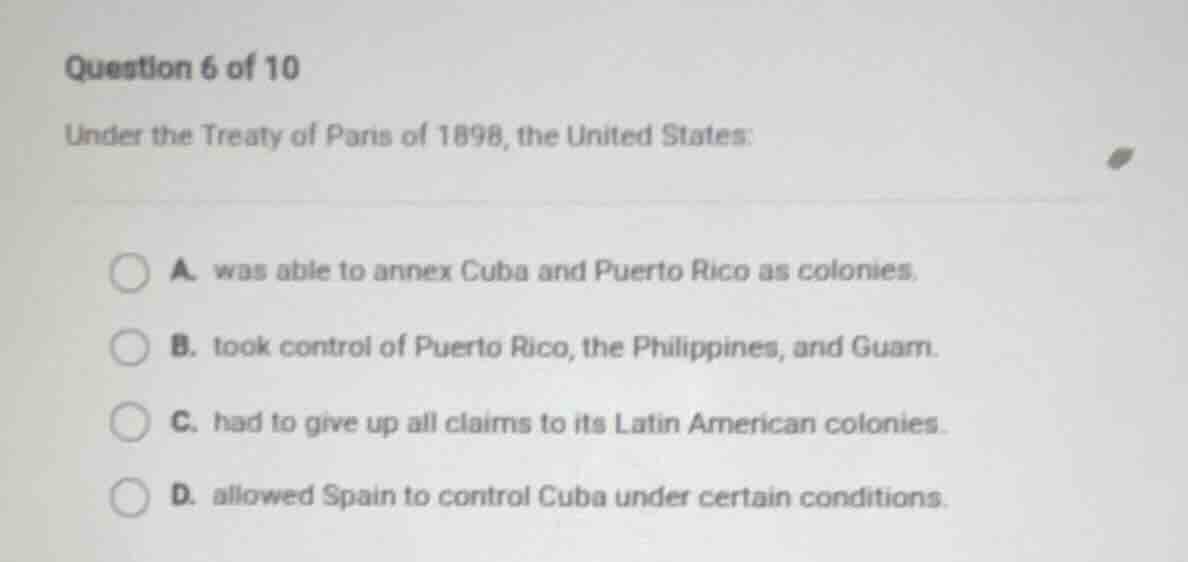
under the treaty of paris of 1898, the united states:
a. was able to annex cuba and puerto rico as colonies.
b. took control of puerto rico, the philippines, and guam.
c. had to give up all claims to its latin american colonies.
d. allowed spain to control cuba under certain conditions.
Identify the terms of the Treaty of Paris of 1898
The Treaty of Paris of 1898 officially ended the Spanish-American War. Under its terms, Spain relinquished all claim of sovereignty over and title to Cuba, and ceded Puerto Rico, Guam, and the Philippine Islands to the United States.
Evaluate the given options
- Option A is incorrect because the United States did not annex Cuba as a colony; the Teller Amendment prevented direct annexation, and Cuba became a protectorate.
- Option B is correct because Spain ceded Puerto Rico, Guam, and the Philippines to the United States.
- Option C is incorrect because the United States gained territories rather than giving up claims.
- Option D is incorrect because Spain surrendered all control and claims over Cuba.

Snap & solve any problem in the app
Get step-by-step solutions on Sovi AI
Photo-based solutions with guided steps
Explore more problems and detailed explanations
- (A) was able to annex Cuba and Puerto Rico as colonies.
- (B) took control of Puerto Rico, the Philippines, and Guam. (Correct answer)
- (C) had to give up all claims to its Latin American colonies.
- (D) allowed Spain to control Cuba under certain conditions.