QUESTION IMAGE
Question
question 10
5 pts
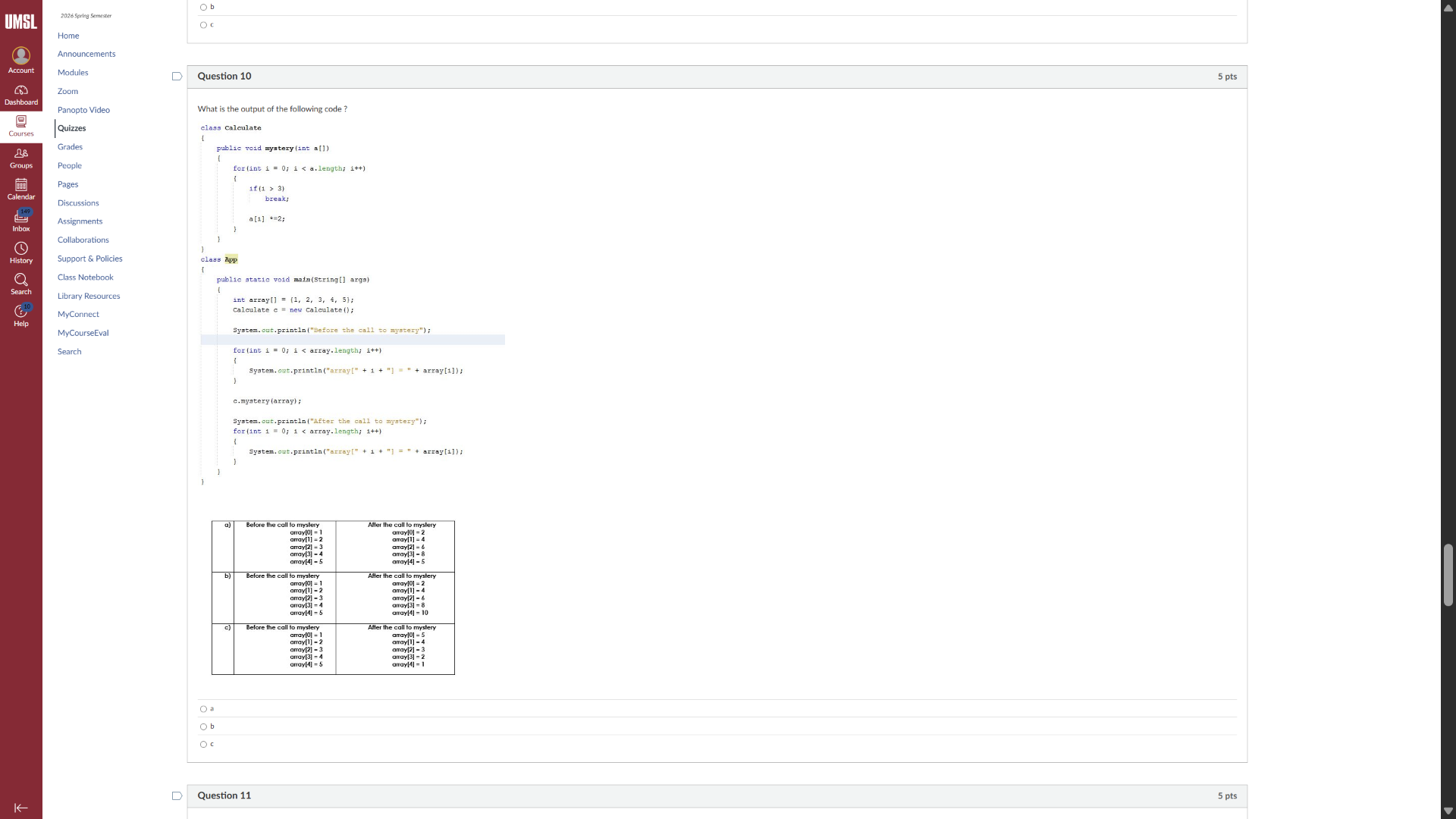
what is the output of the following code?
class calculate
{
public void mystery(int a)
{
for(int i = 0; i < a.length; i++)
{
if(i > 3)
break;
ai *= 2;
}
}
}
class app
{
public static void main(string args)
{
int array = {1, 2, 3, 4, 5};
calculate c = new calculate();
system.out.println(\before the call to mystery\);
for(int i = 0; i < array.length; i++)
{
system.out.println(\array\ + i + \ = \ + arrayi);
}
c.mystery(array);
system.out.println(\after the call to mystery\);
for(int i = 0; i < array.length; i++)
{
system.out.println(\array\ + i + \ = \ + arrayi);
}
}
}
a)
before the call to mystery
array0 = 1
array1 = 2
array2 = 3
array3 = 4
array4 = 5
after the call to mystery
array0 = 2
array1 = 4
array2 = 6
array3 = 8
array4 = 5
b)
before the call to mystery
array0 = 1
array1 = 2
array2 = 3
array3 = 4
array4 = 5
after the call to mystery
array0 = 2
array1 = 4
array2 = 6
array3 = 8
array4 = 10
c)
before the call to mystery
array0 = 1
array1 = 2
array2 = 3
array3 = 4
array4 = 5
after the call to mystery
array0 = 5
array1 = 4
array2 = 3
array3 = 2
array4 = 1
🆕 New Concept Discovered: Pass-by-Value with Reference Types
In Java, arrays are objects. When passed to a method, a copy of the reference is passed, meaning modifications to the array elements inside the method affect the original array.
Step 1: Analyze the Initial State
The program initializes an integer array in the main method:int array[] = {1, 2, 3, 4, 5};
The first loop prints the array elements before calling mystery:
Before the call to mystery
array[0] = 1
array[1] = 2
array[2] = 3
array[3] = 4
array[4] = 5
Step 2: Trace the mystery Method Execution
The method mystery(int a[]) is called with array as its argument. Since arrays are reference types, a points to the same array in memory as array.
Let's trace the loop inside mystery:
- Iteration 1 (\(i = 0\)):
- Check condition:
if (i > 3)\(
ightarrow 0 > 3\) is false.
- Execute:
a[i] *= 2;\(
ightarrow a[0] = a[0] \times 2 = 1 \times 2 = 2\).
- Iteration 2 (\(i = 1\)):
- Check condition:
if (i > 3)\(
ightarrow 1 > 3\) is false.
- Execute:
a[i] *= 2;\(
ightarrow a[1] = a[1] \times 2 = 2 \times 2 = 4\).
- Iteration 3 (\(i = 2\)):
- Check condition:
if (i > 3)\(
ightarrow 2 > 3\) is false.
- Execute:
a[i] *= 2;\(
ightarrow a[2] = a[2] \times 2 = 3 \times 2 = 6\).
- Iteration 4 (\(i = 3\)):
- Check condition:
if (i > 3)\(
ightarrow 3 > 3\) is false.
- Execute:
a[i] *= 2;\(
ightarrow a[3] = a[3] \times 2 = 4 \times 2 = 8\).
- Iteration 5 (\(i = 4\)):
- Check condition:
if (i > 3)\(
ightarrow 4 > 3\) is true.
- The
breakstatement is executed, immediately terminating the loop. a[4]remains unchanged (\(5\)).
Step 3: Determine the Final Output
After the call to mystery, the modified array is printed:
After the call to mystery
array[0] = 2
array[1] = 4
array[2] = 6
array[3] = 8
array[4] = 5
This matches option a.

Snap & solve any problem in the app
Get step-by-step solutions on Sovi AI
Photo-based solutions with guided steps
Explore more problems and detailed explanations
a