QUESTION IMAGE
Question
question 8 of 10
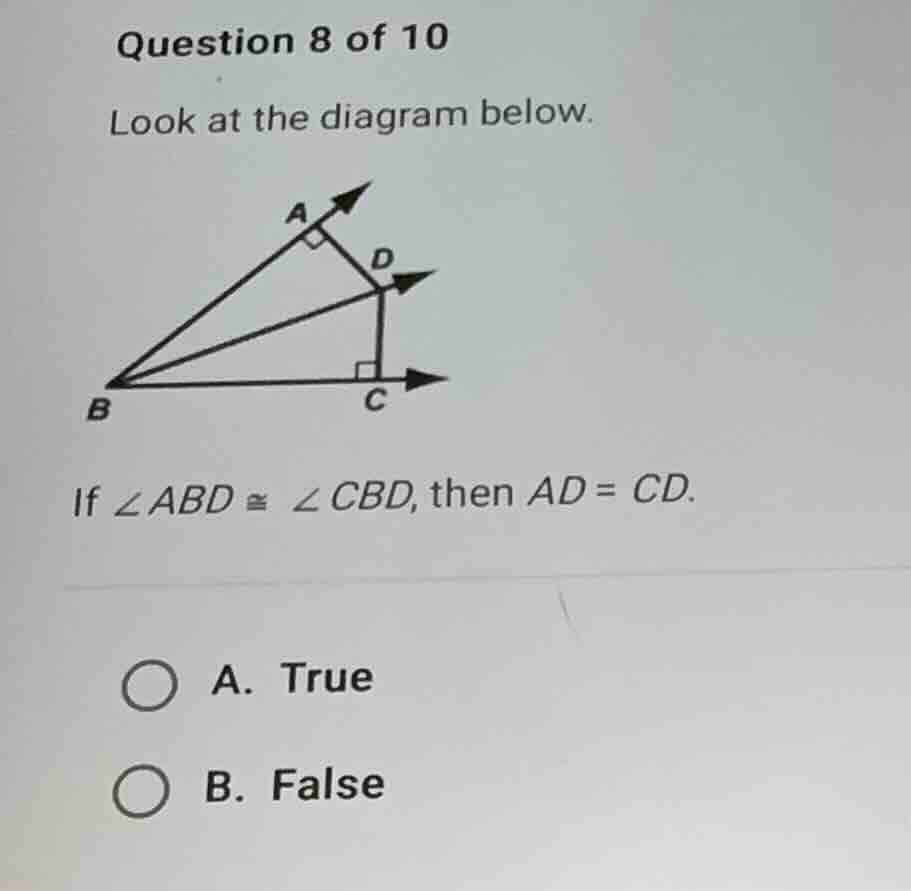
look at the diagram below.
if \\(\angle abd \cong \angle cbd\\), then \\(ad = cd\\).
a. true
b. false
Identify given geometric properties
We are given a diagram with ray \(BD\) between rays \(BA\) and \(BC\).
The segments \(DA\) and \(DC\) are perpendicular to rays \(BA\) and \(BC\) respectively:
We are also given that \(\angle ABD \cong \angle CBD\).
Apply triangle congruence criteria
Using the Locus of Points concept, we analyze the two right triangles \(\triangle DAB\) and \(\triangle DCB\):
- \(\angle DAB \cong \angle DCB\) (both are \(90^\circ\))
- \(\angle ABD \cong \angle CBD\) (given)
- Segment \(BD\) is shared (reflexive property: \(BD \cong BD\))
By the Angle-Angle-Side (AAS) congruence theorem:
Conclude corresponding parts
Since the triangles are congruent, their corresponding parts are congruent (CPCTC):
Thus, the statement "If \(\angle ABD \cong \angle CBD\), then \(AD = CD\)" is true. This is also a direct application of the Angle Bisector Theorem.

Snap & solve any problem in the app
Get step-by-step solutions on Sovi AI
Photo-based solutions with guided steps
Explore more problems and detailed explanations
- A. True (Correct answer)
- B. False