QUESTION IMAGE
Question
question 8 of 10
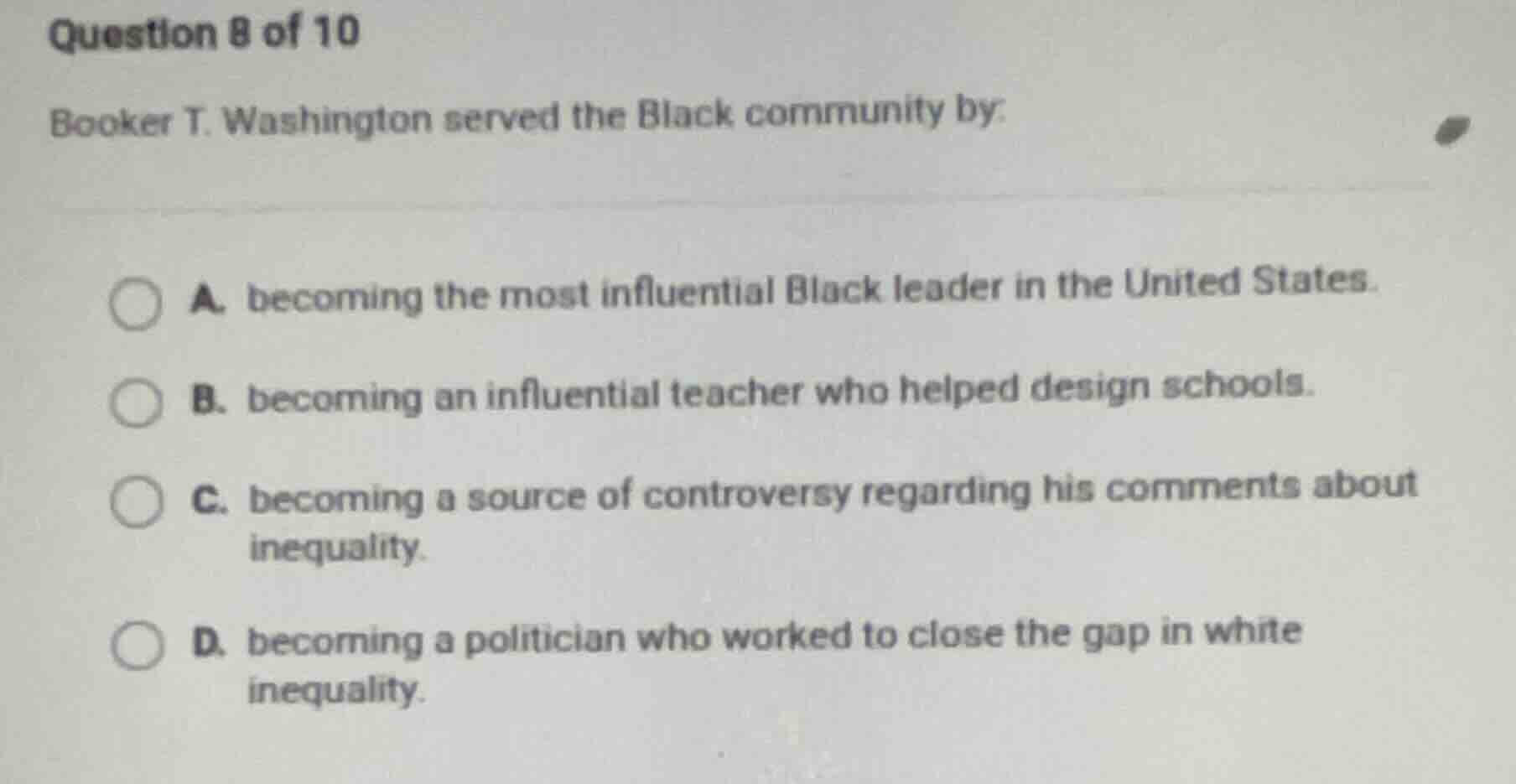
booker t. washington served the black community by:
a. becoming the most influential black leader in the united states.
b. becoming an influential teacher who helped design schools.
c. becoming a source of controversy regarding his comments about inequality.
d. becoming a politician who worked to close the gap in white inequality.
Identify Washington's primary historical role
Booker T. Washington was a prominent educator, author, and orator. He founded the Tuskegee Institute in Alabama, focusing on vocational training and education for African Americans to build economic self-reliance.
Evaluate the given options
- Option A suggests he served the community by "becoming the most influential Black leader." While he was highly influential, "becoming" a leader is a status rather than the direct action of how he served the community's educational needs.
- Option B highlights his role as an influential teacher who helped design and build schools (such as Tuskegee and his collaboration with Julius Rosenwald to build thousands of rural schools). This directly describes his service.
- Option C mentions controversy. While his "Atlanta Compromise" speech drew criticism from leaders like W.E.B. Du Bois, controversy itself was not how he intended to serve.
- Option D calls him a politician. Washington was not an elected politician, and the phrasing "close the gap in white inequality" is historically inaccurate.
Select the best fit
Option B accurately describes his practical, hands-on service to the Black community through education, school design, and vocational training.

Snap & solve any problem in the app
Get step-by-step solutions on Sovi AI
Photo-based solutions with guided steps
Explore more problems and detailed explanations
- (A) becoming the most influential Black leader in the United States.
- (B) becoming an influential teacher who helped design schools. (Correct answer)
- (C) becoming a source of controversy regarding his comments about inequality.
- (D) becoming a politician who worked to close the gap in white inequality.