QUESTION IMAGE
Question
question 5 of 10
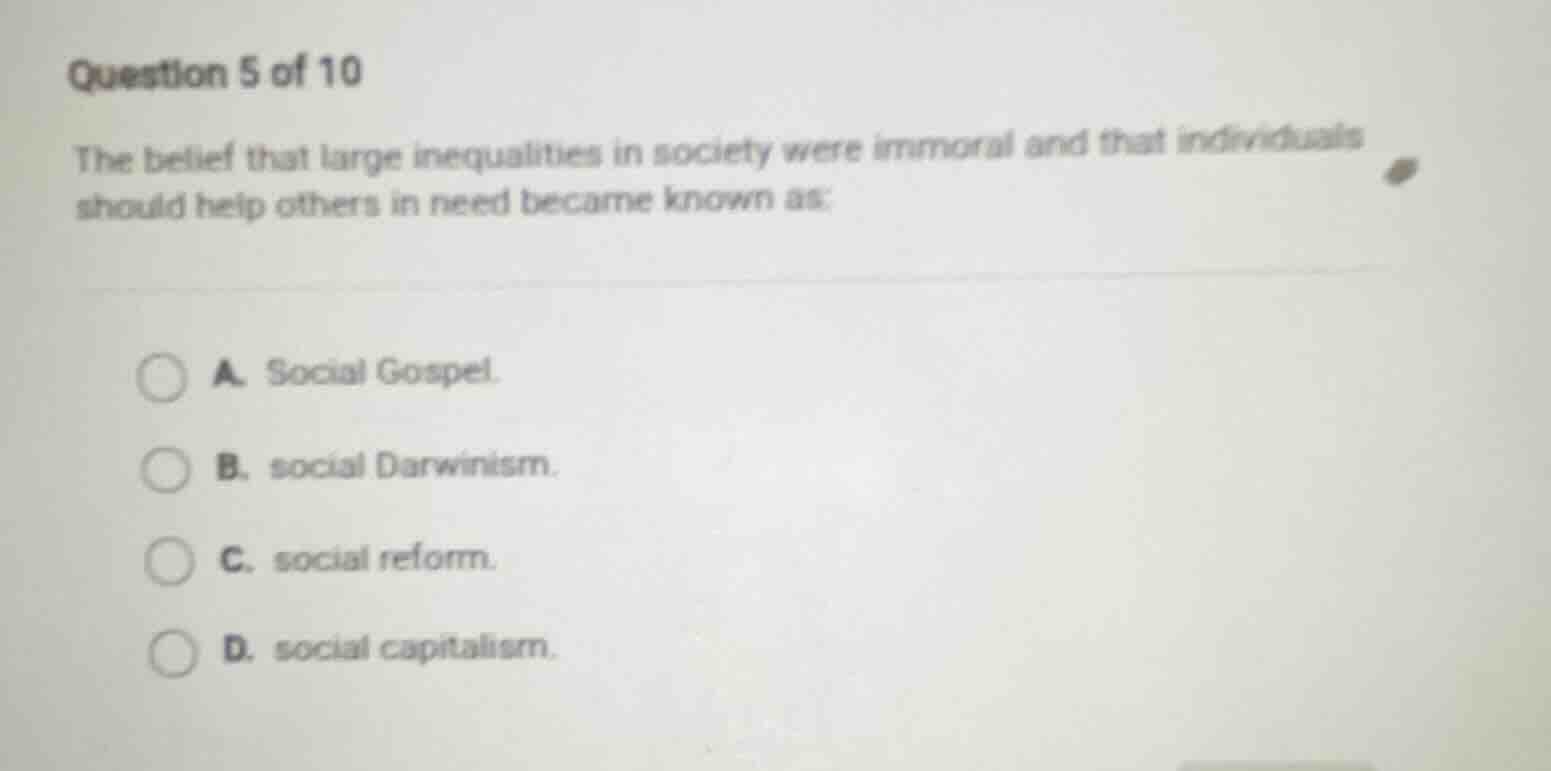
the belief that large inequalities in society were immoral and that individuals should help others in need became known as:
a. social gospel.
b. social darwinism.
c. social reform.
d. social capitalism.
Analyze the core definition
The question asks for the term associated with the belief that large inequalities in society are immoral and that individuals have a moral obligation to help those in need. This perspective emerged prominently during the late 19th and early 20th centuries in the United States as a response to the rapid industrialization and urban poverty of the Gilded Age.
Evaluate the options
- A. Social Gospel: This was a Protestant Christian intellectual movement that was most prominent in the late 19th and early 20th centuries. The movement applied Christian ethics to social problems, especially issues of social justice such as economic inequality, poverty, alcoholism, crime, racial tensions, slums, unclean environment, child labor, lack of unionization, poor schools, and the dangers of war. It argued that salvation required addressing these systemic social ills and helping those in need, directly matching the prompt's definition.
- B. social Darwinism: This theory, popular in the late 19th century, applied biological concepts of natural selection and "survival of the fittest" to sociology and politics. It argued that wealth and power naturally accumulated in the hands of the most capable individuals, and that helping the poor was counterproductive to human evolutionary progress. This is the opposite of the belief described in the prompt.
- C. social reform: While this is a broad term describing efforts to improve society, it is not the specific historical term or ideology defined by the moral imperative of helping others to combat societal inequalities in this context.
- D. social capitalism: This is not a standard historical term used to describe this specific Gilded Age moral movement.
Formulate the final conclusion
The belief that societal inequalities are immoral and that individuals should actively help those in need is the defining characteristic of the Social Gospel movement.

Snap & solve any problem in the app
Get step-by-step solutions on Sovi AI
Photo-based solutions with guided steps
Explore more problems and detailed explanations
- (A) Social Gospel. (Correct answer)
- (B) social Darwinism.
- (C) social reform.
- (D) social capitalism.