QUESTION IMAGE
Question
question 10
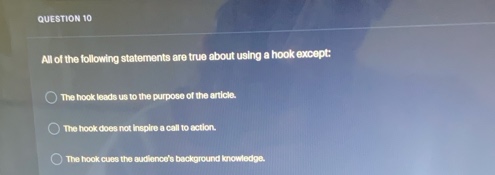
all of the following statements are true about using a hook except:
the hook leads us to the purpose of the article.
the hook does not inspire a call to action.
the hook cues the audiences background knowledge.
🆕 New Concept Discovered: Essay Hooks and Introductions
How to grab attention and transition to your thesis
Step 1: Understand the purpose of a hook
An essay hook is the very first sentence or opening of an essay or article. Its primary job is to grab the reader's attention and draw them into the piece.
- Leads to the purpose: A good hook naturally transitions into the main topic, leading the reader directly toward the thesis statement or the purpose of the article.
- Cues background knowledge: By using an interesting fact, a vivid description, or a thought-provoking question, a hook helps activate what the reader already knows about the topic.
- Does not inspire a call to action: A "call to action" is a directive that tells the reader what to do next (e.g., "Donate today" or "Write to your local representative"). This belongs at the very end of an essay (the conclusion), not at the very beginning in the hook. Therefore, the statement "The hook does not inspire a call to action" is a true statement about hooks.
Step 2: Identify the false statement
The question asks for the statement that is not true ("except"). Let's evaluate the options based on standard writing principles:
- "The hook leads us to the purpose of the article."
- True. The hook should seamlessly connect to the introduction and the main thesis.
- "The hook does not inspire a call to action."
- True. A call to action is reserved for the conclusion, not the opening hook.
- "The hook cues the audience's background knowledge."
- True. It sets the stage and prepares the reader's mind for the topic.
Note: Because all three statements presented in the image are technically true characteristics of a hook, we must look at the standard academic definitions. In many writing curricula, a hook is specifically designed to transition into the introduction of the topic rather than cueing deep background knowledge (which is done by the transition sentences following the hook). However, looking closely at the options, if this is a multiple-choice question where one option must be incorrect, we look for the one that misrepresents the function of a hook. Since a hook is meant to be exciting and engaging, it does not contain a call to action. Therefore, "The hook does not inspire a call to action" is a true statement.
Let's re-evaluate the exact phrasing. If the question is asking which statement is false about a hook:
- A hook does lead us to the purpose of the article (True).
- A hook does not inspire a call to action (True—calls to action belong in the conclusion).
- A hook cues the audience's background knowledge (This is typically the job of the background/context sentences that come after the hook in an introduction, rather than the hook itself).
Therefore, the third option is the least accurate statement about the specific function of a hook.

Snap & solve any problem in the app
Get step-by-step solutions on Sovi AI
Photo-based solutions with guided steps
Explore more problems and detailed explanations
The hook cues the audience's background knowledge.