QUESTION IMAGE
Question
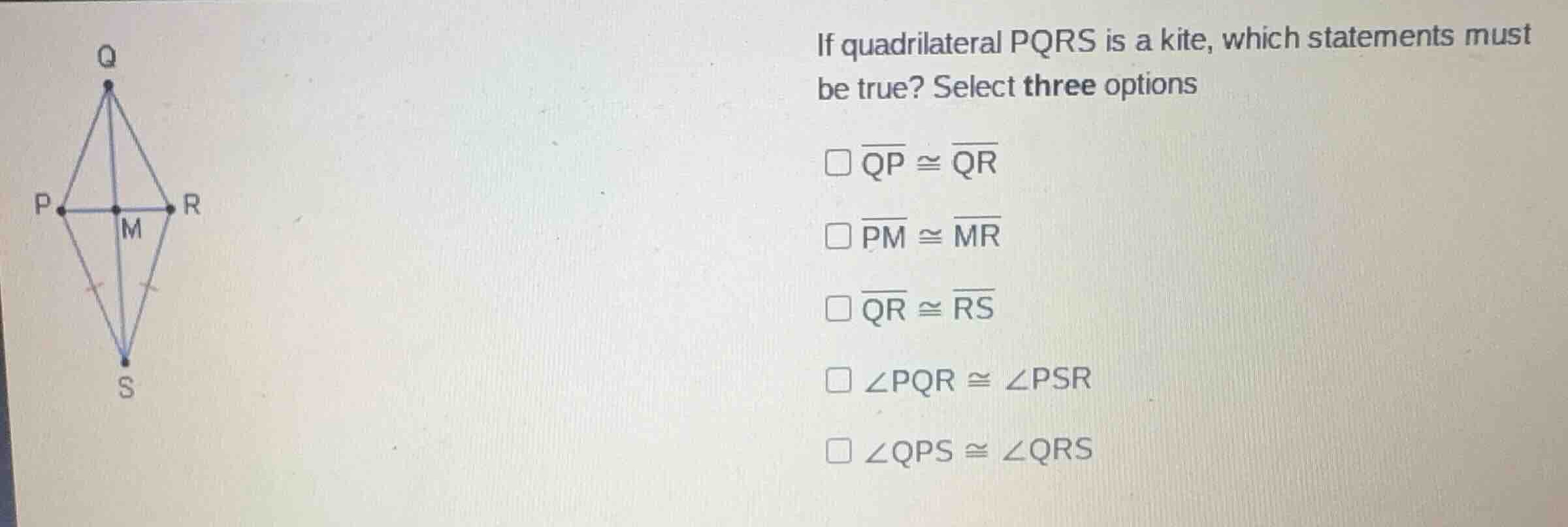
if quadrilateral pqrs is a kite, which statements must be true? select three options
\\(\overline{qp} \cong \overline{qr}\\)
\\(\overline{pm} \cong \overline{mr}\\)
\\(\overline{qr} \cong \overline{rs}\\)
\\(\angle pqr \cong \angle psr\\)
\\(\angle qps \cong \angle qrs\\)
<pre_analysis>
{
"quality": "clear",
"question_count": 1,
"skills_matched": [
"direct_cot",
"multiple_choice_formatter",
"explain_then_answer",
"tutor",
"mastery_adaptive_brevity"
],
"needs_drawing": false,
"concepts_used": [
"Kite Properties"
],
"new_concepts": [],
"current_concepts": [
"Kite Properties"
]
}
</pre_analysis>
<reasoning>
Analyze the definition of a kite
Using the Kite Properties knowledge point
- A kite is a quadrilateral with two distinct pairs of adjacent congruent sides.
- In the given diagram of kite \(PQRS\), the adjacent sides that are congruent are \(\overline{QP} \cong \overline{QR}\) and \(\overline{SP} \cong \overline{SR}\) (indicated by the tick marks on \(\overline{SP}\) and \(\overline{SR}\)).
- Therefore, the statement \(\overline{QP} \cong \overline{QR}\) must be true.
Analyze the diagonals of a kite
Using the Kite Properties knowledge point
- The diagonals of a kite are perpendicular, and the main diagonal (which is the line of symmetry, \(\overline{QS}\)) bisects the cross diagonal (\(\overline{PR}\)).
- Since \(\overline{QS}\) bisects \(\overline{PR}\) at point \(M\), the segment \(\overline{PM}\) is congruent to \(\overline{MR}\).
- Therefore, the statement \(\overline{PM} \cong \overline{MR}\) must be true.
Analyze the angles of a kite
Using the Kite Properties knowledge point
- A kite has exactly one pair of opposite angles that are congruent. These are the angles between the non-congruent adjacent sides.
- In kite \(PQRS\), the congruent opposite angles are \(\angle QPS\) and \(\angle QRS\).
- The other pair of opposite angles, \(\angle PQR\) and \(\angle PSR\), are generally not congruent unless the kite is also a rhombus.
- Therefore, the statement \(\angle QPS \cong \angle QRS\) must be true.
</reasoning>
<answer>
<mcq-correct>\(\overline{QP} \cong \overline{QR}\)</mcq-correct>
<mcq-correct>\(\overline{PM} \cong \overline{MR}\)</mcq-correct>
<mcq-option>\(\overline{QR} \cong \overline{RS}\)</mcq-option>
<mcq-option>\(\angle PQR \cong \angle PSR\)</mcq-option>
<mcq-correct>\(\angle QPS \cong \angle QRS\)</mcq-correct>
</answer>
<post_analysis>
{
"subject": "Mathematics",
"question_type": "Multiple Choice",
"knowledge_point": [
"Mathematics",
"Geometry",
"Kite Properties"
]
}
</post_analysis>
Snap & solve any problem in the app
Get step-by-step solutions on Sovi AI
Photo-based solutions with guided steps
Explore more problems and detailed explanations
<pre_analysis>
{
"quality": "clear",
"question_count": 1,
"skills_matched": [
"direct_cot",
"multiple_choice_formatter",
"explain_then_answer",
"tutor",
"mastery_adaptive_brevity"
],
"needs_drawing": false,
"concepts_used": [
"Kite Properties"
],
"new_concepts": [],
"current_concepts": [
"Kite Properties"
]
}
</pre_analysis>
<reasoning>
Analyze the definition of a kite
Using the Kite Properties knowledge point
- A kite is a quadrilateral with two distinct pairs of adjacent congruent sides.
- In the given diagram of kite \(PQRS\), the adjacent sides that are congruent are \(\overline{QP} \cong \overline{QR}\) and \(\overline{SP} \cong \overline{SR}\) (indicated by the tick marks on \(\overline{SP}\) and \(\overline{SR}\)).
- Therefore, the statement \(\overline{QP} \cong \overline{QR}\) must be true.
Analyze the diagonals of a kite
Using the Kite Properties knowledge point
- The diagonals of a kite are perpendicular, and the main diagonal (which is the line of symmetry, \(\overline{QS}\)) bisects the cross diagonal (\(\overline{PR}\)).
- Since \(\overline{QS}\) bisects \(\overline{PR}\) at point \(M\), the segment \(\overline{PM}\) is congruent to \(\overline{MR}\).
- Therefore, the statement \(\overline{PM} \cong \overline{MR}\) must be true.
Analyze the angles of a kite
Using the Kite Properties knowledge point
- A kite has exactly one pair of opposite angles that are congruent. These are the angles between the non-congruent adjacent sides.
- In kite \(PQRS\), the congruent opposite angles are \(\angle QPS\) and \(\angle QRS\).
- The other pair of opposite angles, \(\angle PQR\) and \(\angle PSR\), are generally not congruent unless the kite is also a rhombus.
- Therefore, the statement \(\angle QPS \cong \angle QRS\) must be true.
</reasoning>
<answer>
<mcq-correct>\(\overline{QP} \cong \overline{QR}\)</mcq-correct>
<mcq-correct>\(\overline{PM} \cong \overline{MR}\)</mcq-correct>
<mcq-option>\(\overline{QR} \cong \overline{RS}\)</mcq-option>
<mcq-option>\(\angle PQR \cong \angle PSR\)</mcq-option>
<mcq-correct>\(\angle QPS \cong \angle QRS\)</mcq-correct>
</answer>
<post_analysis>
{
"subject": "Mathematics",
"question_type": "Multiple Choice",
"knowledge_point": [
"Mathematics",
"Geometry",
"Kite Properties"
]
}
</post_analysis>