QUESTION IMAGE
Question
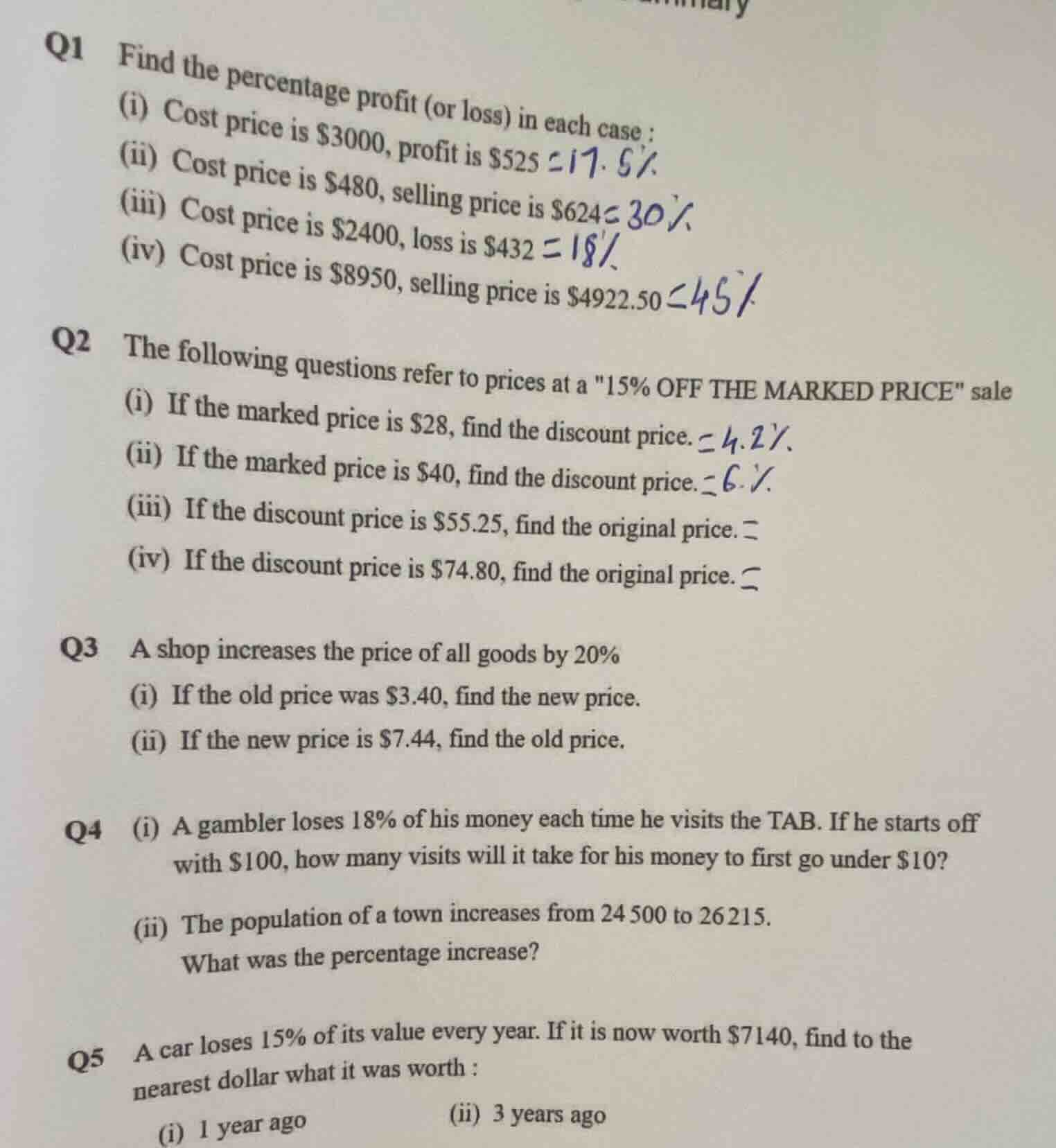
q1 find the percentage profit (or loss) in each case:
(i) cost price is $3000, profit is $525
(ii) cost price is $480, selling price is $624
(iii) cost price is $2400, loss is $432
(iv) cost price is $8950, selling price is $4922.50
q2 the following questions refer to prices at a \15% off the marked price\ sale
(i) if the marked price is $28, find the discount price.
(ii) if the marked price is $40, find the discount price.
(iii) if the discount price is $55.25, find the original price.
(iv) if the discount price is $74.80, find the original price.
q3 a shop increases the price of all goods by 20%
(i) if the old price was $3.40, find the new price.
(ii) if the new price is $7.44, find the old price.
q4 (i) a gambler loses 18% of his money each time he visits the tab. if he starts off with $100, how many visits will it take for his money to first go under $10?
(ii) the population of a town increases from 24 500 to 26 215. what was the percentage increase?
q5 a car loses 15% of its value every year. if it is now worth $7140, find to the nearest dollar what it was worth:
(i) 1 year ago
(ii) 3 years ago
Calculate percentage profit or loss for Q1
We calculate the percentage profit or loss relative to the cost price:
(i) Profit is \$525, Cost is \$3000.
(ii) Cost is \$480, Selling price is \$624. Profit is \(624 - 480 = 144\).
(iii) Loss is \$432, Cost is \$2400.
(iv) Cost is \$8950, Selling price is \$4922.50. Loss is \(8950 - 4922.50 = 4027.50\).
Calculate discount and original prices for Q2
The sale offers a 15% discount, meaning the discount price is 85% of the marked price:
(i) Marked price is \$28.
(ii) Marked price is \$40.
(iii) Discount price is \$55.25.
(iv) Discount price is \$74.80.
Calculate price changes for Q3
The shop increases prices by 20%, so the new price is 120% of the old price:
(i) Old price is \$3.40.
(ii) New price is \$7.44.
Solve compound decay and percentage increase for Q4
(i) The gambler loses 18% each visit, retaining 82% of his money. Let \(n\) be the number of visits:
We test values of \(n\):
- For \(n = 11\): \((0.82)^{11} \approx 0.113\)
- For \(n = 12\): \((0.82)^{12} \approx 0.092\)
Thus, it takes 12 visits.
(ii) Population increases from 24,500 to 26,215. The increase is \(26215 - 24500 = 1715\).
Calculate historical value with annual depreciation for Q5
A car loses 15% of its value each year, meaning its value is multiplied by 0.85 each year.
(i) Value 1 year ago:
(ii) Value 3 years ago:
Rounding to the nearest dollar gives \$11,626.

Snap & solve any problem in the app
Get step-by-step solutions on Sovi AI
Photo-based solutions with guided steps
Explore more problems and detailed explanations
Question 1
(i) 17.5% profit
(ii) 30% profit
(iii) 18% loss
(iv) 45% loss
Question 2
(i) \$23.80
(ii) \$34.00
(iii) \$65.00
(iv) \$88.00
Question 3
(i) \$4.08
(ii) \$6.20
Question 4
(i) 12 visits
(ii) 7%
Question 5
(i) \$8400
(ii) \$11,626