QUESTION IMAGE
Question
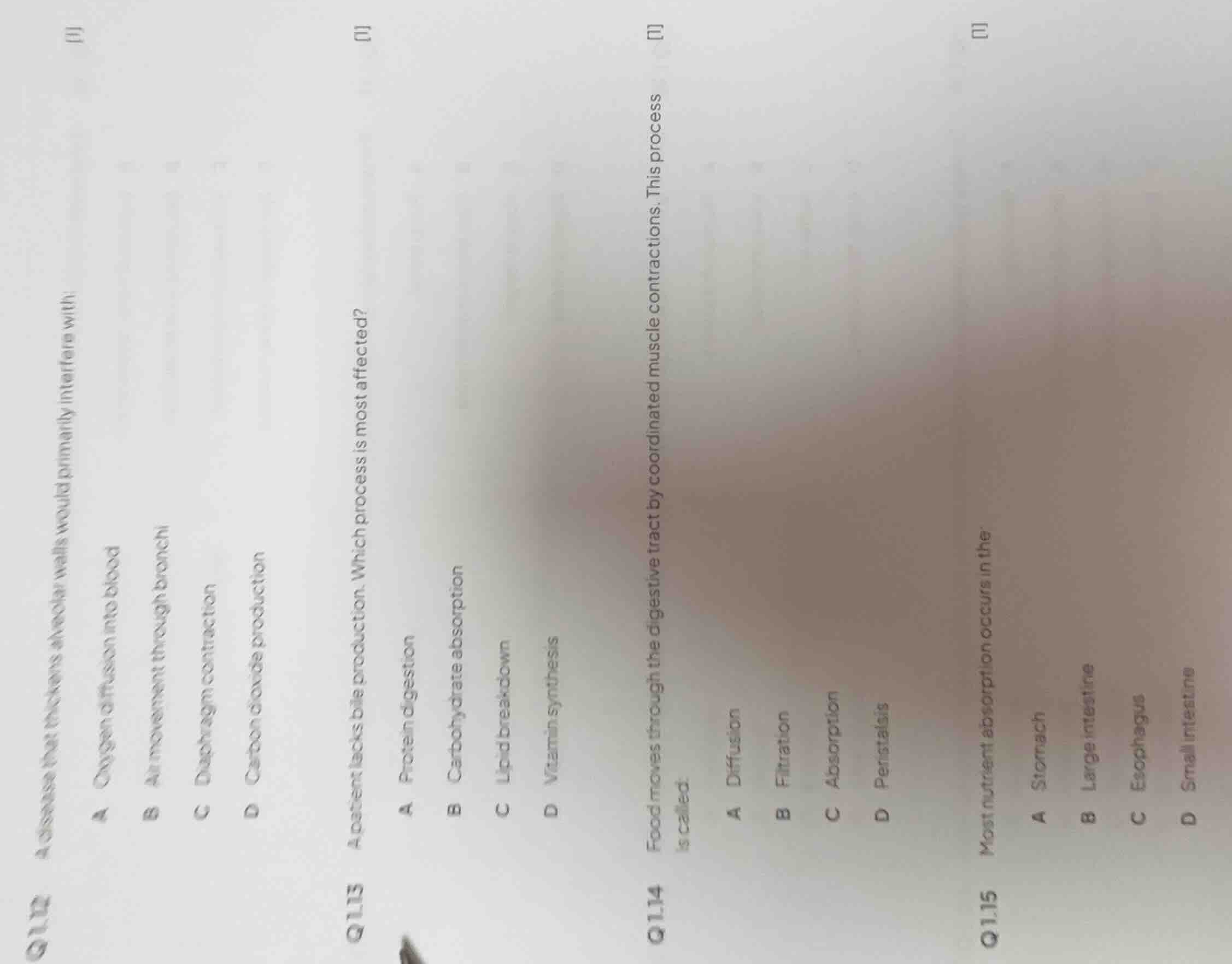
q1.12 a disease that thickens alveolar walls would primarily interfere with:
a oxygen diffusion into blood
b air movement through bronchi
c diaphragm contraction
d carbon dioxide production
q1.13 a patient lacks bile production. which process is most affected?
a protein digestion
b carbohydrate absorption
c lipid breakdown
d vitamin synthesis
q1.14 food moves through the digestive tract by coordinated muscle contractions. this process is called:
a diffusion
b filtration
c absorption
d peristalsis
q1.15 most nutrient absorption occurs in the:
a stomach
b large intestine
c esophagus
d small intestine
Analyze Q1.12: Alveolar wall thickening
Alveoli are the sites of gas exchange in the lungs. Thickening of their walls increases the diffusion distance, which primarily hinders the diffusion of oxygen from the air into the blood.
Analyze Q1.13: Lack of bile production
Bile is produced by the liver and stored in the gallbladder. Its primary function is to emulsify lipids (fats), breaking them down into smaller droplets to facilitate chemical digestion by enzymes. Therefore, a lack of bile most directly affects lipid breakdown.
Analyze Q1.14: Coordinated muscle contractions in the digestive tract
The wave-like, coordinated muscular contractions that move food through the digestive tract are known as peristalsis.
Analyze Q1.15: Site of most nutrient absorption
The majority of chemical digestion and almost all nutrient absorption occur in the small intestine, which is highly adapted for this function with its villi and microvilli.

Snap & solve any problem in the app
Get step-by-step solutions on Sovi AI
Photo-based solutions with guided steps
Explore more problems and detailed explanations
Question 1.12
- A Oxygen diffusion into blood (Correct answer)
- B Air movement through bronchi
- C Diaphragm contraction
- D Carbon dioxide production
Question 1.13
- A Protein digestion
- B Carbohydrate absorption
- C Lipid breakdown (Correct answer)
- D Vitamin synthesis
Question 1.14
- A Diffusion
- B Filtration
- C Absorption
- D Peristalsis (Correct answer)
Question 1.15
- A Stomach
- B Large intestine
- C Esophagus
- D Small intestine (Correct answer)