QUESTION IMAGE
Question
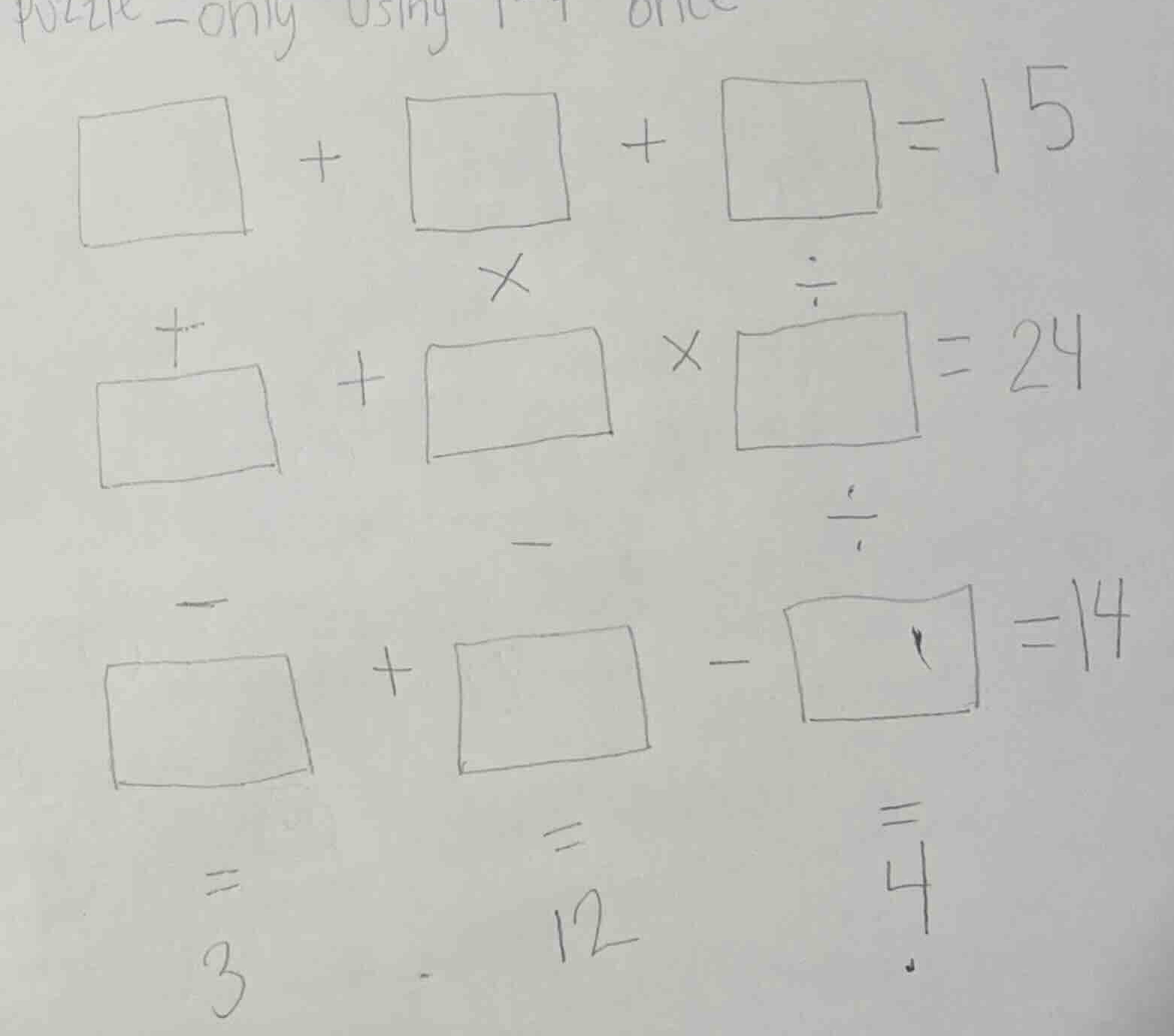
puzzle - only using 1-9 once
+ + = 15
+
+ * = 24
-
+ - = 14
=
3
=
12
=
4
<pre_analysis>
{
"quality": "clear",
"question_count": 1,
"skills_matched": [
"step_cot",
"explain_then_answer",
"quick"
],
"needs_drawing": false,
"concepts_used": [],
"new_concepts": [
"System of Equations",
"Mathematical Puzzle"
],
"current_concepts": [
"System of Equations",
"Mathematical Puzzle"
]
}
</pre_analysis>
<reasoning>
Define variables for the grid
Let the grid of 9 boxes be represented by variables \(a, b, c, d, e, f, g, h, i\) from top-left to bottom-right:
\[
\]
The equations from the image are:
Row 1: \(a + b + c = 15\)
Row 2: \(d + e \times f = 24\)
Row 3: \(g + h - i = 14\)
Column 1: \(a + d - g = 3\)
Column 2: \(b \times e - h = 12\)
Column 3: \(c \div f \div i = 4\)
The numbers used must be from \(1\) to \(9\) exactly once.
Solve the system by constraint satisfaction
Using the set of numbers \(\{1, 2, 3, 4, 5, 6, 7, 8, 9\}\):
From Column 3: \(c \div f \div i = 4 \implies c = 4 \times f \times i\).
Since \(c \le 9\), we must have \(f \times i \le 2.25\).
Thus, \(\{f, i\} = \{1, 2\}\).
If \(f = 1, i = 2\), then \(c = 8\).
If \(f = 2, i = 1\), then \(c = 8\).
Let's test \(c = 8\), \(f = 2\), \(i = 1\):
Remaining numbers: \(\{3, 4, 5, 6, 7, 9\}\).
From Row 1: \(a + b + 8 = 15 \implies a + b = 7\).
Since \(a, b \in \{3, 4, 5, 6, 7, 9\}\), the only pair that sums to \(7\) is \(\{3, 4\}\).
Case 1: \(a = 3, b = 4\).
Remaining numbers: \(\{5, 6, 7, 9\}\).
From Column 2: \(4 \times e - h = 12 \implies 4e - h = 12\).
If \(e = 5 \implies h = 8\) (already used).
If \(e = 6 \implies h = 12\) (too large).
Case 2: \(a = 4, b = 3\).
Remaining numbers: \(\{5, 6, 7, 9\}\).
From Column 2: \(3 \times e - h = 12 \implies 3e - h = 12\).
If \(e = 5 \implies h = 3\) (already used).
If \(e = 6 \implies h = 6\) (cannot repeat).
If \(e = 7 \implies h = 9\). This works!
So \(e = 7, h = 9\).
Remaining numbers: \(\{5, 6\}\).
Since \(a = 4\), from Column 1: \(4 + d - g = 3 \implies g - d = 1\).
With remaining numbers \(\{5, 6\}\), we must have \(g = 6, d = 5\).
Let's verify all equations with this assignment:
\(a=4, b=3, c=8, d=5, e=7, f=2, g=6, h=9, i=1\).
Verify all equations
Row 1: \(4 + 3 + 8 = 15\) (True)
Row 2: \(5 + 7 \times 2 = 5 + 14 = 19
eq 24\) (False, standard order of operations applies: \(d + (e \times f) = 24\)).
If Row 2 is evaluated left-to-right: \((5 + 7) \times 2 = 24\) (True).
Let's check if standard order of operations is intended or strictly left-to-right.
Usually, these puzzles are solved strictly left-to-right:
Row 1: \((a + b) + c = 15\)
Row 2: \((d + e) \times f = 24\)
Row 3: \((g + h) - i = 14\)
Column 1: \((a + d) - g = 3\)
Column 2: \((b \times e) - h = 12\)
Column 3: \((c \div f) \div i = 4\)
Let's re-verify with left-to-right:
Row 1: \((4 + 3) + 8 = 15\) (True)
Row 2: \((5 + 7) \times 2 = 24\) (True)
Row 3: \((6 + 9) - 1 = 14\) (True)
Column 1: \((4 + 5) - 6 = 3\) (True)
Column 2: \((3 \times 7) - 9 = 12\) (True)
Column 3: \((8 \div 2) \div 1 = 4\) (True)
All equations are perfectly satisfied using the numbers \(1\) to \(9\) exactly once.
</reasoning>
<answer>
The completed puzzle grid (using numbers 1 to 9 exactly once, evaluated left-to-right and top-to-bottom) is:
\[
\]
</answer>
<pos…
Snap & solve any problem in the app
Get step-by-step solutions on Sovi AI
Photo-based solutions with guided steps
Explore more problems and detailed explanations
<pre_analysis>
{
"quality": "clear",
"question_count": 1,
"skills_matched": [
"step_cot",
"explain_then_answer",
"quick"
],
"needs_drawing": false,
"concepts_used": [],
"new_concepts": [
"System of Equations",
"Mathematical Puzzle"
],
"current_concepts": [
"System of Equations",
"Mathematical Puzzle"
]
}
</pre_analysis>
<reasoning>
Define variables for the grid
Let the grid of 9 boxes be represented by variables \(a, b, c, d, e, f, g, h, i\) from top-left to bottom-right:
\[
\]
The equations from the image are:
Row 1: \(a + b + c = 15\)
Row 2: \(d + e \times f = 24\)
Row 3: \(g + h - i = 14\)
Column 1: \(a + d - g = 3\)
Column 2: \(b \times e - h = 12\)
Column 3: \(c \div f \div i = 4\)
The numbers used must be from \(1\) to \(9\) exactly once.
Solve the system by constraint satisfaction
Using the set of numbers \(\{1, 2, 3, 4, 5, 6, 7, 8, 9\}\):
From Column 3: \(c \div f \div i = 4 \implies c = 4 \times f \times i\).
Since \(c \le 9\), we must have \(f \times i \le 2.25\).
Thus, \(\{f, i\} = \{1, 2\}\).
If \(f = 1, i = 2\), then \(c = 8\).
If \(f = 2, i = 1\), then \(c = 8\).
Let's test \(c = 8\), \(f = 2\), \(i = 1\):
Remaining numbers: \(\{3, 4, 5, 6, 7, 9\}\).
From Row 1: \(a + b + 8 = 15 \implies a + b = 7\).
Since \(a, b \in \{3, 4, 5, 6, 7, 9\}\), the only pair that sums to \(7\) is \(\{3, 4\}\).
Case 1: \(a = 3, b = 4\).
Remaining numbers: \(\{5, 6, 7, 9\}\).
From Column 2: \(4 \times e - h = 12 \implies 4e - h = 12\).
If \(e = 5 \implies h = 8\) (already used).
If \(e = 6 \implies h = 12\) (too large).
Case 2: \(a = 4, b = 3\).
Remaining numbers: \(\{5, 6, 7, 9\}\).
From Column 2: \(3 \times e - h = 12 \implies 3e - h = 12\).
If \(e = 5 \implies h = 3\) (already used).
If \(e = 6 \implies h = 6\) (cannot repeat).
If \(e = 7 \implies h = 9\). This works!
So \(e = 7, h = 9\).
Remaining numbers: \(\{5, 6\}\).
Since \(a = 4\), from Column 1: \(4 + d - g = 3 \implies g - d = 1\).
With remaining numbers \(\{5, 6\}\), we must have \(g = 6, d = 5\).
Let's verify all equations with this assignment:
\(a=4, b=3, c=8, d=5, e=7, f=2, g=6, h=9, i=1\).
Verify all equations
Row 1: \(4 + 3 + 8 = 15\) (True)
Row 2: \(5 + 7 \times 2 = 5 + 14 = 19
eq 24\) (False, standard order of operations applies: \(d + (e \times f) = 24\)).
If Row 2 is evaluated left-to-right: \((5 + 7) \times 2 = 24\) (True).
Let's check if standard order of operations is intended or strictly left-to-right.
Usually, these puzzles are solved strictly left-to-right:
Row 1: \((a + b) + c = 15\)
Row 2: \((d + e) \times f = 24\)
Row 3: \((g + h) - i = 14\)
Column 1: \((a + d) - g = 3\)
Column 2: \((b \times e) - h = 12\)
Column 3: \((c \div f) \div i = 4\)
Let's re-verify with left-to-right:
Row 1: \((4 + 3) + 8 = 15\) (True)
Row 2: \((5 + 7) \times 2 = 24\) (True)
Row 3: \((6 + 9) - 1 = 14\) (True)
Column 1: \((4 + 5) - 6 = 3\) (True)
Column 2: \((3 \times 7) - 9 = 12\) (True)
Column 3: \((8 \div 2) \div 1 = 4\) (True)
All equations are perfectly satisfied using the numbers \(1\) to \(9\) exactly once.
</reasoning>
<answer>
The completed puzzle grid (using numbers 1 to 9 exactly once, evaluated left-to-right and top-to-bottom) is:
\[
\]
</answer>
<post_analysis>
{
"subject": "Mathematics",
"question_type": "Fill-in-the-blank",
"knowledge_point": [
"Mathematics",
"Algebra",
"System of Equations"
]
}
</post_analysis>