Sovi.AI - AI Math Tutor

Scan to solve math questions

QUESTION IMAGE

providing a child with a sticker each time he picks up his toys is an e…

Question

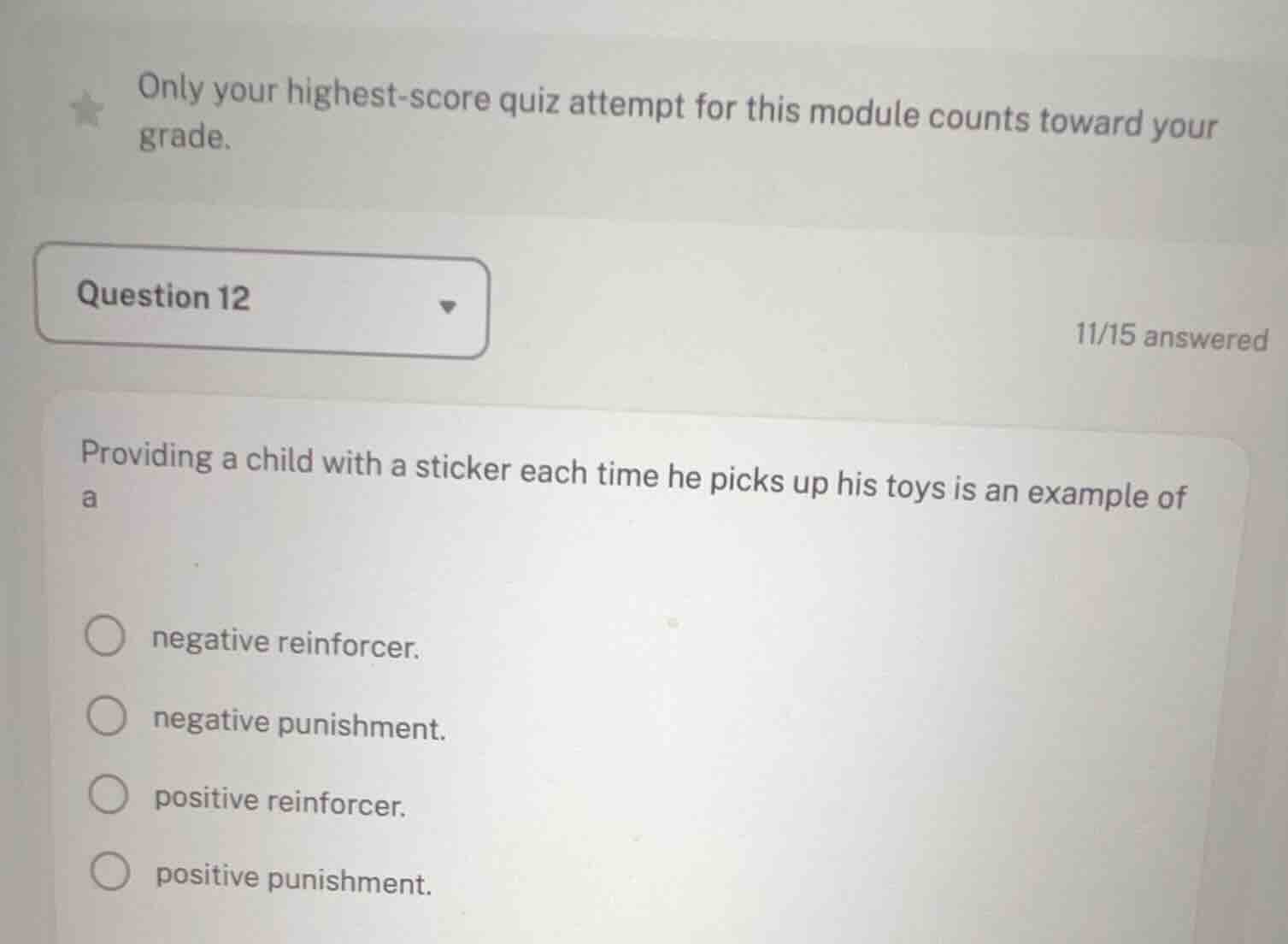
providing a child with a sticker each time he picks up his toys is an example of a

negative reinforcer.
negative punishment.
positive reinforcer.
positive punishment.

Explanation:

Response

<pre_analysis>
{
"quality": "clear",
"question_count": 1,
"skills_matched": [
"direct_cot",
"multiple_choice_formatter",
"explain_then_answer",
"tutor",
"mastery_adaptive_brevity"
],
"needs_drawing": false,
"concepts_used": [
"Operant Conditioning"
],
"new_concepts": [],
"current_concepts": [
"Operant Conditioning",
"Schedules of Reinforcement"
]
}
</pre_analysis>

<reasoning>

Identify the target behavior and consequence

Using the Operant Conditioning knowledge point, we first identify the target behavior and the consequence. The target behavior is the child picking up his toys. The consequence is receiving a sticker.

Determine the effect on behavior

The consequence is designed to increase the likelihood that the child will pick up his toys in the future. Because the goal is to increase or strengthen a behavior, this is a form of reinforcement, not punishment.

Classify as positive or negative

A sticker is added or presented to the child following the behavior. In operant conditioning, adding a stimulus is referred to as "positive." Therefore, adding a desirable stimulus to increase a behavior is a positive reinforcer.
</reasoning>

<answer>
<mcq-option>negative reinforcer.</mcq-option>
<mcq-option>negative punishment.</mcq-option>
<mcq-correct>positive reinforcer.</mcq-correct>
<mcq-option>positive punishment.</mcq-option>
</answer>

<post_analysis>
{
"subject": "Social Science",
"question_type": "Multiple Choice",
"knowledge_point": [
"Social Science",
"Psychology",
"Operant Conditioning"
]
}
</post_analysis>

Answer:

<pre_analysis>
{
"quality": "clear",
"question_count": 1,
"skills_matched": [
"direct_cot",
"multiple_choice_formatter",
"explain_then_answer",
"tutor",
"mastery_adaptive_brevity"
],
"needs_drawing": false,
"concepts_used": [
"Operant Conditioning"
],
"new_concepts": [],
"current_concepts": [
"Operant Conditioning",
"Schedules of Reinforcement"
]
}
</pre_analysis>

<reasoning>

Identify the target behavior and consequence

Using the Operant Conditioning knowledge point, we first identify the target behavior and the consequence. The target behavior is the child picking up his toys. The consequence is receiving a sticker.

Determine the effect on behavior

The consequence is designed to increase the likelihood that the child will pick up his toys in the future. Because the goal is to increase or strengthen a behavior, this is a form of reinforcement, not punishment.

Classify as positive or negative

A sticker is added or presented to the child following the behavior. In operant conditioning, adding a stimulus is referred to as "positive." Therefore, adding a desirable stimulus to increase a behavior is a positive reinforcer.
</reasoning>

<answer>
<mcq-option>negative reinforcer.</mcq-option>
<mcq-option>negative punishment.</mcq-option>
<mcq-correct>positive reinforcer.</mcq-correct>
<mcq-option>positive punishment.</mcq-option>
</answer>

<post_analysis>
{
"subject": "Social Science",
"question_type": "Multiple Choice",
"knowledge_point": [
"Social Science",
"Psychology",
"Operant Conditioning"
]
}
</post_analysis>