QUESTION IMAGE
Question
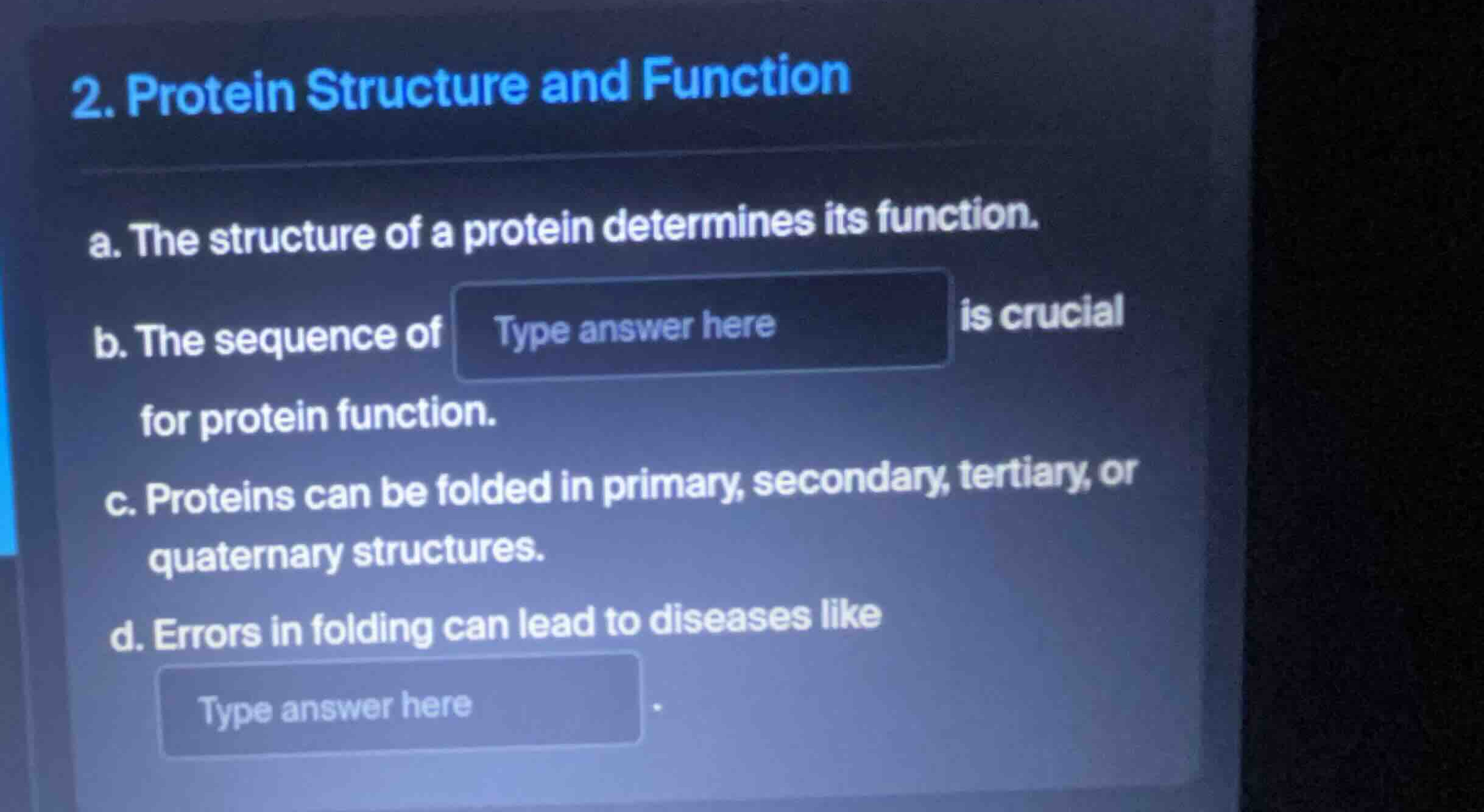
- protein structure and function
a. the structure of a protein determines its function.
b. the sequence of type answer here is crucial for protein function.
c. proteins can be folded in primary, secondary, tertiary, or quaternary structures.
d. errors in folding can lead to diseases like type answer here.
Identify the first blank
The prompt in part (b) states: "The sequence of [blank] is crucial for protein function."
Proteins are polymers made up of monomer subunits.
The specific sequence of these monomers determines how the protein folds into its three-dimensional shape.
These monomer subunits are amino acids.
Therefore, the sequence of amino acids is crucial for protein function.
Identify the second blank
The prompt in part (d) states: "Errors in folding can lead to diseases like [blank]."
When proteins fail to fold into their correct three-dimensional shapes, they can malfunction or aggregate.
Common neurodegenerative diseases associated with protein misfolding include Alzheimer's disease, Parkinson's disease, Huntington's disease, and Creutzfeldt-Jakob disease (prion diseases).
Another classic genetic disease caused by protein misfolding/aggregation is sickle cell anemia or cystic fibrosis.
Alzheimer's disease is the most widely cited introductory example of a protein misfolding disease in high school biology.
Therefore, "Alzheimer's disease" (or "Alzheimer's") fits the blank perfectly.

Snap & solve any problem in the app
Get step-by-step solutions on Sovi AI
Photo-based solutions with guided steps
Explore more problems and detailed explanations
Question 1
b. The sequence of <blank>amino acids</blank> is crucial for protein function.
Question 2
d. Errors in folding can lead to diseases like <blank>Alzheimer's disease</blank>.