QUESTION IMAGE
Question
prompt
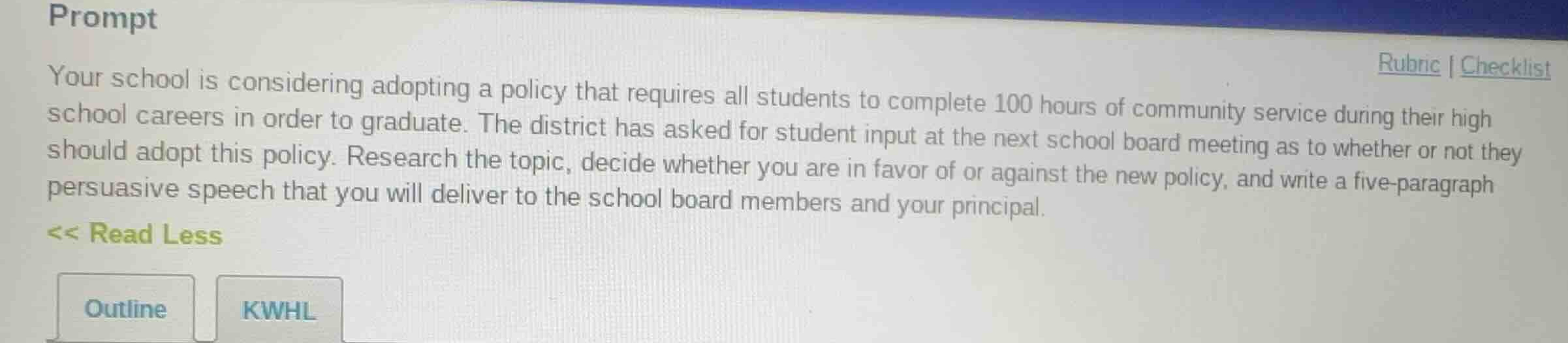
your school is considering adopting a policy that requires all students to complete 100 hours of community service during their high school careers in order to graduate. the district has asked for student input at the next school board meeting as to whether or not they should adopt this policy. research the topic, decide whether you are in favor of or against the new policy, and write a five-paragraph persuasive speech that you will deliver to the school board members and your principal.
Analyze the prompt requirements
The task requires writing a five-paragraph persuasive speech addressed to the school board and principal regarding a proposed policy: requiring 100 hours of community service for high school graduation. The speech must take a clear stance (in favor or against) and present structured arguments.
Outline the five-paragraph speech structure
- Paragraph 1: Introduction. Hook the audience, introduce the policy, and state a clear thesis (against the mandatory policy).
- Paragraph 2: First Body Paragraph. Argue that mandatory service places an unfair logistical and financial burden on busy or low-income students.
- Paragraph 3: Second Body Paragraph. Argue that forcing volunteerism undermines the genuine spirit of community service, turning a positive value into a resentful chore.
- Paragraph 4: Third Body Paragraph. Propose an alternative solution, such as offering elective credits or integrating service-learning into existing classes.
- Paragraph 5: Conclusion. Summarize the main arguments, restate the thesis in a new way, and end with a memorable call to action.
Draft the persuasive speech
Draft a concise, high-impact speech following the outline to fit the quick mode delivery.

Snap & solve any problem in the app
Get step-by-step solutions on Sovi AI
Photo-based solutions with guided steps
Explore more problems and detailed explanations
Title: Choice, Not Coercion: Why Mandatory Community Service Fails Our Students
Good evening, members of the school board and Principal. My name is [Your Name], and I stand before you today to address the proposed policy requiring 100 hours of community service for high school graduation. While the intention to foster civic responsibility is admirable, making community service a mandatory requirement for graduation is a counterproductive approach. This policy places an inequitable burden on students, diminishes the intrinsic value of volunteering, and overlooks more constructive ways to encourage civic engagement. Therefore, I urge the board to reject this mandate.
First, a mandatory service requirement ignores the diverse and often challenging realities of our student body. Many students already balance rigorous academic schedules with part-time jobs to support their families, while others have significant caretaking responsibilities at home. Forcing these students to find and complete 100 hours of unpaid service outside of school hours creates an unfair barrier to graduation. Instead of leveling the playing field, this policy disproportionately penalizes students from low-income backgrounds who lack the free time, transportation, or resources to easily secure volunteer placements.
Second, mandating volunteerism is a contradiction in terms that strips community service of its moral value. True service stems from empathy and a personal desire to help others. When the school district transforms charity into a compulsory graduation requirement, volunteering becomes just another box to check, fostering resentment rather than genuine civic pride. Research shows that forced volunteerism can actually decrease a student's likelihood of volunteering in adulthood. If we want to cultivate lifelong helpers, we must inspire them to serve, not coerce them under the threat of withholding their diplomas.
Rather than imposing a rigid mandate, our school should focus on integrating service-learning into the existing curriculum and offering positive incentives. We can establish elective courses dedicated to community engagement, organize school-sponsored volunteer days, or offer special graduation honors for students who voluntarily complete service hours. By providing structured opportunities within the school day, we can make community service accessible to all students without turning it into a stressful, high-stakes requirement.
In conclusion, requiring 100 hours of community service for graduation is a well-meaning but flawed policy that burdens busy students and devalues the spirit of giving. We should strive to build a culture of voluntary service driven by passion, not a system of forced labor driven by fear of graduation failure. I ask the school board to vote against this mandate and instead collaborate with students to design programs that inspire genuine, voluntary engagement. Thank you for your time and consideration.