QUESTION IMAGE
Question
prokaryotic and eukaryotic cells
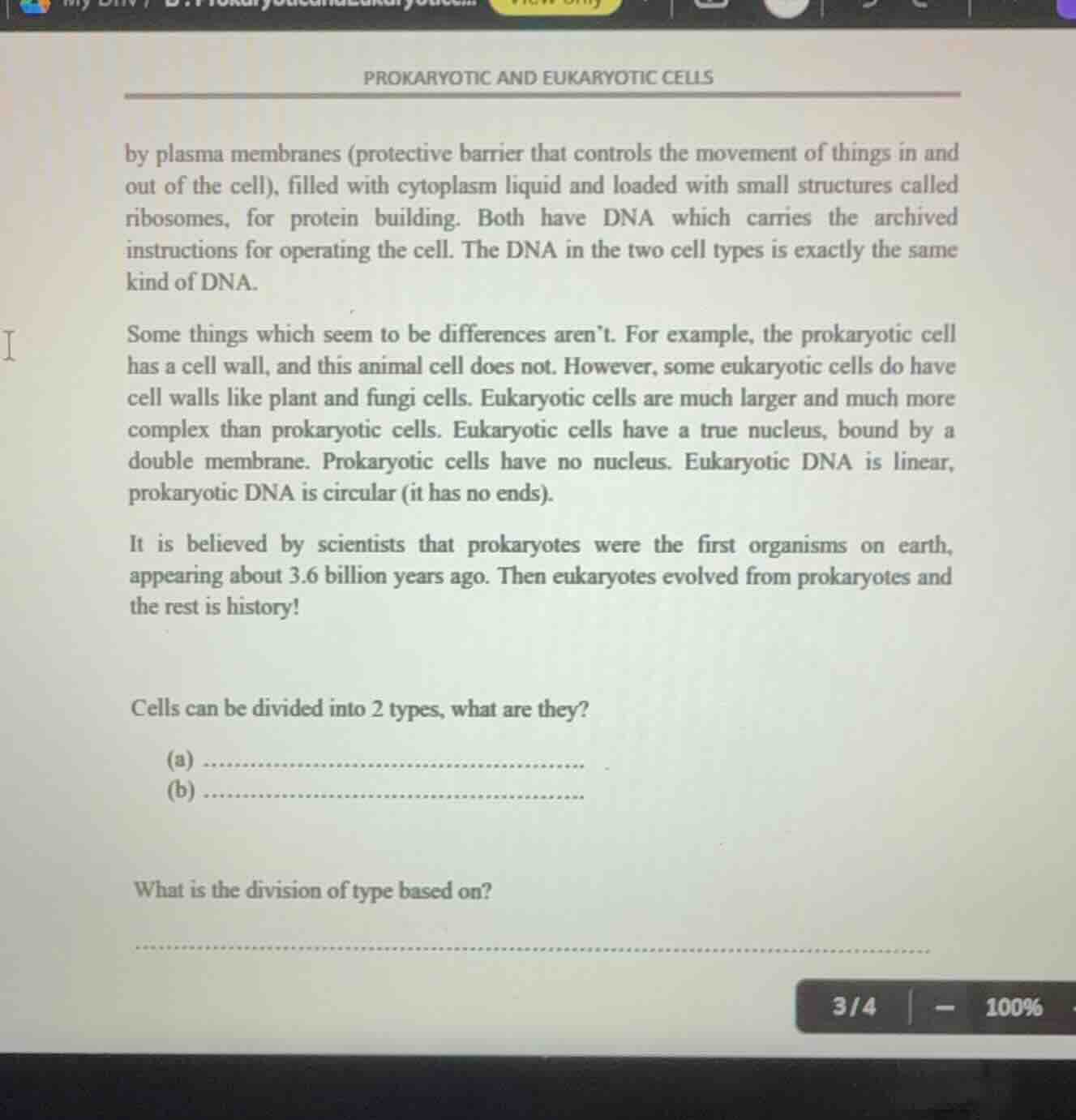
by plasma membranes (protective barrier that controls the movement of things in and out of the cell), filled with cytoplasm liquid and loaded with small structures called ribosomes, for protein building. both have dna which carries the archived instructions for operating the cell. the dna in the two cell types is exactly the same kind of dna.
some things which seem to be differences arent. for example, the prokaryotic cell has a cell wall, and this animal cell does not. however, some eukaryotic cells do have cell walls like plant and fungi cells. eukaryotic cells are much larger and much more complex than prokaryotic cells. eukaryotic cells have a true nucleus, bound by a double membrane. prokaryotic cells have no nucleus. eukaryotic dna is linear, prokaryotic dna is circular (it has no ends).
it is believed by scientists that prokaryotes were the first organisms on earth, appearing about 3.6 billion years ago. then eukaryotes evolved from prokaryotes and the rest is history!
cells can be divided into 2 types, what are they?
(a) .................................................................
(b) .................................................................
what is the division of type based on?
.....................................................................
Identify the two cell types
The text title and body discuss prokaryotic and eukaryotic cells.
These are the two primary divisions of cells.
Determine the basis of division
The text highlights a major structural difference.
Eukaryotic cells have a true nucleus bound by a double membrane.
Prokaryotic cells have no nucleus.
Therefore, the division is based on the presence of a nucleus.

Snap & solve any problem in the app
Get step-by-step solutions on Sovi AI
Photo-based solutions with guided steps
Explore more problems and detailed explanations
Question 1
Cells can be divided into 2 types, what are they?
(a) <blank>Prokaryotic cells</blank>
(b) <blank>Eukaryotic cells</blank>
Question 2
What is the division of type based on?
<blank>The presence or absence of a nucleus (or a true nucleus bound by a double membrane).</blank>