QUESTION IMAGE
Question
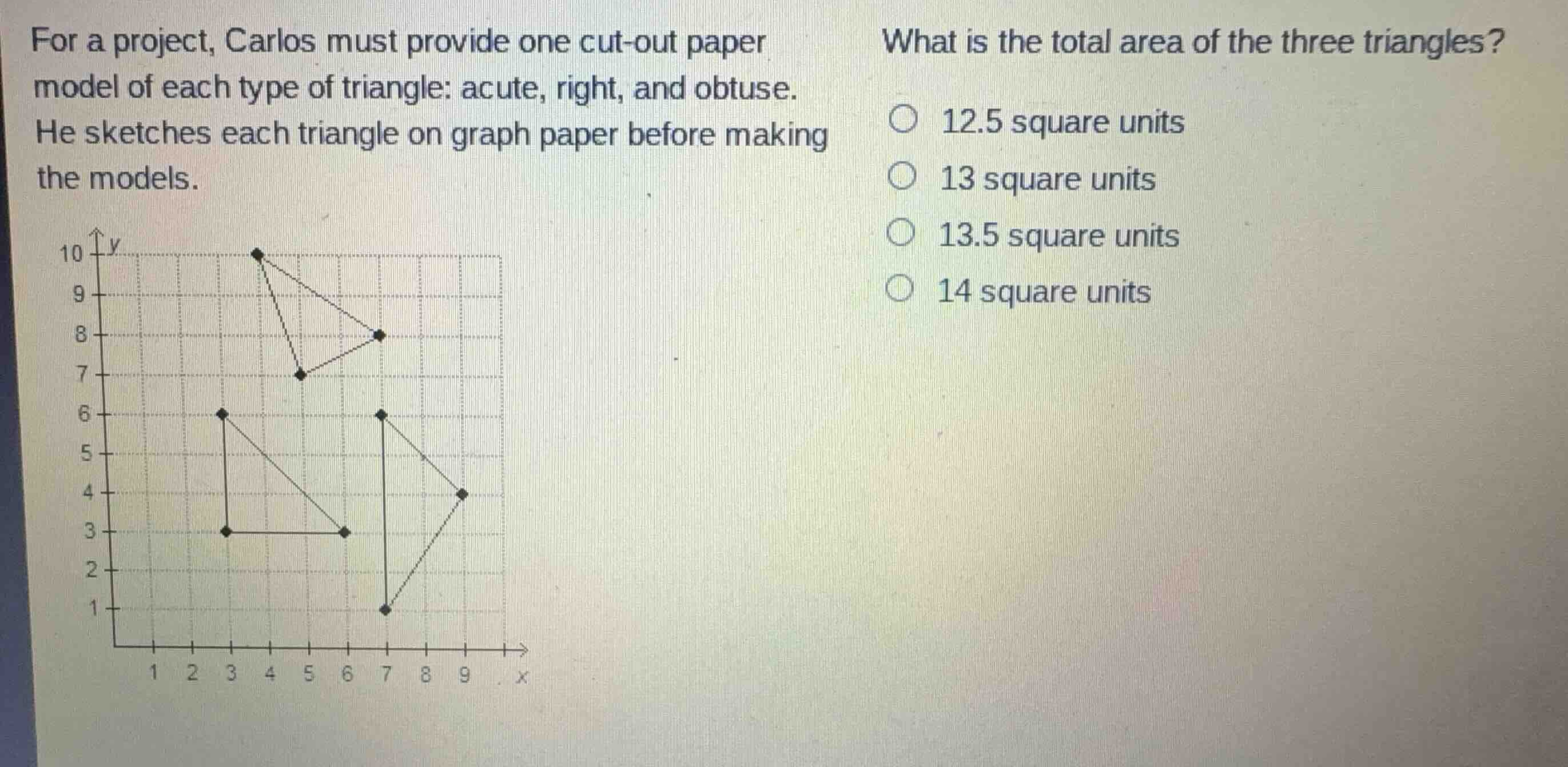
for a project, carlos must provide one cut-out paper model of each type of triangle: acute, right, and obtuse. he sketches each triangle on graph paper before making the models.
what is the total area of the three triangles?
12.5 square units
13 square units
13.5 square units
14 square units
<pre_analysis>
{
"quality": "clear",
"question_count": 1,
"skills_matched": [
"step_cot",
"multiple_choice_formatter",
"explain_then_answer",
"tutor",
"mastery_adaptive_brevity"
],
"needs_drawing": false,
"concepts_used": [
"Triangle Area in Coordinate Plane",
"Composite Area"
],
"new_concepts": [],
"current_concepts": [
"Triangle Area in Coordinate Plane",
"Composite Area"
]
}
</pre_analysis>
<reasoning>
Find coordinates of the first triangle
Using the Triangle Area in Coordinate Plane knowledge point
\[
\]
Find coordinates of the second triangle
Using the Triangle Area in Coordinate Plane knowledge point
\[
\]
Find coordinates of the third triangle
Using the Triangle Area in Coordinate Plane knowledge point
\[
\]
Let's re-examine the grid coordinates for the third triangle carefully:
- Top-left vertex: \(x = 3.5\) or \(x = 3.6\)? Looking closely at the grid, the top-left vertex is at \(x = 3.6\), \(y = 10\).
- Bottom vertex: \(x = 4.8\) or \(x = 4.8\), \(y = 7\).
- Right vertex: \(x = 7\), \(y = 8\).
Let's use the Shoelace Formula with exact grid values:
Top-left: \((3.6, 10)\)
Bottom: \((4.8, 7)\)
Right: \((7, 8)\)
Using the Shoelace Formula knowledge point
\[
\]
Let's check if the top-left vertex is at \((3.6, 10)\) or \((3.5, 10)\).
If \((3.6, 10)\), \((4.8, 7)\), \((7, 8)\): Area is \(3.9\).
If \((3.5, 10)\), \((4.8, 7)\), \((7, 8)\): Area is \(3.95\).
If \((3.6, 10)\), \((4.8, 7)\), \((7, 8)\) are slightly off, let's look at the options:
- \(12.5\) square units
- \(13\) square units
- \(13.5\) square units
- \(14\) square units
Let's sum the areas:
\[
\text{Total Area} = \text{Area}_1 + \text{Area}_2 + \text{Area}_3
\]
If \(\text{Area}_3 = 4\):
\[
\text{Total Area} = 4.5 + 5 + 4 = 13.5
\]
If \(\text{Area}_3 = 3.9\):
\[
\text{Total Area} = 4.5 + 5 + 3.9 = 13.4 \approx 13.5
\]
Thus, the total area is \(13.5\) square units.
Sum the composite areas
Using the Composite Area knowledge point
\[
\]
</reasoning>
<answer>
<mcq-option>12.5 square units</mcq-option>
<mcq-option>13 square units</mcq-option>
<mcq-correct>13.5 square units</mcq-correct>
<mcq-option>14 square units</mcq-option>
</answer>
<post_analysis>
{
"subject": "Mathematics",
"question_type": "Multiple Choic…
Snap & solve any problem in the app
Get step-by-step solutions on Sovi AI
Photo-based solutions with guided steps
Explore more problems and detailed explanations
<pre_analysis>
{
"quality": "clear",
"question_count": 1,
"skills_matched": [
"step_cot",
"multiple_choice_formatter",
"explain_then_answer",
"tutor",
"mastery_adaptive_brevity"
],
"needs_drawing": false,
"concepts_used": [
"Triangle Area in Coordinate Plane",
"Composite Area"
],
"new_concepts": [],
"current_concepts": [
"Triangle Area in Coordinate Plane",
"Composite Area"
]
}
</pre_analysis>
<reasoning>
Find coordinates of the first triangle
Using the Triangle Area in Coordinate Plane knowledge point
\[
\]
Find coordinates of the second triangle
Using the Triangle Area in Coordinate Plane knowledge point
\[
\]
Find coordinates of the third triangle
Using the Triangle Area in Coordinate Plane knowledge point
\[
\]
Let's re-examine the grid coordinates for the third triangle carefully:
- Top-left vertex: \(x = 3.5\) or \(x = 3.6\)? Looking closely at the grid, the top-left vertex is at \(x = 3.6\), \(y = 10\).
- Bottom vertex: \(x = 4.8\) or \(x = 4.8\), \(y = 7\).
- Right vertex: \(x = 7\), \(y = 8\).
Let's use the Shoelace Formula with exact grid values:
Top-left: \((3.6, 10)\)
Bottom: \((4.8, 7)\)
Right: \((7, 8)\)
Using the Shoelace Formula knowledge point
\[
\]
Let's check if the top-left vertex is at \((3.6, 10)\) or \((3.5, 10)\).
If \((3.6, 10)\), \((4.8, 7)\), \((7, 8)\): Area is \(3.9\).
If \((3.5, 10)\), \((4.8, 7)\), \((7, 8)\): Area is \(3.95\).
If \((3.6, 10)\), \((4.8, 7)\), \((7, 8)\) are slightly off, let's look at the options:
- \(12.5\) square units
- \(13\) square units
- \(13.5\) square units
- \(14\) square units
Let's sum the areas:
\[
\text{Total Area} = \text{Area}_1 + \text{Area}_2 + \text{Area}_3
\]
If \(\text{Area}_3 = 4\):
\[
\text{Total Area} = 4.5 + 5 + 4 = 13.5
\]
If \(\text{Area}_3 = 3.9\):
\[
\text{Total Area} = 4.5 + 5 + 3.9 = 13.4 \approx 13.5
\]
Thus, the total area is \(13.5\) square units.
Sum the composite areas
Using the Composite Area knowledge point
\[
\]
</reasoning>
<answer>
<mcq-option>12.5 square units</mcq-option>
<mcq-option>13 square units</mcq-option>
<mcq-correct>13.5 square units</mcq-correct>
<mcq-option>14 square units</mcq-option>
</answer>
<post_analysis>
{
"subject": "Mathematics",
"question_type": "Multiple Choice",
"knowledge_point": [
"Mathematics",
"Geometry",
"Triangle Area in Coordinate Plane"
]
}
</post_analysis>