QUESTION IMAGE
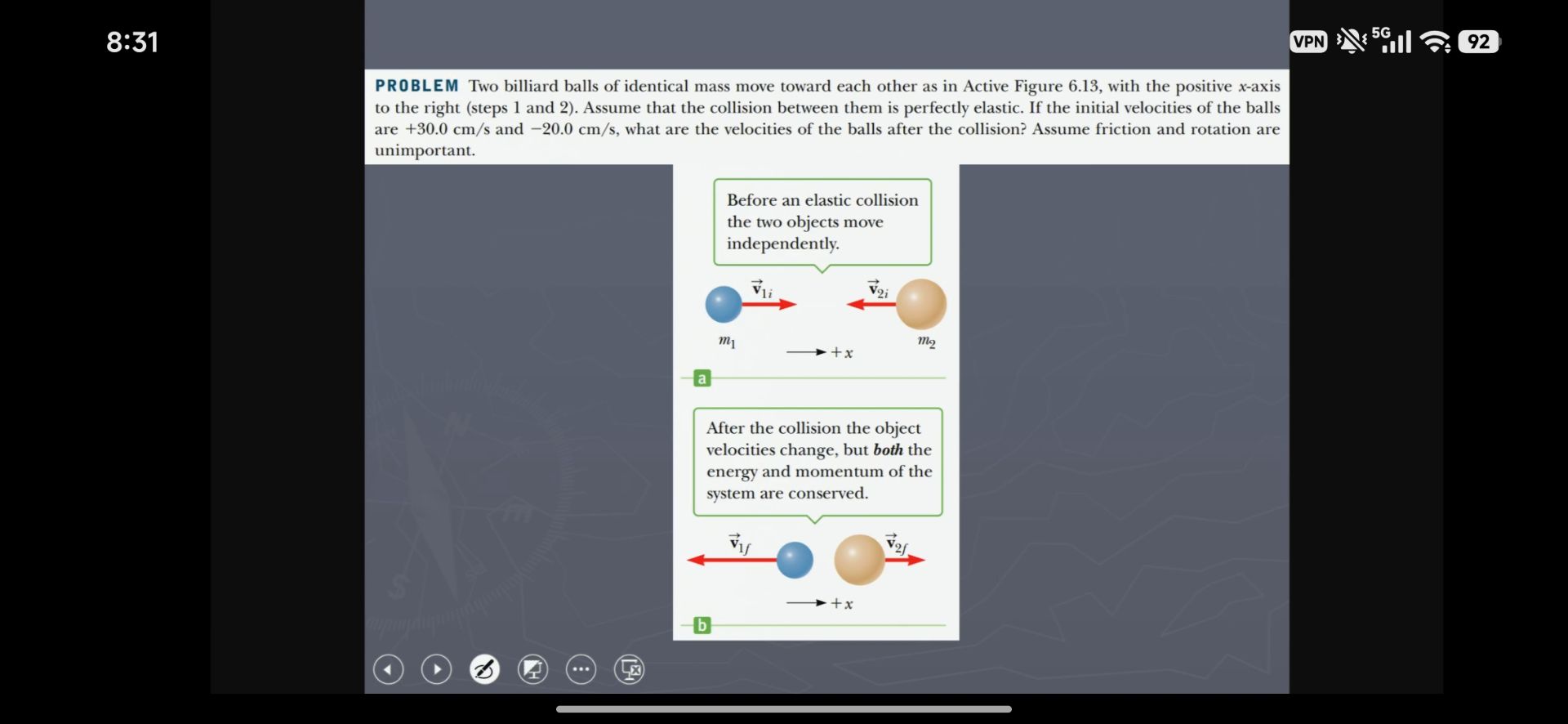
Question
problem two billiard balls of identical mass move toward each other as in active figure 6.13, with the positive \\(x\\)-axis to the right (steps 1 and 2). assume that the collision between them is perfectly elastic. if the initial velocities of the balls are \\(+30.0\text{ cm/s}\\) and \\(-20.0\text{ cm/s}\\), what are the velocities of the balls after the collision? assume friction and rotation are unimportant.
🆕 New Concept Discovered: Elastic Collisions
Objects bounce off each other, conserving momentum and kinetic energy.
Step 1: Identify given values and conservation laws
We have two billiard balls of identical mass, so \( m_1 = m_2 = m \).
The initial velocities are:
For any perfectly elastic collision, both total momentum and total kinetic energy are conserved.
Step 2: Apply momentum conservation
Because the masses are equal, the conservation of momentum equation simplifies significantly:
Since \( m_1 = m_2 = m \), we can divide the entire equation by \( m \):
Substitute the known initial values:
Step 3: Apply the relative velocity relation for elastic collisions
For a perfectly elastic head-on collision, the relative velocity of approach equals the relative velocity of separation:
Substitute the known initial values:
Step 4: Solve the system of equations
We have two linear equations:
- \( v_{1f} + v_{2f} = 10.0 \)
- \( -v_{1f} + v_{2f} = 50.0 \)
Add Equation 1 and Equation 2 together:
Now, substitute \( v_{2f} \) back into Equation 1 to find \( v_{1f} \):
Note: When two identical masses undergo a head-on elastic collision, they simply exchange their velocities.

Snap & solve any problem in the app
Get step-by-step solutions on Sovi AI
Photo-based solutions with guided steps
Explore more problems and detailed explanations
The velocities of the balls after the collision are:
- Ball 1: \(-20.0\text{ cm/s}\) (moving to the left)
- Ball 2: \(+30.0\text{ cm/s}\) (moving to the right)