QUESTION IMAGE
Question
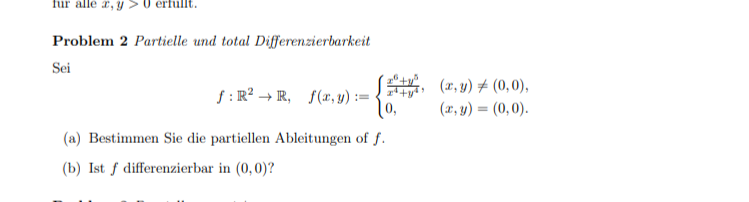
problem 2 partielle und total differenzierbarkeit
sei
\\ f : \mathbb{r}^2 \to \mathbb{r}, \quad f(x,y) := \
\\
(a) bestimmen sie die partiellen ableitungen of \\(f\\).
(b) ist \\(f\\) differenzierbar in \\((0,0)\\)?
🆕 New Concept Discovered: Total Differentiability
Checking if a multivariable function is locally linear at a point.
Step 1: Partial derivatives for \((x, y)
eq (0, 0)\)
For any point \((x, y)
eq (0, 0)\), we can find the partial derivatives using standard calculus rules (specifically, the quotient rule).
The function is:
For \(\frac{\partial f}{\partial x}\):
For \(\frac{\partial f}{\partial y}\):
---
Step 2: Partial derivatives at \((0, 0)\)
At the origin \((0, 0)\), we must use the limit definition of partial derivatives because the algebraic formula is piecewise-defined.
For \(\frac{\partial f}{\partial x}(0, 0)\):
Since \(f(h, 0) = \frac{h^6 + 0^5}{h^4 + 0^4} = \frac{h^6}{h^4} = h^2\) (for \(h
eq 0\)) and \(f(0, 0) = 0\):
For \(\frac{\partial f}{\partial y}(0, 0)\):
Since \(f(0, h) = \frac{0^6 + h^5}{0^4 + h^4} = \frac{h^5}{h^4} = h\) (for \(h
eq 0\)) and \(f(0, 0) = 0\):
---
Step 3: Testing total differentiability at \((0, 0)\)
A function \(f\) is totally differentiable at \((0, 0)\) if and only if the following limit is equal to \(0\):
Substituting our known values:
- \(f(0, 0) = 0\)
- \(\frac{\partial f}{\partial x}(0, 0) = 0\)
- \(\frac{\partial f}{\partial y}(0, 0) = 1\)
The expression inside the limit becomes:
Let's evaluate this limit along a specific path to see if it approaches \(0\). Let \(h = k\) with \(h > 0\):
Taking the limit as \(h \to 0^+\):
Since the limit along this path is not \(0\), the overall limit cannot be \(0\). Therefore, the function is not totally differentiable at \((0, 0)\).

Snap & solve any problem in the app
Get step-by-step solutions on Sovi AI
Photo-based solutions with guided steps
Explore more problems and detailed explanations
(a) Partial derivatives of \(f\):
For \((x, y)
eq (0, 0)\):
At \((0, 0)\):
(b) Differentiability at \((0, 0)\):
No, \(f\) is not differentiable at \((0, 0)\) because the limit:
along the path \(h = k > 0\) yields \(-\frac{1}{2\sqrt{2}}\), which is not equal to \(0\).