QUESTION IMAGE
Question
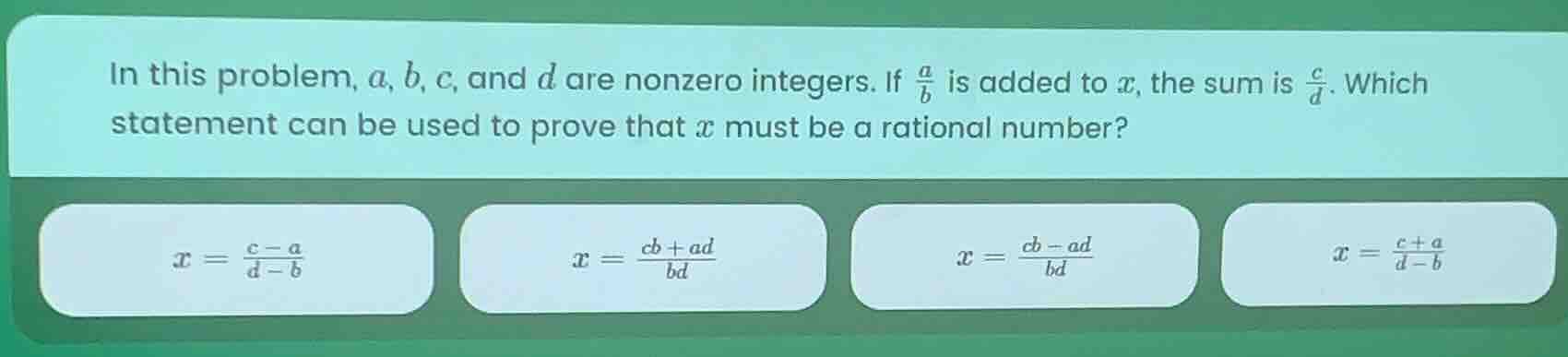
in this problem, (a), (b), (c), and (d) are nonzero integers. if (\frac{a}{b}) is added to (x), the sum is (\frac{c}{d}). which statement can be used to prove that (x) must be a rational number?
(x = \frac{c - a}{d - b})
(x = \frac{cb + ad}{bd})
(x = \frac{cb - ad}{bd})
(x = \frac{c + a}{d - b})
Step1: Start with the given equation
We know that \(\frac{a}{b}+x = \frac{c}{d}\), where \(a,b,c,d\) are non - zero integers. Our goal is to solve for \(x\) by isolating it on one side of the equation.
Step2: Subtract \(\frac{a}{b}\) from both sides
To solve for \(x\), we perform the operation \(x=\frac{c}{d}-\frac{a}{b}\).
Step3: Find a common denominator
The common denominator of \(d\) and \(b\) is \(bd\). So we rewrite the fractions with the common denominator: \(\frac{c}{d}=\frac{cb}{bd}\) and \(\frac{a}{b}=\frac{ad}{bd}\).
Step4: Subtract the two fractions
Now, \(x = \frac{cb}{bd}-\frac{ad}{bd}=\frac{cb - ad}{bd}\). Since \(a,b,c,d\) are non - zero integers, \(cb - ad\) and \(bd\) are also integers (the product and difference of integers are integers), and \(bd
eq0\) (because \(b\) and \(d\) are non - zero). A number that can be written as the ratio of two integers (where the denominator is non - zero) is a rational number. So the expression \(x=\frac{cb - ad}{bd}\) can be used to prove that \(x\) is rational.

Snap & solve any problem in the app
Get step-by-step solutions on Sovi AI
Photo-based solutions with guided steps
Explore more problems and detailed explanations
\(x = \frac{cb - ad}{bd}\) (the third option among the given options)