QUESTION IMAGE
Question
problem 21
\
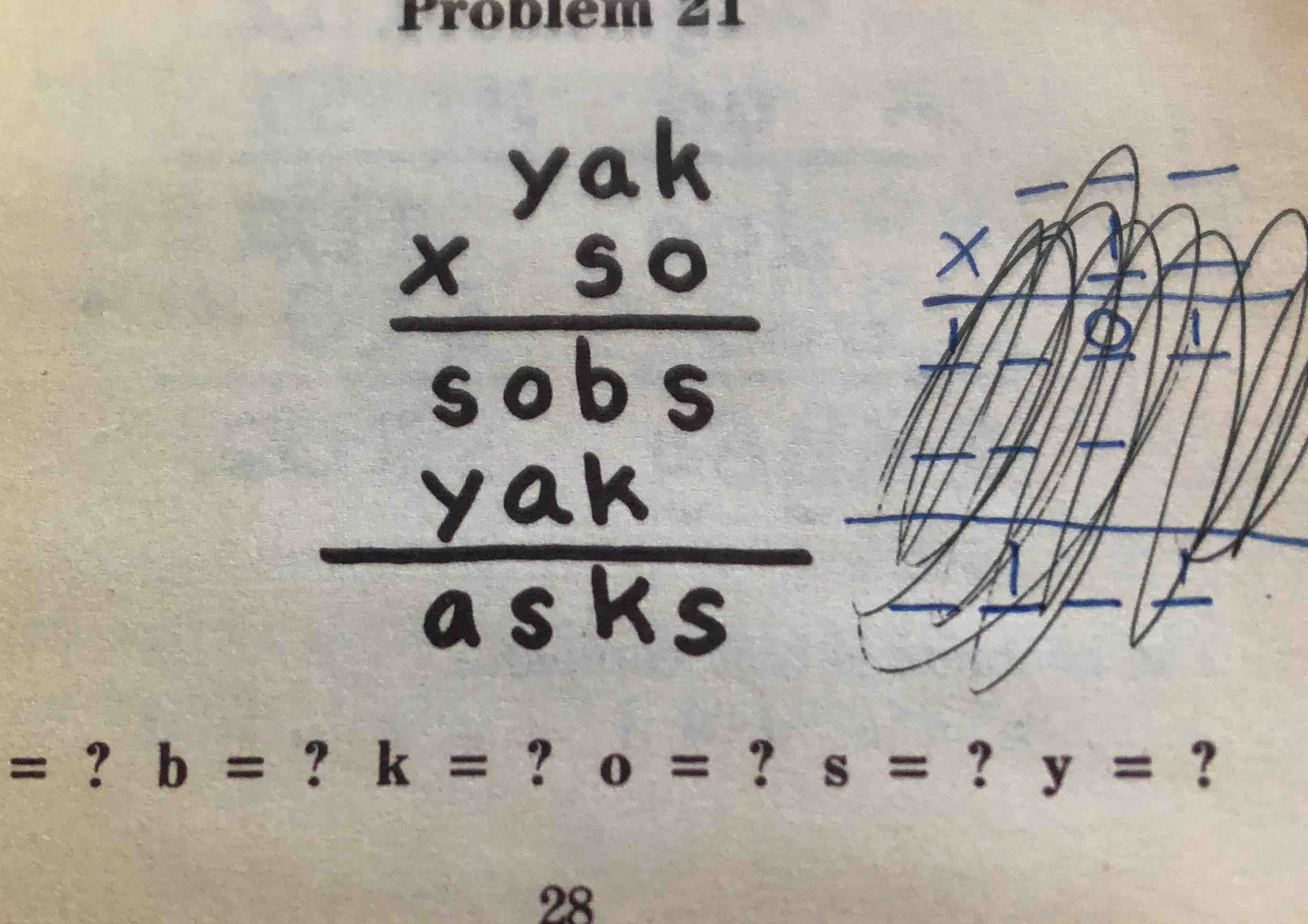
a = ? b = ? k = ? o = ? s = ? y = ?
Analyze the multiplication structure
The cryptarithm is:
This represents:
- \(\text{yak} \times \text{o} = \text{sobs}\)
- \(\text{yak} \times \text{s} = \text{yak} \implies \text{s} = 1\)
- \(\text{sobs} + 10 \times \text{yak} = \text{asks}\)
Determine values for s, o, and y
Since \(\text{yak} \times \text{s} = \text{yak}\) and \(\text{s}
eq 0\), we have:
Substituting \(\text{s} = 1\) into the equations:
- \(\text{yak} \times \text{o} = 1\text{ob}1\)
- \(1\text{ob}1 + 10 \times \text{yak} = \text{a}1\text{k}1\)
From the units digit of \(\text{yak} \times \text{o} = 1\text{ob}1\):
Thus, \(\{\text{k}, \text{o}\}\) must be chosen from the pairs \(\{1, 1\}\) (not possible since letters represent distinct digits and \(\text{s}=1\)), \(\{3, 7\}\), or \(\{9, 9\}\) (not possible).
So, \(\{\text{k}, \text{o}\} = \{3, 7\}\).
From the addition:
Looking at the tens column:
Looking at the hundreds column:
Since \(\text{yak} \times \text{o} = 1\text{ob}1\), and \(\text{b} = 0\), we have:
If \(\text{o} = 3\):
If \(\text{o} = 7\):
This gives \(\text{y} = 2\), \(\text{a} = 4\), \(\text{k} = 3\).
Verify the solution
Let's check all digits:
- \(\text{s} = 1\)
- \(\text{o} = 7\)
- \(\text{b} = 0\)
- \(\text{y} = 2\)
- \(\text{a} = 4\)
- \(\text{k} = 3\)
All digits \(\{0, 1, 2, 3, 4, 7\}\) are distinct.
Check multiplication:
Partial products:
- \(243 \times 7 = 1701\) (\(\text{sobs} = 1701\), matches \(\text{s}=1, \text{o}=7, \text{b}=0, \text{s}=1\))
- \(243 \times 1 = 243\) (\(\text{yak} = 243\))
- Sum: \(1701 + 2430 = 4131\) (\(\text{asks} = 4131\), matches \(\text{a}=4, \text{s}=1, \text{k}=3, \text{s}=1\))

Snap & solve any problem in the app
Get step-by-step solutions on Sovi AI
Photo-based solutions with guided steps
Explore more problems and detailed explanations
\(a = 4\), \(b = 0\), \(k = 3\), \(o = 7\), \(s = 1\), \(y = 2\)