QUESTION IMAGE
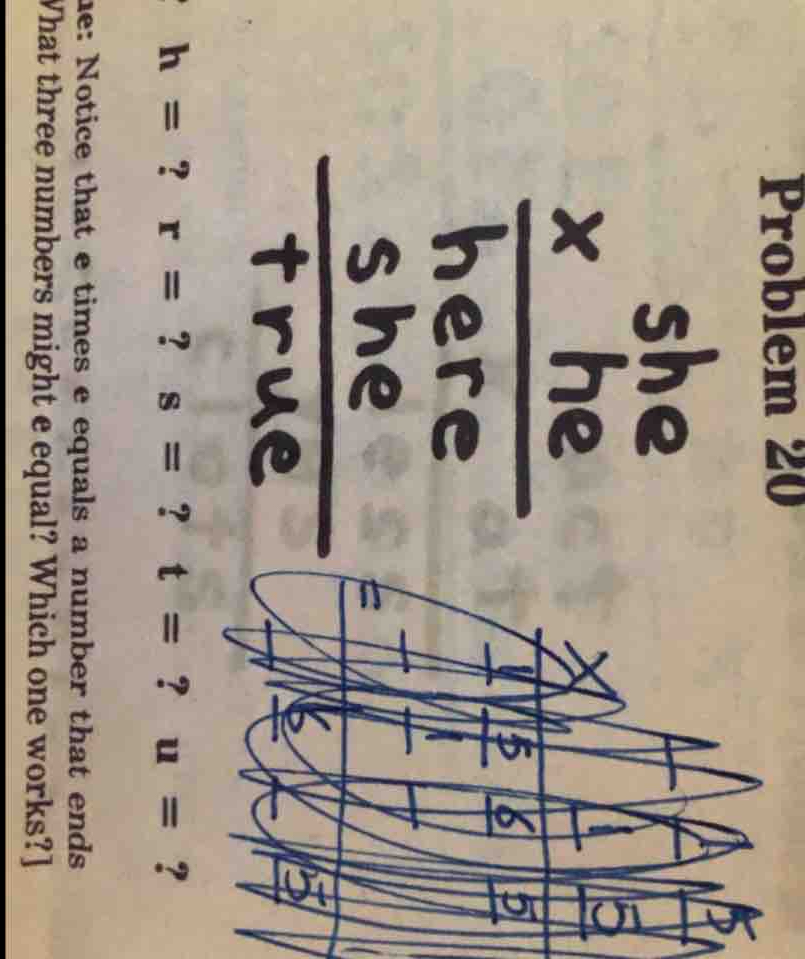
Question
problem 20
\
\text{e} = ? \quad \text{h} = ? \quad \text{r} = ? \quad \text{s} = ? \quad \text{t} = ? \quad \text{u} = ?
clue: notice that e times e equals a number that ends in e. what three numbers might e equal? which one works?
Analyze the cryptarithm structure
We are given the multiplication puzzle:
This represents the standard multiplication algorithm:
- \(\text{she} \times e = \text{here}\)
- \(\text{she} \times h = \text{she}\) (shifted by one position to the left)
- \(\text{here} + 10 \times \text{she} = \text{true}\)
Let's represent the letters as distinct digits from \(0\) to \(9\): \(s, h, e, r, t, u\).
Determine the value of \(h\)
From the second partial product:
Since \(\text{she}\) is a non-zero three-digit number, multiplying it by \(h\) yields itself.
Therefore, we must have:
Analyze the first partial product
Using \(h = 1\), the first partial product is:
Let's look at the units digit of this multiplication:
The single digits that satisfy \(e^2 \equiv e \pmod{10}\) are \(e \in \{0, 1, 5, 6\}\).
- Since \(h = 1\) and digits must be distinct, \(e
eq 1\).
- If \(e = 0\), then \(\text{s10} \times 0 = 0\), which does not equal the four-digit number \(\text{10r0}\). Thus, \(e
eq 0\).
Therefore, \(e\) must be either \(5\) or \(6\).
Test the case \(e = 5\)
If \(e = 5\), the multiplication is:
Let's expand this algebraically:
Divide by 10:
Since \(r\) is a single digit (\(0 \le r \le 9\)):
- If \(s = 3\): \(150 - r = 143 \implies r = 7\).
Let's check if this assignment works:
Digits used so far: \(h=1\), \(e=5\), \(s=3\), \(r=7\). These are all distinct.
Let's calculate the final sum \(\text{true}\):
Matching \(\text{true} = 4725\):
- \(t = 4\)
- \(r = 7\) (consistent with above)
- \(u = 2\)
- \(e = 5\) (consistent with above)
Let's check all digits for uniqueness:
- \(s = 3\)
- \(h = 1\)
- \(e = 5\)
- \(r = 7\)
- \(t = 4\)
- \(u = 2\)
All digits \(\{1, 2, 3, 4, 5, 7\}\) are distinct and valid.
Test the case \(e = 6\)
If \(e = 6\), the multiplication is:
Divide by 10:
- If \(s = 3\): \(180 - r = 151 \implies r = 29\) (not a single digit).
- If \(s = 2\): \(120 - r = 151 \implies r = -31\) (not a single digit).
Thus, no solution exists for \(e = 6\).

Snap & solve any problem in the app
Get step-by-step solutions on Sovi AI
Photo-based solutions with guided steps
Explore more problems and detailed explanations
Question 1
she \(\times\) he = true:
\(e = 5\), \(h = 1\), \(r = 7\), \(s = 3\), \(t = 4\), \(u = 2\)
\(e = \) <blank>5</blank> \(h = \) <blank>1</blank> \(r = \) <blank>7</blank> \(s = \) <blank>3</blank> \(t = \) <blank>4</blank> \(u = \) <blank>2</blank>