QUESTION IMAGE
Question
prime numbers and prime factorization
assignment active
explaining prime and composite
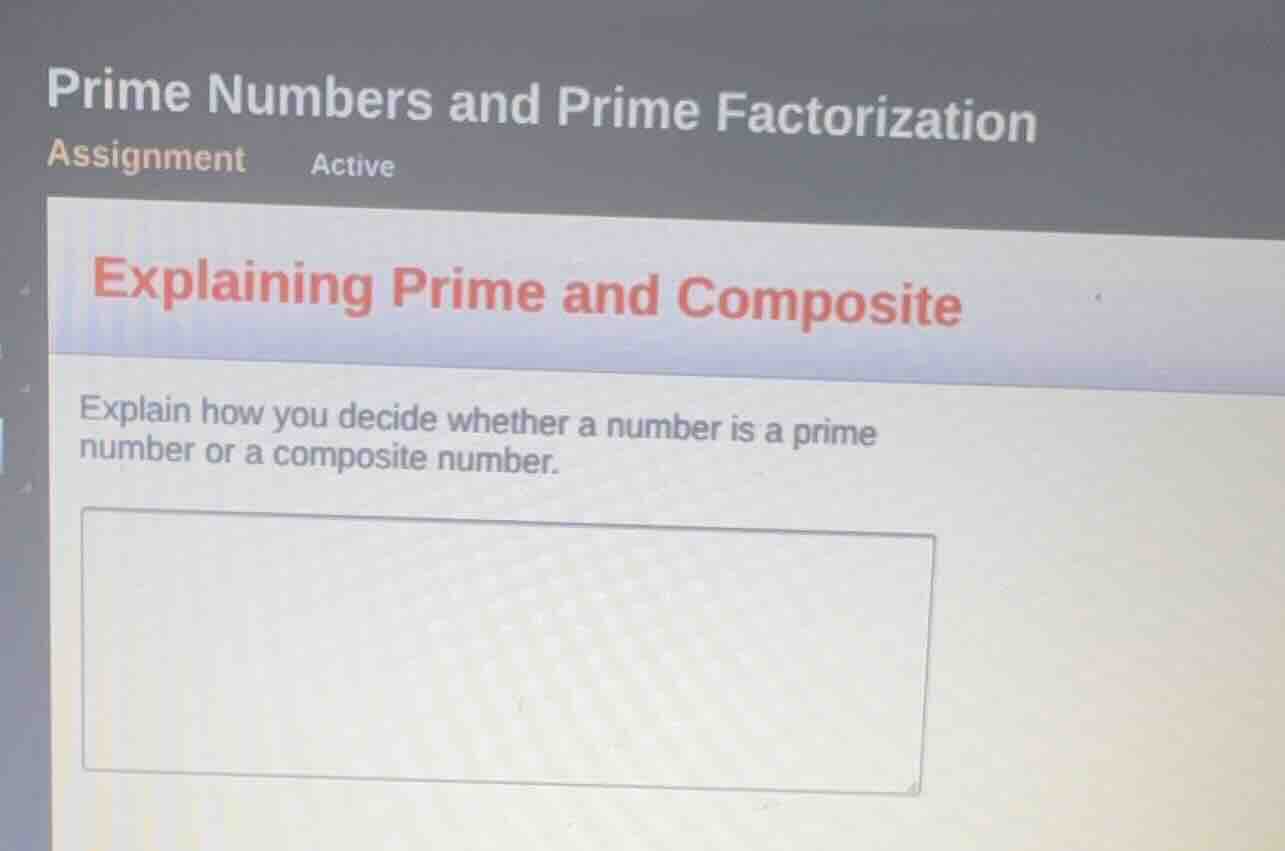
explain how you decide whether a number is a prime number or a composite number.
Define prime and composite numbers by counting factors
A whole number greater than 1 is prime if it has exactly two factors: 1 and itself. A whole number greater than 1 is composite if it has more than two factors.
Determine the number of factors
Find all whole numbers that divide the given number evenly without a remainder.
Classify the number based on the factor count
If only 1 and the number itself divide it, it is prime. If any other number also divides it, it is composite.

Snap & solve any problem in the app
Get step-by-step solutions on Sovi AI
Photo-based solutions with guided steps
Explore more problems and detailed explanations
To decide whether a whole number greater than 1 is prime or composite, count its factors:
- Find all whole numbers that divide the number evenly with no remainder.
- If the number has exactly two factors (1 and itself), it is a prime number.
- If the number has more than two factors, it is a composite number.
(Note: The number 1 is neither prime nor composite because it has only one factor.)