QUESTION IMAGE
Question
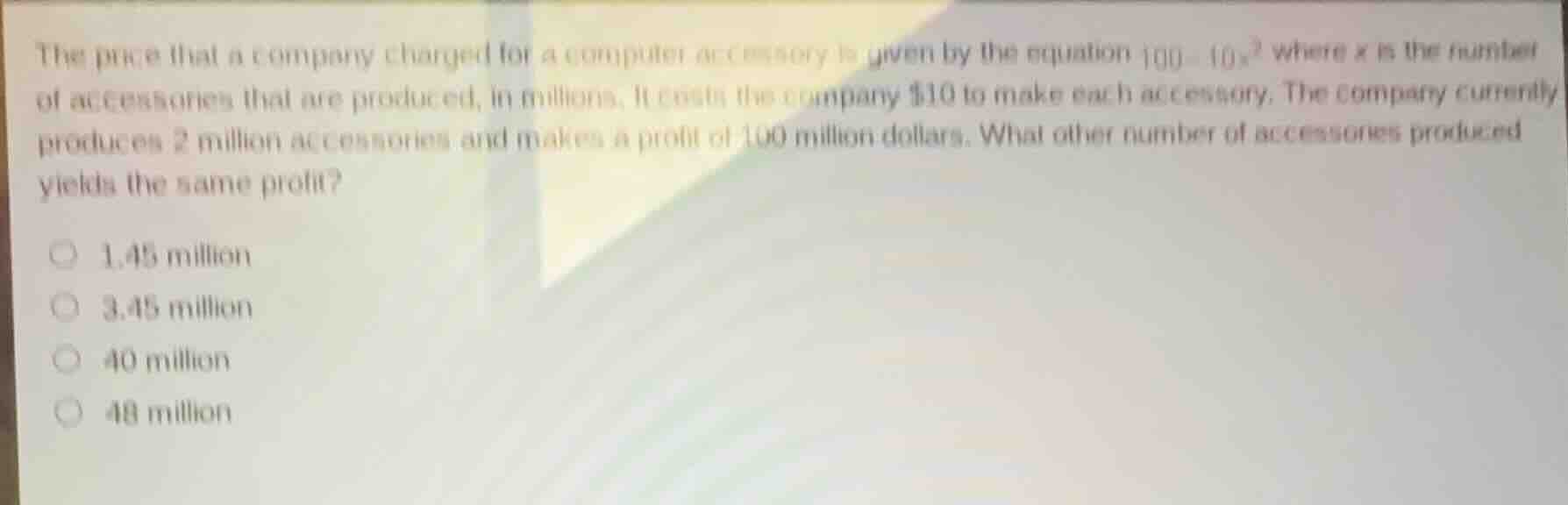
the price that a company charged for a computer accessory is given by the equation \\(100 - 10x\\) where \\(x\\) is the number of accessories that are produced, in millions. it costs the company \\(\\$10\\) to make each accessory. the company currently produces 2 million accessories and makes a profit of 100 million dollars. what other number of accessories produced yields the same profit?
1.45 million
3.45 million
40 million
48 million
Formulate the profit equation
The price per accessory is \(P(x) = 100 - 10x\) dollars, where \(x\) is the number of accessories in millions.
The cost to make each accessory is \(\$10\).
The total revenue in millions of dollars is:
The total cost in millions of dollars is:
The profit function \(\Pi(x)\) in millions of dollars is:
Set up the equation for the target profit
We are given that the company makes a profit of \(100\) million dollars.
Using the Polynomial Equation Solving concept, we set the profit function equal to \(100\):
Solve the quadratic equation
Rearrange the equation into standard quadratic form:
Divide the entire equation by \(10\):
Using the quadratic formula to solve for \(x\):
Calculate the numerical values
Using the approximation \(\sqrt{41} \approx 6.403\):
Let's re-examine the price equation from the image. The image text says: "given by the equation \(100 - 10x^2\)" or is it \(100 - 10x\)?
Looking closely at the image: "given by the equation \(100 - 10x\)". No, there is a superscript \(2\) on the \(x\)? Let's check: "100 - 10x". It looks like \(100 - 10x\).
Wait, let's test the options with \(x = 2\) yielding a profit of \(100\).
If \(P(x) = 100 - 10x\):
At \(x = 2\):
Price \(P(2) = 100 - 10(2) = 80\).
Revenue \(R(2) = 2 \times 80 = 160\).
Cost \(C(2) = 10 \times 2 = 20\).
Profit \(\Pi(2) = 160 - 20 = 140
eq 100\).
Let's assume the price equation is indeed \(P(x) = 100 - 10x^2\) as it looks like \(100 - 10x^2\) with a superscript 2.
If \(P(x) = 100 - 10x^2\):
At \(x = 2\):
Price \(P(2) = 100 - 10(2^2) = 100 - 40 = 60\).
Revenue \(R(2) = 2 \times 60 = 120\).
Cost \(C(2) = 10 \times 2 = 20\).
Profit \(\Pi(2) = 120 - 20 = 100\).
This matches the given statement perfectly! Thus, the price equation is indeed \(P(x) = 100 - 10x^2\).
Solve the cubic profit equation
Now we set up the profit equation with \(P(x) = 100 - 10x^2\):
We set the profit equal to \(100\) million:
Divide by \(-10\) and rearrange:
We know \(x = 2\) is a root. We can factor out \((x - 2)\) using polynomial division:
Now solve the remaining quadratic equation \(x^2 + 2x - 5 = 0\) using the quadratic formula:
Since the number of accessories produced must be positive:

Snap & solve any problem in the app
Get step-by-step solutions on Sovi AI
Photo-based solutions with guided steps
Explore more problems and detailed explanations
- (A) 1.45 million (Correct answer)
- (B) 3.45 million
- (C) 40 million
- (D) 48 million