QUESTION IMAGE
Question
preguntas
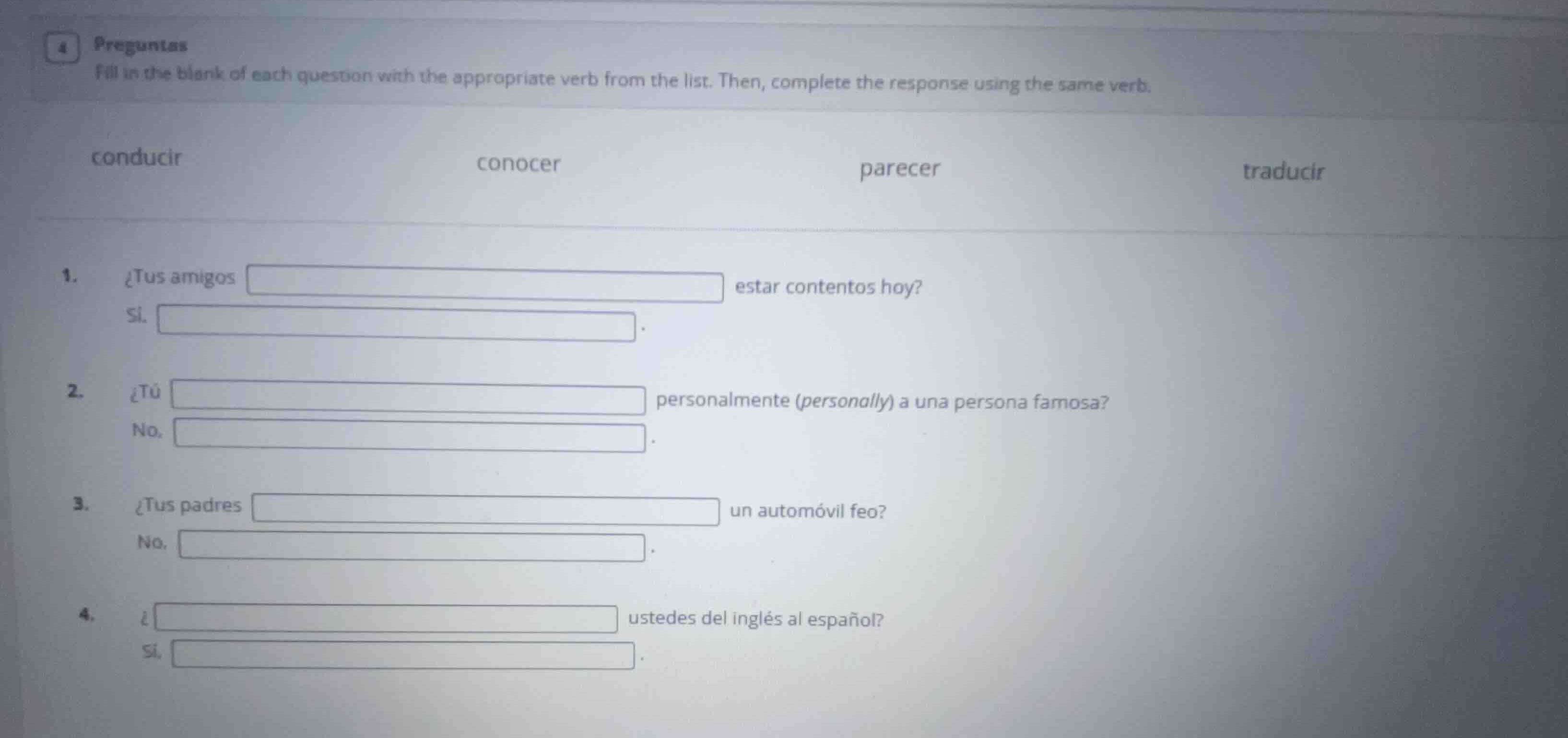
fill in the blank of each question with the appropriate verb from the list. then, complete the response using the same verb.
conducir conocer parecer traducir
- ¿tus amigos estar contentos hoy?
sí, .
- ¿tú personalmente (personally) a una persona famosa?
no, .
- ¿tus padres un automóvil feo?
no, .
- ¿ ustedes del inglés al español?
sí, .
Analyze verbs and context
We have four Spanish verbs: conducir (to drive), conocer (to know/be acquainted with), parecer (to seem), and traducir (to translate).
- Question 1: "¿Tus amigos [blank] estar contentos hoy? Sí, [blank]."
- Context: "estar contentos hoy" (to be happy today).
- Verb choice: parecer (to seem). "Do your friends seem to be happy today?"
- Question 2: "¿Tú [blank] personalmente a una persona famosa? No, [blank]."
- Context: "a una persona famosa" (a famous person).
- Verb choice: conocer (to know a person). Saber vs Conocer is applied here.
- Question 3: "¿Tus padres [blank] un automóvil feo? No, [blank]."
- Context: "un automóvil feo" (an ugly car).
- Verb choice: conducir (to drive). "Do your parents drive an ugly car?"
- Question 4: "¿[blank] ustedes del inglés al español? Sí, [blank]."
- Context: "del inglés al español" (from English to Spanish).
- Verb choice: traducir (to translate). "Do you all translate from English to Spanish?"
Conjugate Question 1
Using Spanish Verb Conjugation and Spanish Present Tense:
- Subject in question: Tus amigos (they / ellos).
- Conjugation of parecer: parecen.
- Question: "¿Tus amigos parecen estar contentos hoy?"
- Subject in response: Sí, [ellos]... (Yes, they seem to...).
- Conjugation: parecen (or parecen estarlo / parecen estar contentos). The prompt says "complete the response using the same verb".
- Response: "Sí, parecen estar contentos" or simply "Sí, parecen." Let's provide the complete natural response: "Sí, parecen estar contentos hoy" / "Sí, parecen."
Conjugate Question 2
Using Spanish Verb Conjugation and Saber vs Conocer:
- Subject in question: Tú (you, informal).
- Conjugation of conocer: conoces.
- Question: "¿Tú conoces personalmente a una persona famosa?"
- Subject in response: No, [yo]... (No, I don't know...).
- Conjugation of conocer in first person singular (yo): conozco (irregular -zco ending).
- Response: "No, no conozco a ninguna" or "No, no conozco personalmente a una persona famosa."
Conjugate Question 3
Using Spanish Verb Conjugation and Spanish Present Tense:
- Subject in question: Tus padres (they / ellos).
- Conjugation of conducir: conducen.
- Question: "¿Tus padres conducen un automóvil feo?"
- Subject in response: No, [ellos]... (No, they don't drive...).
- Conjugation: no conducen (or no conducen un automóvil feo).
- Response: "No, no conducen un automóvil feo" or "No, no conducen."
Conjugate Question 4
Using Spanish Verb Conjugation and Spanish Sentence Construction:
- Subject in question: Ustedes (you all).
- Conjugation of traducir: traducen.
- Question: "¿Traducen ustedes del inglés al español?"
- Subject in respon…

Snap & solve any problem in the app
Get step-by-step solutions on Sovi AI
Photo-based solutions with guided steps
Explore more problems and detailed explanations
Question 1
¿Tus amigos <blank>parecen</blank> estar contentos hoy?
Sí, <blank>parecen</blank>.
Question 2
¿Tú <blank>conoces</blank> personalmente a una persona famosa?
No, <blank>no conozco a nadie personalmente</blank>.
Question 3
¿Tus padres <blank>conducen</blank> un automóvil feo?
No, <blank>no conducen un automóvil feo</blank>.
Question 4
¿<blank>Traducen</blank> ustedes del inglés al español?
Sí, <blank>traducimos del inglés al español</blank>.