QUESTION IMAGE
Question
pre-lab video coaching activity: examining a long bone
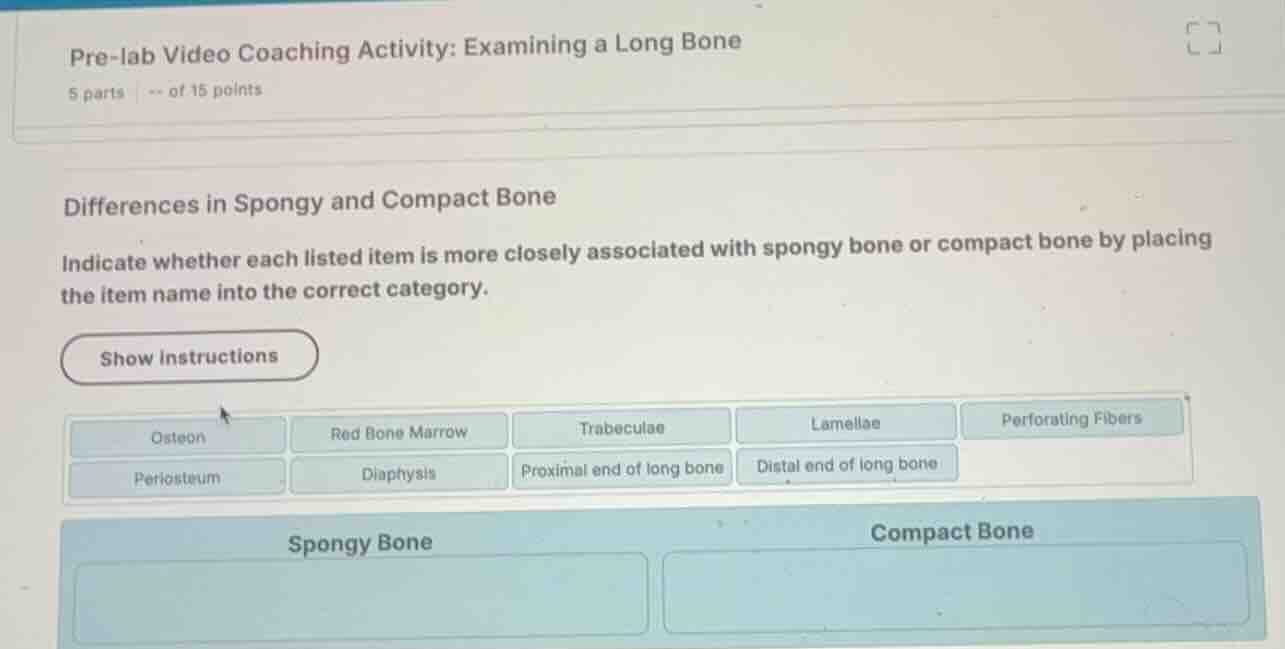
differences in spongy and compact bone
indicate whether each listed item is more closely associated with spongy bone or compact bone by placing the item name into the correct category.
items to place:
- osteon
- red bone marrow
- trabeculae
- lamellae
- perforating fibers
- periosteum
- diaphysis
- proximal end of long bone
- distal end of long bone
categories:
- spongy bone
- compact bone
Identify the target categories and items
The goal is to classify nine anatomical items into either Spongy Bone or Compact Bone based on their primary association.
The items to classify are:
- Osteon
- Red Bone Marrow
- Trabeculae
- Lamellae
- Perforating Fibers
- Periosteum
- Diaphysis
- Proximal end of long bone
- Distal end of long bone
Analyze associations for Spongy Bone
Let's evaluate which items are structurally or functionally characteristic of spongy (cancellous) bone:
- Trabeculae: Spongy bone is composed of a lattice-like network of thin bony plates called trabeculae.
- Red Bone Marrow: The spaces between the trabeculae in spongy bone are filled with red bone marrow, where blood cell production occurs.
- Proximal end of long bone: The epiphyses (ends) of long bones, such as the proximal end, are filled internally with spongy bone.
- Distal end of long bone: Similarly, the distal end (epiphysis) of a long bone contains spongy bone covered by a thin layer of compact bone.
Analyze associations for Compact Bone
Let's evaluate which items are structurally or functionally characteristic of compact (cortical) bone:
- Osteon: The osteon (or Haversian system) is the fundamental functional and structural unit of compact bone.
- Lamellae: Compact bone is organized into concentric rings of hard, calcified matrix called lamellae (which make up the osteons), as well as interstitial and circumferential lamellae.
- Periosteum: The periosteum is the dense fibrous membrane covering the outer surface of bones, which is closely adhered to the outer compact bone layer.
- Perforating Fibers: Also known as Sharpey's fibers, these secure the periosteum to the underlying compact bone.
- Diaphysis: The shaft of a long bone (diaphysis) is primarily constructed of a thick collar of compact bone surrounding a central medullary cavity.

Snap & solve any problem in the app
Get step-by-step solutions on Sovi AI
Photo-based solutions with guided steps
Explore more problems and detailed explanations
| Spongy Bone | Compact Bone |
|---|---|
| Trabeculae | Lamellae |
| Proximal end of long bone | Perforating Fibers |
| Distal end of long bone | Periosteum |
| Diaphysis |