QUESTION IMAGE
Question
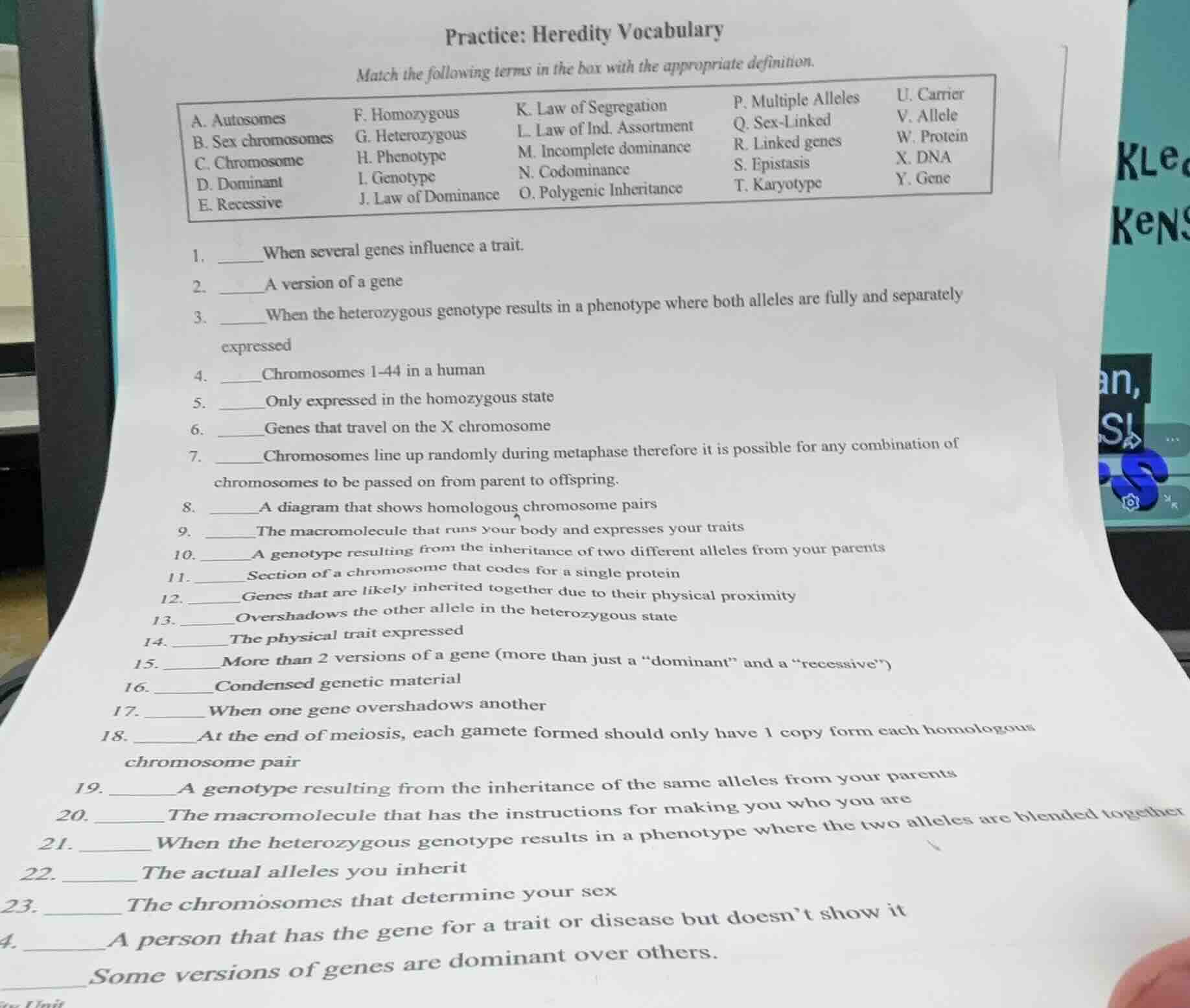
practice: heredity vocabulary
match the following terms in the box with the appropriate definition.
a. autosomes
b. sex chromosomes
c. chromosome
d. dominant
e. recessive
f. homozygous
g. heterozygous
h. phenotype
i. genotype
j. law of dominance
k. law of segregation
l. law of ind. assortment
m. incomplete dominance
n. codominance
o. polygenic inheritance
p. multiple alleles
q. sex-linked
r. linked genes
s. epistasis
t. karyotype
u. carrier
v. allele
w. protein
x. dna
y. gene
- ______ when several genes influence a trait.
- ______ a version of a gene
- ______ when the heterozygous genotype results in a phenotype where both alleles are fully and separately expressed
- ______ chromosomes 1-44 in a human
- ______ only expressed in the homozygous state
- ______ genes that travel on the x chromosome
- ______ chromosomes line up randomly during metaphase therefore it is possible for any combination of chromosomes to be passed on from parent to offspring.
- ______ a diagram that shows homologous chromosome pairs
- ______ the macromolecule that runs your body and expresses your traits
- ______ a genotype resulting from the inheritance of two different alleles from your parents
- ______ section of a chromosome that codes for a single protein
- ______ genes that are likely inherited together due to their physical proximity
- ______ overshadows the other allele in the heterozygous state
- ______ the physical trait expressed
- ______ more than 2 versions of a gene (more than just a \dominant\ and a
ecessive\)
- ______ condensed genetic material
- ______ when one gene overshadows another
- ______ at the end of meiosis, each gamete formed should only have 1 copy form each homologous chromosome pair
- ______ a genotype resulting from the inheritance of the same alleles from your parents
- ______ the macromolecule that has the instructions for making you who you are
- ______ when the heterozygous genotype results in a phenotype where the two alleles are blended together
- ______ the actual alleles you inherit
- ______ the chromosomes that determine your sex
- ______ a person that has the gene for a trait or disease but doesnt show it
- ______ some versions of genes are dominant over others.
Analyze definitions 1 to 5
- Definition 1: "When several genes influence a trait." This describes Polygenic Inheritance (O).
- Definition 2: "A version of a gene." This is an Allele (V).
- Definition 3: "When the heterozygous genotype results in a phenotype where both alleles are fully and separately expressed." This is Codominance (N).
- Definition 4: "Chromosomes 1-44 in a human." These are the non-sex chromosomes, known as Autosomes (A).
- Definition 5: "Only expressed in the homozygous state." This describes a Recessive allele (E).
Analyze definitions 6 to 10
- Definition 6: "Genes that travel on the X chromosome." These are Sex-Linked genes (Q).
- Definition 7: "Chromosomes line up randomly during metaphase therefore it is possible for any combination of chromosomes to be passed on from parent to offspring." This is the Law of Independent Assortment (L).
- Definition 8: "A diagram that shows homologous chromosome pairs." This is a Karyotype (T).
- Definition 9: "The macromolecule that runs your body and expresses your traits." This is Protein (W).
- Definition 10: "A genotype resulting from the inheritance of two different alleles from your parents." This is Heterozygous (G).
Analyze definitions 11 to 15
- Definition 11: "Section of a chromosome that codes for a single protein." This is a Gene (Y).
- Definition 12: "Genes that are likely inherited together due to their physical proximity." These are Linked genes (R).
- Definition 13: "Overshadows the other allele in the heterozygous state." This is Dominant (D).
- Definition 14: "The physical trait expressed." This is the Phenotype (H).
- Definition 15: "More than 2 versions of a gene (more than just a 'dominant' and a 'recessive')." This refers to Multiple Alleles (P).
Analyze definitions 16 to 20
- Definition 16: "Condensed genetic material." This is a Chromosome (C).
- Definition 17: "When one gene overshadows another." This is Epistasis (S).
- Definition 18: "At the end of meiosis, each gamete formed should only have 1 copy form each homologous chromosome pair." This is the Law of Segregation (K).
- Definition 19: "A genotype resulting from the inheritance of the same alleles from your parents." This is Homozygous (F).
- Definition 20: "The macromolecule that has the instructions for making you who you are." This is DNA (X).
Analyze definitions 21 to 25
- Definition 21: "When the heterozygous genotype results in a phenotype where the two alleles are blended together." This is Incomplete dominance (M).
- Definition 22: "The actual alleles you inherit." This is the Genotype (I).
- Definition 23: "The chromosomes that determine your sex." These are Sex chromosomes (B).
- Definition 24: "A person that has the gene for a trait or disease but doesn't show it." This is a Carrier (U).
- Definition 25: "Some versions of genes are dominant over others." This is the Law of Dominance (J).

Snap & solve any problem in the app
Get step-by-step solutions on Sovi AI
Photo-based solutions with guided steps
Explore more problems and detailed explanations
| No. | Answer |
|---|---|
| 2 | V. Allele |
| 3 | N. Codominance |
| 4 | A. Autosomes |
| 5 | E. Recessive |
| 6 | Q. Sex-Linked |
| 7 | L. Law of Ind. Assortment |
| 8 | T. Karyotype |
| 9 | W. Protein |
| 10 | G. Heterozygous |
| 11 | Y. Gene |
| 12 | R. Linked genes |
| 13 | D. Dominant |
| 14 | H. Phenotype |
| 15 | P. Multiple Alleles |
| 16 | C. Chromosome |
| 17 | S. Epistasis |
| 18 | K. Law of Segregation |
| 19 | F. Homozygous |
| 20 | X. DNA |
| 21 | M. Incomplete dominance |
| 22 | I. Genotype |
| 23 | B. Sex chromosomes |
| 24 | U. Carrier |
| 25 | J. Law of Dominance |