QUESTION IMAGE
Question
practice graphing exponential functions in base e.
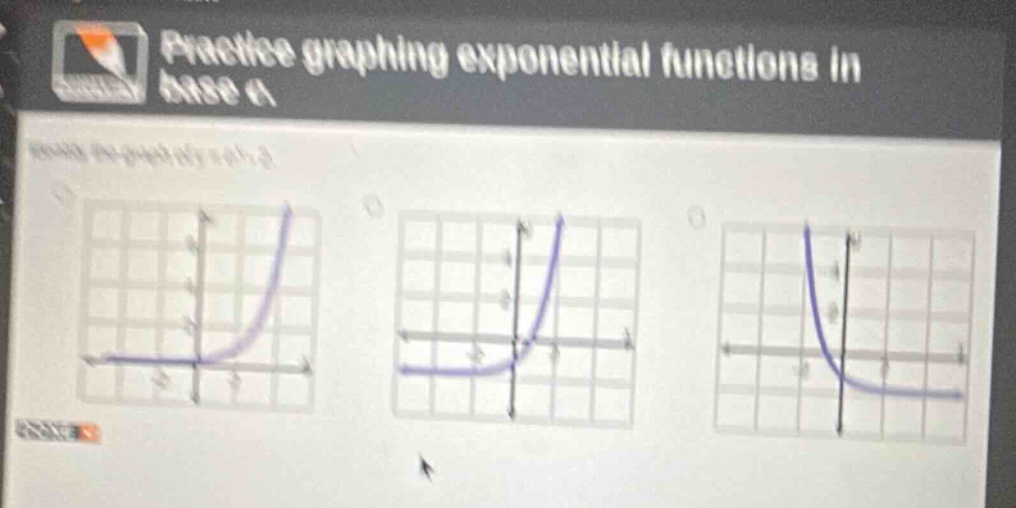
what is the graph of (y = e^x - 2)?
⚡ Using what you learned: Graphing Exponential Functions
Step 1: Identify the function and its asymptote
The problem asks to graph the exponential function:
The parent function is \( y = e^x \), which has a horizontal asymptote at \( y = 0 \).
Subtracting \( 1 \) shifts the entire graph down by \( 1 \) unit. Therefore, the horizontal asymptote of \( y = e^x - 1 \) is:
Step 2: Find key points on the graph
Let's evaluate the function at a few key values of \( x \):
- At \( x = 0 \):
So, the graph must pass through the origin \( (0, 0) \).
- At \( x = 1 \):
So, the graph passes through approximately \( (1, 1.72) \).
Step 3: Match with the correct option
- First graph: Has a horizontal asymptote at \( y = 0 \) and passes through \( (0, 1) \). This is the graph of \( y = e^x \).
- Second graph: Has a horizontal asymptote at \( y = -1 \) (indicated by the dashed line at \( y = -1 \)) and passes through the origin \( (0, 0) \). This matches our function \( y = e^x - 1 \).
- Third graph: Shows a decaying exponential function, which does not match our base \( e > 1 \).

Snap & solve any problem in the app
Get step-by-step solutions on Sovi AI
Photo-based solutions with guided steps
Explore more problems and detailed explanations
The correct graph is the second option (the middle graph), which has a horizontal asymptote at \( y = -1 \) and passes through the origin \( (0, 0) \).